10-K: Annual report [Section 13 and 15(d), not S-K Item 405]
Published on March 23, 2026
w,
UNITED STATES
SECURITIES AND EXCHANGE COMMISSION
WASHINGTON, D.C. 20549
FORM
(Mark One)
ANNUAL REPORT PURSUANT TO SECTION 13 OR 15(d) OF THE SECURITIES EXCHANGE ACT OF 1934 |
For the fiscal year ended
OR
TRANSITION REPORT PURSUANT TO SECTION 13 OR 15(d) OF THE SECURITIES EXCHANGE ACT OF 1934 |
For the transition period from to
Commission File Number
(Exact Name of Registrant as Specified in Its Charter)
|
||
(State or other jurisdiction of |
|
(I.R.S. Employer |
incorporation or organization) |
|
Identification No.) |
|
|
|
|
||
(Address of principal executive offices) |
|
(Zip Code) |
(
(Registrant’s telephone number, including area code)
Securities registered pursuant to Section 12(b) of the Act:
Title of each class |
|
Trading Symbol |
|
Name of each exchange on which registered |
|
|
(Nasdaq Global Market) |
Securities registered pursuant to Section 12(g) of the Act:
None
Indicate by check mark if the registrant is a well-known seasoned issuer, as defined in Rule 405 of the Securities Act. Yes ☐
Indicate by check mark if the registrant is not required to file reports pursuant to Section 13 or Section 15(d) of the Act. Yes ☐
Indicate by check mark whether the issuer (1) has filed all reports required to be filed by Section 13 or 15(d) of the Securities Exchange Act of 1934 during the preceding 12 months (or for such shorter period that the registrant was required to file such reports), and (2) has been subject to such filing requirements for the past 90 days.
Indicate by check mark whether the registrant has submitted electronically every Interactive Data File required to be submitted pursuant to Rule 405 of Regulation S-T (§232.405 of this chapter) during the preceding 12 months (or for such shorter period that the registrant was required to submit such files).
Indicate by check mark whether the registrant is a large accelerated filer, an accelerated filer, a non-accelerated filer, a smaller reporting company or an emerging growth company. See the definitions of “large accelerated filer,” “accelerated filer,” “smaller reporting company” and “emerging growth company” in Rule 12b-2 of the Exchange Act.
Large accelerated filer |
☐ |
|
|
Accelerated filer |
☐ |
☒ |
|
|
Smaller reporting company |
||
|
|
|
|
Emerging growth company |
|
If an emerging growth company, indicate by check mark if the registrant has elected not to use the extended transition period for complying with any new or revised financial accounting standards provided pursuant to Section 13(a) of the Exchange Act. ☐
Indicate by check mark whether the registrant has filed a report on and attestation to its management’s assessment of the effectiveness of its internal control over financial reporting under Section 404(b) of the Sarbanes-Oxley Act (15 U.S.C. 7262(b)) by the registered public accounting firm that prepared or issued its audit report.
If securities are registered pursuant to Section 12(b) of the Act, indicate by check mark whether the financial statements of the registrant included in the filing reflect the correction of an error to previously issued financial statements.
Indicate by check mark whether any of those error corrections are restatements that required a recovery analysis of incentive-based compensation received by any of the registrant’s executive officers during the relevant recovery period pursuant to §240.10D-1(b). ☐
Indicate by check mark whether the registrant is a shell company (as defined in Rule 12b-2 of the Exchange Act). Yes ☐ No
The aggregate market value of the voting and non-voting common equity held by non-affiliates of the Registrant on June 30, 2025 (the last business day of the Registrant’s second fiscal quarter), based upon the closing price of $7.10 of the Registrant’s common stock as reported on The Nasdaq Global Market, was approximately $
The number of shares of the registrant’s common stock outstanding as of March 16, 2026, was
DOCUMENTS INCORPORATED BY REFERENCE
Portions of the registrant’s definitive proxy statement to be filed for its 2026 Annual Meeting of Stockholders are incorporated by reference into Part III hereof. Such proxy statement will be filed with the Securities and Exchange Commission within 120 days of the end of the fiscal year covered by this Annual Report on Form 10-K.
Sutro Biopharma, Inc.
ANNUAL REPORT ON FORM 10-K
TABLE OF CONTENTS
|
|
|
|
Page |
|
|
|
|
|
|
|
|
6 |
|
|
|
|
|
|
ITEM 1. |
|
|
6 |
|
|
|
|
|
|
ITEM 1A. |
|
|
36 |
|
|
|
|
|
|
ITEM 1B. |
|
|
95 |
|
|
|
|
|
|
ITEM 1C. |
|
|
95 |
|
|
|
|
|
|
ITEM 2. |
|
|
97 |
|
|
|
|
|
|
ITEM 3. |
|
|
97 |
|
|
|
|
|
|
ITEM 4. |
|
|
97 |
|
|
|
|
|
|
|
|
|
98 |
|
|
|
|
|
|
ITEM 5. |
|
|
98 |
|
|
|
|
|
|
ITEM 6. |
|
|
98 |
|
|
|
|
|
|
ITEM 7. |
|
Management’s Discussion and Analysis of Financial Condition and Results of Operations |
|
99 |
|
|
|
|
|
ITEM 7A. |
|
|
113 |
|
|
|
|
|
|
ITEM 8. |
|
|
115 |
|
|
|
|
|
|
ITEM 9. |
|
Changes in and Disagreements with Accountants on Accounting and Financial Disclosure |
|
154 |
|
|
|
|
|
ITEM 9A. |
|
|
154 |
|
|
|
|
|
|
ITEM 9B. |
|
|
155 |
|
|
|
|
|
|
ITEM 9C. |
|
Disclosure Regarding Foreign Jurisdictions that Prevent Inspections |
|
155 |
|
|
|
|
|
|
|
|
156 |
|
|
|
|
|
|
ITEM 10. |
|
Directors, Executive Officers of the Registrant and Corporate Governance |
|
156 |
|
|
|
|
|
ITEM 11. |
|
|
156 |
|
|
|
|
|
|
ITEM 12. |
|
Security Ownership of Certain Beneficial Owners and Management and Related Stockholder Matters |
|
156 |
|
|
|
|
|
ITEM 13. |
|
Certain Relationships and Related Transactions, and Director Independence |
|
156 |
|
|
|
|
|
ITEM 14. |
|
|
156 |
|
|
|
|
|
|
|
|
|
157 |
|
|
|
|
|
|
ITEM 15. |
|
|
157 |
|
|
|
|
|
|
ITEM 16. |
|
|
161 |
|
|
|
|
|
|
|
|
|
162 |
|
|
|
|
|
|
|
|
|
|
|
|
2 |
|
Forward-Looking Statements
This Annual Report on Form 10-K, or Annual Report, contains forward-looking statements within the meaning of Section 21E of the Securities Exchange Act of 1934, as amended, or the Exchange Act, and section 27A of the Securities Act of 1933, as amended, or the Securities Act. All statements contained in this Annual Report other than statements of historical fact, including statements regarding our future results of operations and financial position, the use and adequacy of our existing cash to achieve our business goals, business strategy, market size for our product candidates, potential future milestone and royalty payments, potential growth opportunities, nonclinical and clinical development activities, efficacy and safety profile of our product candidates, our ability to maintain and recognize the benefits of certain designations received by product candidates, the timing and results of nonclinical studies and clinical trials, collaboration with third parties, the impact of health pandemics, tariffs, geopolitical conflicts, changes in interest rates, inflation, potential uncertainty with respect to the debt ceiling and government shutdowns, on our operations, and the receipt and timing of potential regulatory designations, approvals and commercialization of product candidates, are forward-looking statements. The words “believe,” “may,” “will,” “potentially,” “estimate,” “continue,” “anticipate,” “predict,” “target,” “intend,” “could,” “would,” “should,” “project,” “plan,” “expect,” and similar expressions that convey uncertainty of future events or outcomes are intended to identify forward-looking statements, although not all forward-looking statements contain these identifying words.
These forward-looking statements are subject to a number of risks, uncertainties and assumptions, including those described in Item 1A, “Risk Factors” and elsewhere in this Annual Report. Moreover, we operate in a very competitive and rapidly changing environment, and new risks emerge from time to time. It is not possible for our management to predict all risks, nor can we assess the impact of all factors on our business or the extent to which any factor, or combination of factors, may cause actual results to differ materially from those contained in any forward-looking statements we may make. In light of these risks, uncertainties, and assumptions, the forward-looking events and circumstances discussed in this Annual Report may not occur and actual results could differ materially and adversely from those anticipated or implied in the forward-looking statements.
You should not rely upon forward-looking statements as predictions of future events. Although we believe that the expectations reflected in the forward-looking statements are reasonable, we cannot guarantee that the future results, levels of activity, performance or events and circumstances reflected in the forward-looking statements will be achieved or occur. We undertake no obligation to update publicly any forward-looking statements for any reason after the date of this report to conform these statements to actual results or to changes in our expectations, except as required by law. You should read this Annual Report with the understanding that our actual future results, levels of activity, performance and events and circumstances may be materially different from what we expect.
Except where the context otherwise requires, in this Annual Report on Form 10-K, “we,” “us,” “our” and the “Company” refer to Sutro Biopharma, Inc.
Trademarks
This Annual Report on Form 10-K includes trademarks, service marks and trade names owned by us or other companies. All trademarks, service marks and trade names included in this Annual Report on Form 10-K are the property of their respective owners. We do not intend our use or display of other companies’ trade names, trademarks or service marks to imply a relationship with, or endorsement or sponsorship of us by, these other companies.
|
3 |
|
Summary of Risk Factors
Our business is subject to a number of risks and uncertainties, including those highlighted in the section titled “Risk Factors” in this Annual Report on Form 10-K. Some of these risks include:
|
4 |
|
|
5 |
|
PART I
Item 1. Business
Overview
We are a clinical stage oncology company developing site-specific and novel-format antibody drug conjugates, or ADCs, enabled by our proprietary integrated cell-free protein synthesis platform, XpressCF®, and our site-specific conjugation platform, XpressCF+®. We aim to design and develop therapeutics using the most relevant and potent modalities, including ADCs, bispecific ADCs, immunostimulatory ADCs, or iADCs, and dual-payload ADCs, or dpADCs. Our molecules are directed primarily against clinically validated targets where the current standard of care is suboptimal. We believe that our platform allows us to accelerate the discovery and development of potential first-in-class and/or best-in-class molecules by enabling the rapid and systematic evaluation of protein structure-activity relationships to create optimized homogeneous product candidates. Our mission is to transform the lives of patients by creating medicines with improved therapeutic profiles for areas of unmet need.
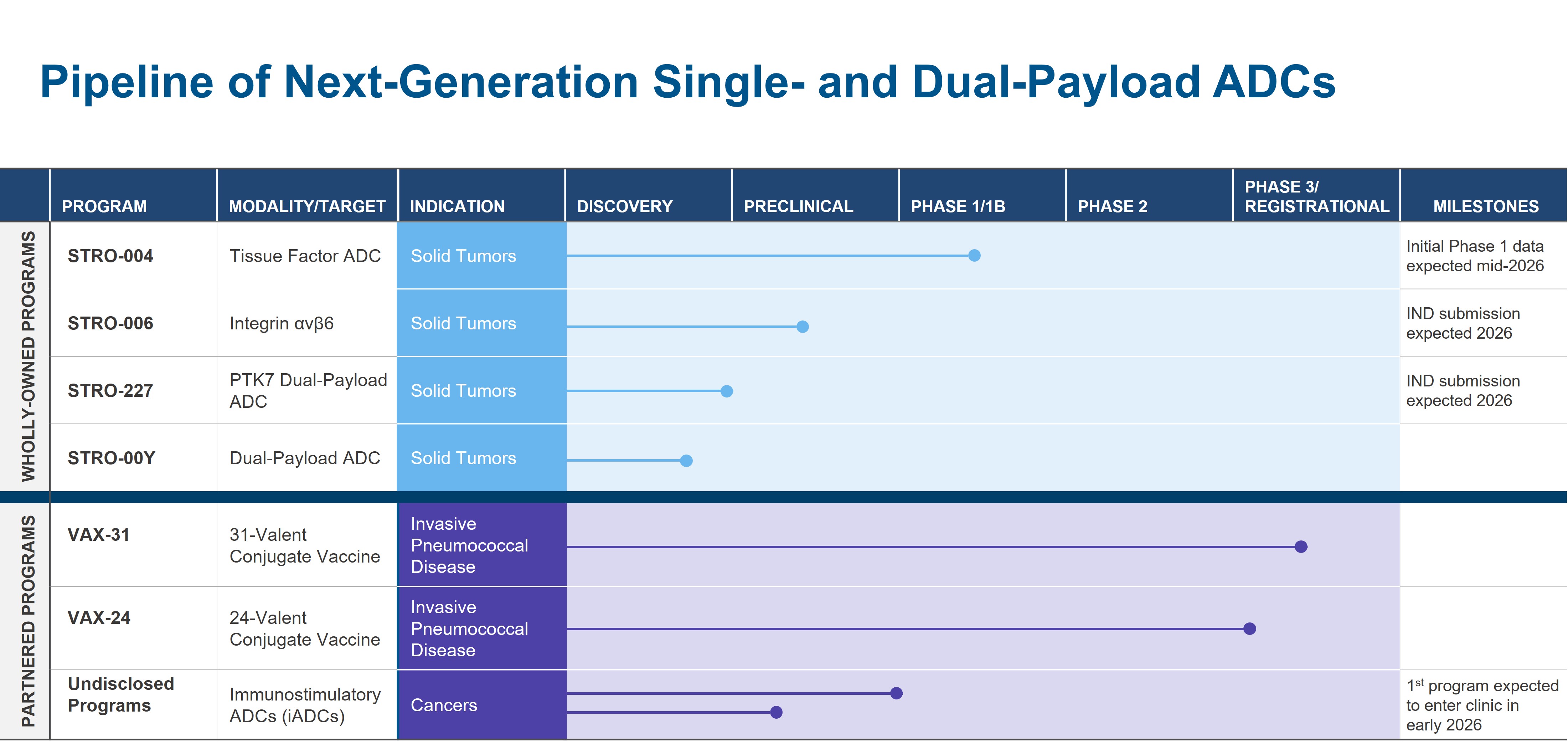
Our highest priority wholly-owned product candidate is STRO-004, a single homogeneous ADC directed against tissue factor, or TF, which we are developing for the treatment of solid tumors. We believe STRO-004 has the potential to be a best-in-class ADC targeting TF. In preclinical studies, STRO-004 has demonstrated potent antitumor activity and the potential for a differentiated safety profile. We filed an IND and received IND clearance for STRO-004 in October 2025, and initiated a Phase 1 trial in November 2025. We expect to report initial data from this trail in mid-2026.
The Phase 1 open-label, multicenter trial of STRO-004 is designed to evaluate the safety, pharmacokinetics, and preliminary anti-tumor activity of STRO-004 in patients with advanced TF-expressing solid tumors, including non-small cell lung cancer, head and neck squamous cell carcinoma, cervical cancer, colorectal cancer, pancreatic ductal adenocarcinoma, endometrial cancer, and bladder cancer. The dose-escalation phase includes multiple cohorts with ascending dose levels, supported by strong tolerability in non-human primates at up to 50 mg/kg. We finished dosing of patients in dose level 2 in February 2026 and began dosing patients in the dose level 3 cohort in February of 2026. We expect to report initial data from this trial in mid-2026.
Our preclinical assets include STRO-227 and STRO-006. STRO-006 is an ADC targeting integrin alpha v beta 6, or ITGß6. We believe STRO-006 has the potential to be a best-in-class ADC targeting ITGß6 based on preclinical studies that have demonstrated potent antitumor activity and the potential for a differentiated safety profile. IND enabling activities are underway for STRO-006 that could potentially support an IND filing in connection with this program in 2026.
STRO-227 is our first wholly-owned dual-payload ADC, a dual-payload ADC targeting Protein Tyrosine Kinase 7, or PTK7. This approach incorporates two distinct cytotoxic payloads, one that is designed to inhibit tubulin and another that is designed to inhibit topoisomerase. We have initiated certain chemistry, manufacturing and controls, or CMC, related activities for the PTK7-targeting dual-payload ADC and anticipate filing an IND in connection with this program in late 2026 or early 2027.
Enabled through our proprietary XpressCF® and XpressCF+® platforms, we have entered into multitarget, product-focused collaborations with leading pharmaceutical and biotechnology companies in the field of oncology, including an immunostimulatory ADCs collaboration with Astellas Pharma Inc., or Astellas; a cytokine derivatives collaboration with Merck Sharp & Dohme Corp., a subsidiary of Merck & Co., Inc., Kenilworth, NJ, or Merck; a B Cell Maturation Antigen, or BCMA, ADC collaboration with Celgene Corporation, or Celgene, a wholly owned subsidiary of Bristol Myers Squibb Company, New York, NY, or BMS; a MUC1-EGFR ADC collaboration with Merck KGaA, Darmstadt Germany (operating in the United States and Canada under the name “EMD Serono”), or EMD Serono, and we may enter into additional such collaborations in the future. In addition to potential research and development collaborations, we may partner or out-license one or more of our wholly-owned preclinical or clinical development programs depending on resource and capital availability.
Our XpressCF® and XpressCF+® platforms have also supported Vaxcyte, Inc., or Vaxcyte, focused on discovery and development of vaccines for the treatment and prophylaxis of infectious disease. We believe our XpressCF® platform is the first and only current Good Manufacturing Practices, or cGMP, compliant and scalable
|
6 |
|
cell-free protein synthesis technology that has resulted in multiple product candidates in clinical development. We believe key advantages of our cell-free protein synthesis platform over conventional biologic drug discovery and development include:
We plan to leverage these capabilities to accelerate the discovery and development of potential first-in-class and best-in-class molecules.
The benefits of our XpressCF® and XpressCF+® platforms have resulted in multiple research and/or development collaborations with leaders in the field of oncology, including Ipsen, Astellas, Merck, BMS and EMD Serono. In 2024, we entered into an Exclusive License Agreement with Ipsen granting Ipsen worldwide rights to develop and commercialize STRO-003. This License Agreement was terminated in 2025. In 2022, we entered into a License and Collaboration Agreement with Astellas for the development of iADCs for up to three biological targets. In 2024, Astellas notified us that it would not be nominating a third target program. The first iADC in the Astellas collaboration entered clinical development in the first quarter of 2026; preclinical development of the iADC directed to the second of two targets remains ongoing.
Our research collaborations with Merck, BMS, and EMD Serono all resulted in development candidate molecules that entered clinical development. As part of our partners’ strategic portfolio review processes, each elected to terminate further clinical development of the candidate molecules following Phase 1 clinical studies. Through December 31, 2025, we have received an aggregate of approximately $1.016 billion in payments from all of our collaborations, which includes approximately $79 million in investments in our stock. We intend to selectively enter into additional collaborations with partners who are seeking efficient and effective drug discovery, preclinical development and manufacturing capabilities for the creation of novel therapeutics.
From 2018 through February 2025, we had been developing luveltamab tazevibulin, or STRO-002 or luvelta. In March 2025, we conducted a strategic review of our product portfolio. Following this review, we made the strategic decision to deprioritize additional investment into luvelta development, and development has since been terminated.
In December 2021, we entered into the Tasly License Agreement, as amended in April 2022, to develop and commercialize luvelta in the Greater China territory.
Beyond these programs and collaborations, we are developing a broader pipeline of next-generation protein therapeutics using our XpressCF® and XpressCF+® platforms. Our protein engineering and chemistry efforts are focused on maximizing therapeutic indices, and our technology allows us to rapidly test our therapeutic hypothesis in significantly more product candidates than conventional protein synthesis allows, with the goal of identifying the best molecule to advance to the clinic. We are also actively pursuing the discovery and development of other novel ADCs and next-generation ADC modalities, including iADCs, bispecific ADCs, and dpADCs.
Our Strategy
Our goal is to use our proprietary XpressCF® platform to create product candidates primarily against clinically validated targets. Key elements of our strategy are to:
|
7 |
|
Cancers Remain a Major Unmet Medical Need
Cancers are the second leading cause of mortality in the United States and the leading cause of death for those under 65 years of age. The American Cancer Society estimated that there would be greater than 2 million new cases of cancer diagnosed and approximately 626,000 people would die of cancer in the United States in 2026.
Traditional Cancer Therapeutics
Cancer treatment has traditionally included chemotherapy, radiation, surgery, or a combination of these approaches. Chemotherapy agents and other small molecule targeted therapies can be effective in certain types of cancer, but they can also cause toxicities that may lead to life-threatening consequences, lower quality of life or early termination of treatment. Furthermore, these agents offer limited efficacy in many types of cancer.
Over the last twenty years, new paradigms of cancer research and treatment have emerged to address the limitations of existing treatments. Some of the most promising new approaches involve biologic therapies, including ADCs. ADCs have shown promise over the last decade with fourteen currently marketed products in the United States and hundreds of ADC candidates investigated in the clinic. ADCs use the foundation of monoclonal antibodies and small molecule drugs by targeting the delivery of chemotherapeutics to the tumor. They have shown clinical benefit in hematological and solid tumors and often have a better safety profile than systemically
|
8 |
|
delivered chemotherapeutics. We believe our XpressCF® platform will provide enhanced therapeutic approaches for treating cancer to address these unmet needs and are exploring next generation biologics, including ADCs, iADCs, and dpADCs. The expectation is that multiple therapeutic modalities will be used in novel combinations to treat patients and provide the most potent anti-cancer effect.
Antibody-Drug Conjugates (ADCs)
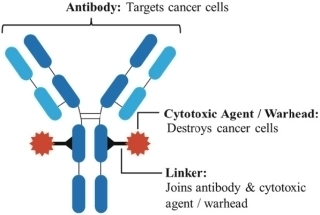
ADCs are a highly potent improvement to monoclonal antibody oncology therapies. The key components of ADCs include an antibody, a stable linker, and a cytotoxic agent (warhead). The antibody is used to target and deliver cytotoxic agents to tumor cells. ADCs can be mono, bispecific, or multi-specific. The intended result of this powerful and targeted approach is greater tumor cell death and less systemic tolerability issues as compared to traditional chemotherapy. The following diagram shows the component parts of an ADC.
Kadcyla and Adcetris were the first of the new generation of ADCs to be approved for the treatment of specific subsets of breast cancer and lymphoma, respectively. Several more ADCs are currently on the market in the U.S.: Besponsa, Mylotarg, Polivy, and Zynlonta were approved for the treatment of specific subsets of leukemia and lymphoma; Padcev was approved for the treatment of bladder and urinary tract cancers; Enhertu and Trodelvy were approved for the treatment of breast cancer as well as gastric and urinary tract cancers respectively; Tivdak was approved for the treatment of cervical cancer; Elahere was approved for the treatment of ovarian cancer; and Datroway was approved for the treatment of a subset of breast cancer in January 2025. Several of these drugs, such as Enhertu and Datroway, have gained label expansions subsequent to their initial approvals. In the meantime, Emrelis was approved in May 2025 for treating high c-Met-expressing non-small cell lung cancer, and Blenrep was re-approved for multiple myeloma in October 2025 after being withdrawn in 2022. These approved therapies demonstrate that ADCs have an emerging role in the armamentarium of cancer therapeutics.
Limitations to Current ADC Approaches
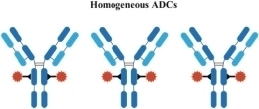
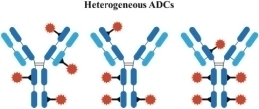
Despite the approvals of these ADCs and hundreds more being investigated in clinical development, there have been challenges in achieving the full clinical potential of this modality. We believe these challenges are directly related to the following:
|
9 |
|
|
10 |
|
Dual conjugations to enable iADC and dpADC modalities to address current limitations of conventional ADCs and to optimize the therapeutic index, or TI
XpressCF® enables the incorporation of non-natural amino acids into antibody sequences and results in site specific conjugation of drug payloads. More recently, we have developed technology to enable incorporation of two different non-natural amino acids that allows for the site-specific conjugation of two different payloads, providing the opportunity to combine pharmacology into a single molecule. One example of these dual-payload concepts is the iADC, which includes both an immunostimulatory and a cytotoxic payload in the same molecule. We believe these iADC concepts are the first use of dual conjugation combining a conventional cytotoxin with an immunostimulatory payload to drive not only direct killing of the tumor cells but an immune response against the tumor. These iADC molecules utilize immune agonists such as TLR 7, TLR 8 and STING agonists that are believed to induce activation of innate immune cells within the tumor microenvironment and resulted in more complete responses and protective anti-tumor immune responses in preclinical tumor models. This dual conjugation approach is the basis for our research collaboration with Astellas, focused on the discovery of iADC molecules for treatment of solid tumors.
In addition to immune modulators, additional payloads can be incorporated into our dual conjugation approach. These dpADC concepts are focused on validated targets that are upregulated in tumors that do not respond well to existing therapies. Our goal is to provide more durable responses in hard-to-treat tumors by combining two payloads that may overcome the onset of resistance to single payload ADCs. The therapeutic benefit of combining microtubule inhibitors, or MTIs, with exatecan-based ADCs has been demonstrated in the clinic by coadministration of two ADCs with either an MTI or exatecan-based payload. We believe that the use of payloads that induce tumor cell death via different mechanism of action may reduce or delay development of resistance to either one of the payloads. We are also exploring dual-payload concepts combining inhibitors of DNA repair with exatecan-based payloads. We believe that blocking alternative signaling pathways by combining a DNA double-strand repair inhibitors, or DDRi, with exatecan-based payloads may be a promising dual-payload approach for BRCA1/2 mutant tumors.
Our Proprietary XpressCF® Platform
While ADCs, iADCs, and dpADCs hold significant promise, drug developers working with these complex biologics face significant design and development challenges. Optimizing these complex biological structures is a challenging, trial and error process that requires the refinement of several properties in tandem. This iterative
|
11 |
|
process is cumbersome and fraught with significant limitations. As a result, the drug candidate nominated for development is often plagued by inefficient design properties, which then translates to a suboptimal therapeutic index when investigated in the clinic.
Our XpressCF® platform seeks to address these significant shortcomings. We believe our cell-free-based protein synthesis technology allows for efficient and proper design exploration to be conducted prior to nominating a lead drug candidate. In addition, we believe we can optimally design these types of complex biologics in a manner that is ideal for subsequent production at relevant scale and manufacture. We believe we are the only company with products in clinical development that has the capability to produce cell-free-based protein synthesis at scale. We believe we have a significant advantage over other development approaches in this space.
Overview of Our XpressCF® Platform
Our XpressCF® platform is fundamentally different from the conventional cell-based protein synthesis approach in that we separate the production of the cell mass from the production of the protein.
We first generate a cellular mass from our proprietary cell line from which we harvest the inner cellular machinery for making proteins. The cellular mass is generated from our highly engineered variant of Escherichia coli, or E.coli bacteria, and has been optimized to make an extract that can produce complex mammalian proteins. These cells are grown over the course of several days, harvested, broken apart, clarified, and stored as a cell mass for future production of our protein therapeutics. We refer to this proprietary cell mass as extract, or XtractCF®. The extract includes necessary components for energy production, transcription and translation, and can be used to support cell-free protein synthesis. This extract can then be used agnostically to manufacture a wide variety of therapeutic proteins and protein fragments without the need to generate further cell lines.
As a result, protein synthesis then becomes a predictable and reproducible biochemical reaction, independent of the constraints of a cell. A specific DNA sequence is added to the extract, which results in the coding and expression of the desired protein in less than 24 hours. Using this process, we can express hundreds or thousands of DNA sequences simultaneously within the same cell-free extract system and therefore can make and purify hundreds or thousands of unique proteins at the same time. This allows us to perform rapid expression, testing and characterization of many variants early in discovery to elucidate structure-activity relationships. Structure-activity relationship refers to how changes to the structure of a protein can lead to modify a molecule’s properties, such as binding, internalization, functional activity and stability, which are properties that are key to the therapeutic protein’s efficacy and tolerability in the patient. We are thereby able to optimize many properties with high specificity, including: binding efficiency to each antigen target, spatial orientation, linker design, target killing efficiency, immunological activity, protein expression, and folding efficiency and stability.
Advantages of Our XpressCF® Platform
We believe the advantages of our cell-free-based protein synthesis technology platform include:
|
12 |
|
Our XpressCF® Solution for ADCs, iADCs, Bispecific ADCs, and dpADC Therapeutics
We believe our technology enables new approaches to ADCs, iADCs, bispecific ADCs, and dpADC drug discovery, development and manufacturing. Key attributes are:
|
13 |
|
Accordingly, we use our XpressCF® platform to discover and develop cancer therapeutics by empirically determining the optimum structure-activity relationships for cytokine-based immuno-oncology therapeutics, ADCs, iADCs, bispecific ADCs and dpADCs and transitioning those products to cGMP compliant manufacturing.
Our Collaborations Validate Our Technology
Our XpressCF® platform has garnered the attention of leading pharmaceutical and biopharmaceutical companies and resulted in collaborations to discover and develop novel therapeutics. We have leveraged these strategic partnerships to extend our own capabilities and broaden the scope of our XpressCF® platform. Through December 31, 2025, all of our collaborations have provided us with an aggregate of approximately $1.016 billion in payments, which includes approximately $79 million in investments in our stock. Our currently active collaborations include:
|
14 |
|
Our Pipeline of Product Candidates and Discovery/Preclinical Programs
Our current product candidates and Discovery and Preclinical stage programs, all based on our proprietary XpressCF® platform, are summarized in the chart below:
Our Product Candidates
STRO-004, An ADC Directed Against Tissue Factor
Our lead developmental asset is STRO-004. STRO-004 is a TF-targeting ADC for the treatment of TF-expressing solid tumors, potentially including cervical, head and neck, lung, pancreatic, bladder, and colorectal cancers. STRO-004 is an anti-TF human IgG1 antibody conjugated using our XpressCF+® platform technology to a cleavable DBCO-PEGylated β-glucuronidase-exatecan linker-payload, at a DAR of approximately eight. There is an approved ADC targeting TF, TIVDAK®, developed by Seattle Genetics and Genmab A/S, which is approved for the treatment of recurrent or metastatic cervical cancer. In preclinical in vitro and in vivo studies benchmarking STRO-004 against a TIVDAK® surrogate molecule, we observed comparable antitumor activity but achieved 5- to 10-fold higher dose levels in nonhuman primate safety studies for STRO-004. Therefore, we believe that STRO-004 has the potential for an improved clinical therapeutic index over existing standard of care. We believe these features present a unique opportunity for clinical development of STRO-004 to address unmet medical needs in multiple solid tumors.
We believe STRO-004 has been precisely designed and optimized to provide the potential for a best-in-class ADC targeting TF. Our proprietary non-natural amino acid, which provides the substrate for conjugation to our proprietary β-glucuronidase cleavable exatecan linker warhead, has been placed at what we believe are the optimal sites in the amino acid sequence of our high affinity anti-TF antibody, resulting in enhanced performance and stability in preclinical in vitro and in vivo models. These models also suggest that our β-glucuronidase cleavable linkers may provide greater tumor specificity and enhanced tolerability relative to a protease-cleavable linker delivering an exatecan payload. In particular, in a nonhuman primate safety study, we did not observe neutropenia, ocular toxicity signals or ILD signals, even in the highest dose cohort for STRO-004. Finally, our preclinical testing has shown that the exatecan payload delivered by STRO-004 elicits potent tumor cell killing, bystander activity and immunogenic cell death, which we believe may provide meaningful clinical benefit to patients.
STRO-004 is currently in a Phase 1 open-label, multicenter trial and is designed to evaluate the safety, pharmacokinetics, and preliminary anti-tumor activity of STRO-004 in patients with advanced TF-expressing solid
|
15 |
|
tumors, including non-small cell lung cancer, head and neck squamous cell carcinoma, cervical cancer, colorectal cancer, pancreatic ductal adenocarcinoma, endometrial cancer, and bladder cancer. The dose-escalation phase includes multiple cohorts with ascending dose levels, supported by strong tolerability in non-human primates at up to 50 mg/kg. Dosing of patients in the dose level 2 cohort was completed and dosing of patients in the dose level 3 cohort was initiated in February 2026. We expect to report initial preliminary data, including safety and pharmacokinetic data, from this trial in mid-2026.
STRO-004 Business Opportunity
We believe TF is a favorable target for an ADC due to its clinical validation in cervical and head and neck cancer and its prevalence across many solid tumors, including cervical, head and neck, lung, pancreatic, bladder and colorectal cancers. Its expression is correlated with poor prognosis in different cancers.
STRO-227, A Dual-Payload ADC Directed Against PTK7
In 2025, we nominated STRO-227 for further development. STRO-227 is a PTK7-targeting ADC for the treatment of PTK7-expressing solid tumors. STRO-227 is an anti-PTK7 human IgG1 antibody conjugated using our XpressCF+®platform technology to a cleavable DBCO-PEGylated β-glucuronidase-exatecan linker-payload, at a DAR of approximately eight and to a cleavable hydroxy-PEGylated β-glucuronidase-mono-methyl auristatin E, or MMAE, at a DAR of approximately two. Currently, there are no therapeutics approved that specifically target PTK7, although there are several PTK7-targeting ADCs in development. Based on preclinical in vitro and in vivo data, we believe that STRO-227 has the potential for overcoming resistance and prolonging responses when compared to other PTK7-targeting ADCs. We believe these features present a unique opportunity for clinical development of STRO-227 to address unmet medical needs in multiple solid tumors.
We believe STRO-227 has been precisely designed and optimized to provide the potential for a best-in-class ADC targeting PTK-7. Our proprietary non-natural amino acid, which provides the substrate for conjugation to our proprietary β-glucuronidase cleavable exatecan linker warhead, has been placed at what we believe are the optimal sites in the amino acid sequence of the heavy chain of our high affinity anti-PTK7 antibody. Similarly, the non-natural amino acid providing the conjugation site for the β-glucuronidase cleavable MMAE linker warhead has been precisely placed at what we believe to be the optimal site in the light chain. Taken together, we believe this design results in the enhanced performance and stability observed in preclinical in vitro and in vivo models. These models also suggest that our β-glucuronidase cleavable linkers may provide greater tumor specificity and enhanced tolerability relative to a protease-cleavable linker delivering an exatecan or tubulin-targeting payload. Finally, our preclinical testing has shown that STRO-227 elicits potent tumor cell killing, bystander activity and immunogenic cell death, which we believe may provide meaningful clinical benefit to patients.
STRO-227 Business Opportunity
We believe PTK7 is a favorable target for an ADC due to its early clinical validation in multiple cancers, as well as its prevalence in solid tumors, including lung, TNBC, ovarian, endometrial, colorectal, renal cell carcinoma, gastric/GEJ and cervical. Its expression is correlated with poor prognosis in different cancers. Currently, there are no approved therapeutics that specifically target PTK7, but it is a target of increasing interest with several clinical-stage ADCs in development, including DAY301 (Phase 1), LY4175408 (Phase 1), KIVU-107 (Phase 1), and SKB518 (Phase 1 in China). As all of these programs are single payload ADCs made using conventional ADC technology, we believe that STRO-227, as a dual-payload ADC, has best in-class potential relative to these molecules.
STRO-006, An ADC Directed Against Iβ6
In 2025, we also nominated STRO-006 for further development. STRO-006 is an ITGB6-targeting ADC for the treatment of ITGB6-expressing solid tumors, including non-small cell lung cancer, or NSCLC, and head and neck cancer. STRO-006 is an anti-ITGB6 human IgG1 antibody conjugated using our XpressCF+® platform technology to a cleavable DBCO-PEGylated β-glucuronidase-exatecan linker-payload, at a DAR of approximately eight. Currently, there are no therapeutics approved that specifically target ITGB6, although there is one ITGB6-targeting ADC, sigvotatug vedotin, or SV, also known as SGN-V6A, in Phase 3 testing targeting NSCLC and in Phase 1 testing for other solid tumors. In addition to SV, Pfizer is developing at least two additional ADCs
|
16 |
|
targeting ITGB6. Based on preclinical in vitro and in vivo data, we believe that STRO-006 has the potential for an improved therapeutic index compared to SV.
We believe STRO-006 has been precisely designed and optimized to provide the potential for a best-in-class ADC targeting ITGB6 that could address unmet medical needs in NSCLC, head and neck cancer, and other solid tumors. Our proprietary non-natural amino acid, which provides the substrate for conjugation to our proprietary β-glucuronidase cleavable exatecan linker warhead, has been placed at what we believe are the optimal sites in the amino acid sequence of our high affinity anti-ITGB6 antibody, resulting in enhanced performance and stability in preclinical in vitro and in vivo models. These models also suggest that our β-glucuronidase cleavable linkers may provide greater tumor specificity and enhanced tolerability relative to a protease-cleavable linker delivering an exatecan payload. In particular, in a nonhuman primate safety study, we did not observe neutropenia, ocular toxicity signals or lung toxicity signals even in the highest dose cohort for STRO-006. Finally, our preclinical testing has shown that the exatecan payload delivered by STRO-006 elicits potent tumor cell killing, bystander activity and immunogenic cell death, which we believe may provide meaningful clinical benefit to patients.
STRO-006 Business Opportunity
We believe ITGB6 is a favorable target for an ADC due to its emerging clinical validation in NSCLC, as well as its prevalence in solid tumors, including head and neck cancer. Its expression is correlated with poor prognosis in different cancers. As mentioned above, there are no approved therapeutics that specifically target ITGB6, but it is a target of increasing interest with several clinical-stage ADCs in development, most notably SV (Phase 3) and the two other ITGB6-targeting ADCs in development by Pfizer (PF08046876 and PF08052667).
Additional Discovery Efforts
We are also actively researching to identify new ADCs and dpADCs to add to our pipeline. We have multiple ADC discovery programs ongoing using our XpressCF+® platform. Our protein engineering and chemistry efforts are focused on maximizing therapeutic indices, and our technology allows us to rapidly test our therapeutic hypotheses in significantly more product candidates than conventional protein synthesis allows in order to identify the best molecule to advance to the clinic.
We have also expanded our ADC technology platform to include dpADCs, including iADCs. For iADCs, our XpressCF+® platform has enabled homogeneous, dually-conjugated immunostimulant and cytotoxic warheads on a single ADC molecule. Our novel iADC design is intended to deliver two different drugs directly to the tumor, to not only kill tumor cells but also potentially prime a local immune response to the patient’s particular tumor cells. We believe that our iADC approach has the potential to create a new therapeutic opportunity by combining the best features of an ADC with the biology of a personalized vaccine.
In addition, development of our XpressCF+® platform to enable homogenous, dually-conjugated iADCs also enables us to discover, develop and manufacture other dpADC molecules, such as STRO-227. In these dpADC molecules, two different linker-warheads are precisely conjugated at specific positions to deliver two different small molecule payloads to a single cancer cell. We are actively investigating different combinations of payloads to identify synergistic pairings with differentiated toxicity profiles. To date, we have assessed combinations that include two different cytotoxins, such as a tubulin-targeting agent combined with a topoisomerase-targeting agent, and a cytotoxin and a potentiating molecule, such as a topoisomerase-targeting agent combined with a DDRI. We believe such dpADC molecules have the potential to provide the next generation of highly potent cancer therapeutics with acceptable safety and tolerability.
Collaboration and License Agreements
Astellas Agreement
In June 2022, we entered into a license and collaboration agreement with Astellas, or the Astellas Agreement, for the development of immunostimulatory antibody-drug conjugates for up to three biological targets, to be identified by Astellas. In June 2024, Astellas notified us that it would not be nominating a third target program. This decision was based on Astellas' strategic portfolio considerations. We will conduct research and preclinical development of any compound (as designated by Astellas) in each of the two programs in accordance with the
|
17 |
|
terms of a research plan between us and Astellas. Astellas will have an exclusive worldwide license to develop and commercialize any such designated compound, subject to our rights to participate in cost and profit sharing in the United States, as described below. The first Astellas program began clinical development in the first quarter of 2026.
Pursuant to the Astellas Agreement, we received from Astellas a one-time, nonrefundable, non-creditable, upfront payment of $90.0 million during the year ended December 31, 2022.
We are also eligible to receive up to $422.5 million in development, regulatory and commercial milestone payments for each product candidate, and tiered royalties ranging from low double-digit to mid-teen percentages on worldwide sales of any commercial products that may result from the collaboration, subject to customary deductions under certain circumstances. We can also elect to convert any product candidate into a cost and profit-sharing arrangement, for the United States only. In the event we make such election, we will share commercialization costs and profits relating to such product candidate equally with Astellas in the United States, and no royalties will be due from Astellas for net sales of such product candidates in the United States.
The Astellas Agreement contains customary provisions for termination, including by Astellas for convenience upon 30 days’ written notice and by either party for cause, including for material breach (subject to cure). We have certain reversion rights as to product candidates in connection with certain termination events.
Vaxcyte (formerly known as SutroVax) Relationship
In 2013, we and Johnson & Johnson Innovation, through the Johnson & Johnson Development Corporation, provided initial co-funding for Vaxcyte, with which we have a license agreement, a supply agreement, an option agreement and a manufacturing rights agreement related to certain development and manufacturing rights. Under the license agreement, Vaxcyte has the right to use the XpressCF® and XpressCF+® platforms to discover and develop vaccine candidates for the treatment or prophylaxis of infectious diseases. The lead programs for Vaxcyte are VAX-31 and VAX-24, its 31-valent and 24-valent, respectively, pneumococcal conjugate vaccine candidates. Vaxcyte is responsible for performing all research and development activities, and we provide technical support and supply XtractCF® and other materials to Vaxcyte.
In May 2018, we entered into a Supply Agreement with Vaxcyte, wherein Vaxcyte engaged us to supply extracts and custom reagents, as requested by Vaxcyte. The pricing is based on an agreed upon cost plus arrangement.
In December 2022, we entered into a letter agreement, or the Vaxcyte Agreement, with Vaxcyte and granted Vaxcyte an option, or the Option, to obtain development and manufacturing rights for XtractCF® that, when exercised, would grant Vaxcyte the right to make and source our cell-free extract for research, development, and manufacture of vaccines for the prophylaxis and treatment of infectious disease.
Pursuant to the Vaxcyte Agreement, we received a one-time, nonrefundable, non-creditable, upfront payment of $10.0 million in cash, and 167,780 shares of Vaxcyte common stock with a fair value of $7.5 million in December 2022.
Additionally, pursuant to the Vaxcyte Agreement, we and Vaxcyte agreed to negotiate the terms and conditions of a form definitive agreement to be entered into in the event Vaxcyte exercises the Option, or the Form Definitive Agreement. In September 2023, we and Vaxcyte mutually agreed upon the Form Definitive Agreement, and in October 2023, we received a $5.0 million payment from Vaxcyte.
Effective immediately upon agreement to the Form Definitive Agreement, we and Vaxcyte entered into Amendment No 3., or Amendment 3, to that certain license agreement between us and Vaxcyte, dated August 1, 2014, and amended and restated on October 12, 2015, and amended again on May 9, 2018 and May 29, 2018, or the License Agreement. Amendment 3 amended certain terms of the License Agreement including with respect to (i) royalty reduction provisions applicable in the event of expiration of relevant patent claims, which would result in lower royalties payable by Vaxcyte under certain circumstances, (ii) the ownership, prosecution, maintenance and enforcement of certain intellectual property rights licensed or arising under the License Agreement, and (iii) the timing and form for financial reporting of royalty payment calculations.
|
18 |
|
In November 2023, or the Exercise Date, Vaxcyte exercised the Option by submitting written notice thereof to us and concurrently paid us $50.0 million in cash as the first of two installment payments for the Option exercise price. In May 2024, Vaxcyte paid us an additional $25.0 million in cash as the second of two installment payments for the Option exercise price under the Vaxcyte Agreement. Upon the occurrence of certain regulatory milestones, Vaxcyte would be obligated to pay us certain additional milestone payments totaling up to $60.0 million in cash. In the event that Vaxcyte undergoes a change of control, certain rights and payments may be accelerated.
We are eligible for four percent royalties on worldwide net sales of any vaccine candidates for human health use under the license agreement, except for royalties on sales of vaccines for prophylaxis of invasive pneumococcal disease, such as VAX-24 or VAX-31, which are owned by Blackstone, as discussed below. Also, we retain the right to discover and develop vaccines for the treatment or prophylaxis of any disease that is not caused by an infectious pathogen, including cancer.
Vaxcyte has the right to terminate the Vaxcyte license agreement for convenience upon prior written notice. Either party may terminate for the other party’s material uncured breach under certain circumstances.
Tasly Relationship
In December 2021, we entered into the Tasly License Agreement with Tasly to grant an exclusive license to develop and commercialize STRO-002 in Greater China. Tasly has the right to pursue the clinical development, regulatory approval, and commercialization of STRO-002 in multiple indications, including ovarian cancer, NSCLC, TNBC, and other indications in Greater China. We retained development and commercial rights of STRO-002 globally outside of Greater China, including the United States.
Tasly has the right to terminate the Tasly License Agreement for convenience or other reasons specified in the Tasly License Agreement, upon prior written notice. Tasly has not disclosed its plans for development of STRO-002 in Greater China following our decision to deprioritize development outside of Greater China in 2025.
Blackstone Relationship
In June 2023, we entered into a purchase and sale agreement with Blackstone, or the Blackstone Agreement, to sell to Blackstone a revenue interest in our 4% royalty on potential future sales of Vaxcyte’s products, including Vaxcyte’s pneumococcal conjugate vaccine, or PCV, products such as VAX-24 and its second-generation PCV product, VAX-31.
Under the Blackstone Agreement, Blackstone paid us an initial upfront payment of $140.0 million in June 2023, with potential payments totaling up to $250.0 million triggered at various return thresholds to Blackstone under the Blackstone Agreement. In addition, under the Blackstone Agreement, we agreed to certain covenants with respect to the exercise of its rights under the Vaxcyte License Agreement, including with respect to the right to amend, assign and terminate the Vaxcyte License Agreement. The Blackstone Agreement contains other customary terms and conditions, including representations and warranties, covenants and indemnification obligations in favor of each party.
Following agreement with Vaxcyte on the Form Definitive Agreement and upon effectiveness of the Amendment, the revenue interest in the 4% royalty on potential future sales of Vaxcyte products other than Vaxcyte’s PCV products reverted to us. As such, we retain the revenue interest in royalties from Vaxcyte on sales of all products other than a PCV product, such as VAX-24 or VAX-31.
Stanford License
In October 2007, we entered into an Amended and Restated Exclusive Agreement, or the Stanford License, with the Board of Trustees of the Leland Stanford Junior University (Stanford), that grants us an exclusive license, with the right to sublicense, under the patent rights owned by Stanford covering certain technology rights related to our XpressCF® expression system.
We owe Stanford annual license maintenance fees of $75,000, which may be creditable against earned royalties in such year and are required to reimburse Stanford for ongoing patent-related costs. We are also
|
19 |
|
required to pay to Stanford low single digit royalties on net sales and to share any sublicensing income received related to the licensed technology. We may terminate the agreement at any time upon 30 days’ written notice.
Manufacturing
We have significant expertise in the production of therapeutic biologics. Our proprietary XpressCF® platform is a cell-free protein synthesis technology that enables rapid and systematic process development, streamlined scale-up and GMP manufacturing.
Extract and Reagents
In 2025, we made the strategic decision to cease operations at our GMP manufacturing facility in San Carlos, California for manufacture of our cell-free extract and reagents in service of our clinical trials and supply commitments. We have identified a contract manufacturing organization, or CMO, to serve as our strategic partner for the production of cell-free extract and have completed technology transfer to this CMO. Similarly, we have identified a CMO to produce custom reagents used in our cell-free production and have completed this technology transfer as well. Given the success of these technology transfers, we have wound down our manufacturing activities in our San Carlos facility and expect to exit the facility completely in 2026 upon expiration of our leases.
Drug Substance and Drug Product
Our process development and manufacturing strategies are tailored to rapidly advance our product candidates, including the use of a supply chain of established CMOs to ensure successful execution. Our strategy for the production of antibodies is to manufacture with our CMO network. We have identified multiple CMOs with the ability to produce the antibody component of our products at different scales and we have successfully completed technology transfer of the manufacturing process to more than one of these CMOs. The production of all other necessary elements for the manufacture of our ADC product candidates, and the final manufacture of the ADC drug product, will also be handled entirely by CMOs. Our XpressCF+® platform has been successfully used for manufacturing several antibodies containing non-natural amino acids and requires minimal process optimization to support early clinical phase manufacturing. We utilize industry established production steps for the purification of our antibodies. The CMOs we have selected have strong track records in cGMP manufacturing with expertise in clinical or commercial drug manufacturing for cytotoxic agents, large scale manufacture of antibodies, conjugation and fill-finish of therapeutic biologics. All activities from cell-free extract production to formulated drug product are performed to maintain aggressive timelines and minimize delays.
Competition
The biotechnology and biopharmaceutical industries, and the immuno-oncology subsector, are characterized by rapid evolution of technologies, fierce competition, and strong defense of intellectual property. Any product candidates that we successfully develop and commercialize will have to compete with existing therapies and new therapies that may become available in the future. While we believe that our proprietary XpressCF® platform and scientific expertise in the field of biologics and immuno-oncology provide us with competitive advantages, a wide variety of institutions, including large biopharmaceutical companies, specialty biotechnology companies, academic research departments and public and private research institutions, are actively developing potentially competitive products and technologies. We face substantial competition from biotechnology and biopharmaceutical companies developing products in immuno-oncology. Our competitors include larger and better funded biopharmaceutical, biotechnological and therapeutics companies, as well as numerous small companies. Moreover, we also compete with current and future therapeutics developed at universities and other research institutions.
If our most advanced product candidates are approved, they will compete with a range of therapeutic treatments that are either in development or currently marketed. Currently marketed oncology therapeutics include a range of biologic modalities with the top selling products by class spanning tumor targeting monoclonal antibodies, to ADCs, to immune checkpoint inhibitors, to T cell-engager immunotherapies, to CAR-T cell therapies. In addition, numerous compounds are in clinical development for cancer treatment. The clinical development pipeline for cancer includes small molecules, antibodies, vaccines, cell therapies and immunotherapies from a variety of companies and institutions.
|
20 |
|
We also face substantial competition from biotechnology and biopharmaceutical companies developing products with TF-targeted therapies. The most advanced clinically active agent targeting TF to date has been TIVDAK® (tisotumab vedotin-tftv; TF-011-MMAE), an ADC currently approved for recurrent or metastatic cervical cancer that is composed of a TF-binding antibody linked to the tubulin-disrupting antimitotic agent, MMAE, via a cleavable linker. Other pharmaceutical companies are developing TF-targeted ADCs for the treatment of a broad range of advanced or metastatic cancers, including the indications we may select for STRO-004 development. As discussed above, our STRO-006 and STRO-227 programs also face substantial competition, with multiple ITGB6-targeting and PTK7-targeting ADCs in clinical development for the treatment of a broad range of advanced or metastatic cancers, including the indications we may select for STRO-227 and/or STRO-006 development.
In addition, we face increasing competition from Chinese biotechnology and pharmaceutical companies, including Chinese state-owned or state-backed enterprises. China has become one of the world's leading developers of new drugs, and Chinese companies benefit from a regulatory regime that enables rapid, low-cost clinical trials that facilitate innovation. Furthermore, we compete with other large pharmaceutical companies, many of which have invested significantly in development in China, in acquiring or licensing Chinese product candidates, or in developing product candidates in China.
Many of our competitors, either alone or with strategic partners, have substantially greater financial, technical, manufacturing, marketing, sales, supply and human resources or experience than we have. Accordingly, our competitors may be more successful than us in obtaining approval for treatments and achieving widespread market acceptance, rendering our treatments obsolete or non-competitive. Accelerated merger and acquisition activity in the biotechnology and biopharmaceutical industries may result in even more resources being concentrated among a smaller number of our competitors. These companies also compete with us in recruiting and retaining qualified scientific and management personnel, establishing clinical trial sites and patient registration for clinical trials, and acquiring technologies complementary to, or necessary for, our programs. Smaller or early-stage companies may also prove to be significant competitors, particularly through collaborative arrangements with large and established companies. Our commercial opportunity could be substantially limited in the event that our competitors develop and commercialize products that are more effective, safer, less toxic, more convenient or less expensive than our comparable products. In geographies that are critical to our commercial success, competitors may also obtain regulatory approvals before us, resulting in our competitors building a strong market position in advance of the entry of our products. We believe the factors determining the success of our programs will be the efficacy, safety and convenience of our product candidates.
Intellectual Property
We strive to protect and enhance the proprietary technology, inventions, and improvements that are commercially important to our business, including seeking, maintaining, and defending patent rights, whether developed internally or licensed from third parties. Our policy is to seek to protect our proprietary position by, among other methods, pursuing and obtaining patent protection in the United States and in jurisdictions outside of the United States related to our proprietary technology, inventions, improvements, platforms, and product candidates that are important to the development and implementation of our business. Our patent portfolio is intended to cover, but is not limited to, our technology platforms, our product candidates, and components thereof, their methods of use and processes for their manufacture, our proprietary reagents and assays, and any other inventions that are commercially important to our business. We also rely on trade secret protection of our confidential information and know-how relating to our proprietary technology, platforms, and product candidates, continuing innovation, as well as trademark protection and in-licensing opportunities to develop, strengthen, and maintain our proprietary position in our XpressCF® platform, XpressCF+® platform, and product candidates. We expect to rely on data exclusivity, market exclusivity, patent term adjustment and patent term extensions when available. Our commercial success may depend in part on our ability to obtain and maintain patent and other proprietary protection for our technology, inventions, and improvements; to preserve the confidentiality of our trade secrets; to maintain our licenses to use intellectual property owned or controlled by third parties; to defend and enforce our proprietary rights, including our patents; to defend against and challenge the assertion by third parties of their purported intellectual property rights; and to operate without the unauthorized infringement on the valid and enforceable patents and other proprietary rights of third parties.
We believe that we have a strong global intellectual property position and substantial know-how and trade secrets relating to our XpressCF® platform, XpressCF+® platform, and product candidates. Our patent portfolio as of December 31, 2025, contained 38 U.S. issued patents and 252 patents issued in ex-U.S. jurisdictions, including Europe, China, Japan, Australia and Singapore, and 46 U.S. pending applications, as well as 119 patent
|
21 |
|
applications pending in ex-U.S. jurisdictions, including Europe, China, Japan, Australia and Singapore owned solely by us. These patents and patent applications include claims relating to:
Our patent portfolio includes the following families and/or groups of families:
In addition, we have exclusively licensed the following patent portfolio from Stanford: 7 U.S. issued patents and 11 patents issued in ex-U.S. jurisdictions, including Europe, China, Canada, India, Australia, South Korea, Eurasia and Singapore. This patent portfolio includes claims relating to methods related to in vitro protein synthesis that we use in our XpressCF® platform and XpressCF+® platform when discovering, developing and manufacturing our product candidates.
Remaining patents in our patent portfolio licensed from Stanford are expected to expire between June 2026 and January 2028, absent any patent term adjustments or extensions.
As for the XpressCF® platform, XpressCF+® platform, product candidates and processes we develop and commercialize, in the normal course of business, we intend to pursue, where appropriate, patent protection or trade secret protection relating to compositions, methods of manufacture, assay methods, methods of use, treatment of indications, dosing and formulations. We may also pursue patent protection with respect to product development processes and technology.
|
22 |
|
We continually assess and refine our intellectual property strategy as we develop new platform technologies and product candidates. To that end, we are prepared to file additional patent applications if our intellectual property strategy requires such filings, or where we seek to adapt to competition or seize business opportunities. Further, we are prepared to file patent applications, as we consider appropriate under the circumstances relating to the new technologies that we develop. In addition to filing and prosecuting patent applications in the United States, we often file counterpart patent applications in the European Union and in additional countries where we believe such foreign filing is likely to be beneficial, including but not limited to any or all of Australia, Brazil, Canada, China, Hong Kong, India, Israel, Japan, Mexico, New Zealand, Singapore, South Africa, South Korea, and Taiwan.
The term of individual patents depends upon the laws of the countries in which they are obtained. In most countries in which we file, the patent term is 20 years from the earliest date of filing of a non-provisional patent application. However, the term of United States patents may be extended for delays incurred due to compliance with the FDA requirements or by delays encountered during prosecution that are caused by the United States Patent and Trademark Office, or the USPTO. For example, the Hatch-Waxman Act permits a patent term extension for FDA-approved drugs of up to five years beyond the expiration of the patent. The length of the patent term extension is related to the length of time the drug is under development and regulatory review. Patent extension cannot extend the remaining term of a patent beyond a total of 14 years from the date of product approval, and only one patent applicable to an approved drug may be extended. Similar provisions are available in Europe and other jurisdictions to extend the term of a patent that covers an approved drug. In the future, if and when our biopharmaceutical product candidates receive FDA approval, we expect to apply for patent term extensions on patents covering those product candidates. We intend to seek patent term extensions to any of our issued patents in any jurisdiction where these are available; however, there is no guarantee that the applicable authorities, including the USPTO and FDA, will agree with our assessment of whether such extensions should be granted, and even if granted, the length of such extensions. Our currently issued patents will likely expire on dates ranging from 2033 to 2040, unless we receive patent term extension or patent term adjustment, or both. If patents are issued on our pending patent applications, the resulting patents are projected to expire on dates ranging from 2033 to 2045, unless we receive patent term extension or patent term adjustment, or both. However, the actual protection afforded by a patent varies on a product-by-product basis, from country-to-country, and depends upon many factors, including the type of patent, the scope of its coverage, the availability of regulatory-related extensions, the availability of legal remedies in a particular country and the validity and enforceability of the patent.
The patent positions of companies like ours are generally uncertain and involve complex legal and factual questions. No consistent policy regarding the scope of claims allowable in patents in the field of immunotherapy has emerged in the United States. The patent situation outside of the United States is even more uncertain. Changes in the patent laws and rules, either by legislation, judicial decisions, or regulatory interpretation in the United States and other countries may diminish our ability to protect our inventions and enforce our intellectual property rights, and more generally could affect the value of our intellectual property. In particular, our ability to stop third parties from making, using, selling, offering to sell, or importing any of our patented inventions, either directly or indirectly, will depend in part on our success in obtaining, defending, and enforcing patent claims that cover our technology, inventions, and improvements. With respect to both licensed and company-owned intellectual property, we cannot be sure that patents will be granted with respect to any of our pending patent applications or with respect to any patent applications filed by us in the future, nor can we be sure that any of our existing patents or any patents that may be granted to us in the future will be commercially useful in protecting our platforms and product candidates and the methods used to manufacture those platforms and product candidates. Moreover, even our issued patents do not guarantee us the right to practice our technology in relation to the commercialization of our platform’s product candidates. However, the area of patent and other intellectual property rights in biotechnology is an evolving one with many risks and uncertainties, and third parties may have blocking patents that could be used to prevent us from commercializing our patented XpressCF® platform, XpressCF+® platform, and product candidates and practicing our proprietary technology. Our issued patents and those that may issue in the future may be challenged, invalidated, or circumvented, which could limit our ability to stop competitors from marketing related platforms or product candidates or limit the length of the term of patent protection that we may have for our XpressCF® platform, XpressCF+® platform, and product candidates. In addition, the rights granted under any issued patents may not provide us with protection or competitive advantages against competitors with similar technology. Furthermore, our competitors may independently develop similar technologies. For these reasons, we may have competition for our XpressCF® platform, XpressCF+® platform, and product candidates. Moreover, because of the extensive time required for
|
23 |
|
development, testing and regulatory review of a potential product, it is possible that, before any particular product candidate can be commercialized, any related patent may expire or remain in force for only a short period following commercialization, thereby reducing any advantage of the patent. For this and more comprehensive risks related to our proprietary technology, inventions, improvements, platforms, and product candidates, please see the section entitled “Risk Factors—Risks Related to Intellectual Property.”
In addition to patent protection, we also rely on trademark registration, trade secrets, know how, other proprietary information and continuing technological innovation to develop and maintain our competitive position. We seek to protect and maintain the confidentiality of proprietary information to protect aspects of our business that are not amenable to, or that we do not consider appropriate for, patent protection. Although we take steps to protect our confidential and proprietary information as trade secrets, including through contractual means with our employees, consultants, partners, and contractors, third parties may independently develop substantially equivalent proprietary information and techniques or otherwise gain access to our trade secrets or disclose our technology. Thus, we may not be able to meaningfully protect our trade secrets. It is our policy to require our employees, consultants, outside scientific collaborators, sponsored researchers and other advisors to execute confidentiality agreements upon the commencement of employment or consulting relationships with us. These agreements provide that all confidential information concerning our business or financial affairs developed or made known to the individual during the course of the individual’s relationship with us is to be kept confidential and not disclosed to third parties except in specific circumstances. In the case of employees, the agreements provide that all inventions conceived by the individual, and which are related to our current or planned business or research and development or made during normal working hours, on our premises or using our equipment or proprietary information, are our exclusive property. In many cases our confidentiality and other agreements with consultants, outside scientific collaborators, sponsored researchers and other advisors require them to assign or grant us licenses to inventions they invent as a result of the work or services they render under such agreements or grant us an option to negotiate a license to use such inventions.
Information Security
We seek to preserve the integrity and confidentiality of our proprietary technology and processes by maintaining physical security of our premises and physical and electronic security of our information technology systems. Our Infosec Governance Committee, comprising senior executives and facilities and information technology employees, and under the supervision of our Audit Committee of our Board of Directors, is responsible for designing, implementing, monitoring and improving the security of our confidential and/or proprietary information. We conduct regular audits of our information security systems, including our on-site and cloud-based information systems and strive to continuously improve the robustness of our security and information recovery systems in the event of, for example, a cyberattack or natural disaster that compromises our data integrity. As part of our security framework, we review publicly available cybersecurity assessments of our third-party partners and vendors to evaluate potential risks. In addition, we conduct regular training and testing of our employees to identify, and report cyberattacks, including phishing and other forms of social engineering. We also maintain a limited insurance policy against cyberattacks that may provide a measure of compensation in the event that we are harmed by an information security attack. Although we have confidence in these individuals, organizations, and systems, our security measures have been breached in the past and may again be breached in the future, and we may not have adequate remedies for any breach. To the extent that our employees, contractors, consultants, collaborators, and advisors use intellectual property owned by others in their work for us, disputes may arise as to the rights in related or resulting know-how and inventions.
Government Regulation
Government authorities in the United States, at the federal, state and local level, and in other countries and jurisdictions extensively regulate, among other things, the research, development, testing, manufacture, quality control, approval, packaging, storage, recordkeeping, labeling, advertising, promotion, distribution, marketing, post-approval monitoring and reporting, and import and export of pharmaceutical products. The processes for obtaining regulatory approvals in the United States and in foreign countries and jurisdictions, along with subsequent compliance with applicable statutes and regulations and other regulatory authorities, require the expenditure of substantial time and financial resources.
|
24 |
|
FDA Review and Approval Process
In the United States, pharmaceutical products are subject to extensive regulation by the FDA. The Federal Food, Drug, and Cosmetic Act, or the FDC Act, and other federal and state statutes and regulations, govern, among other things, the research, development, testing, manufacture, storage, recordkeeping, approval, labeling, promotion and marketing, distribution, post-approval monitoring and reporting, sampling, and import and export of pharmaceutical products. Biological products used for the prevention, treatment, or cure of a disease or condition of a human being are subject to regulation under the FDC Act, except the section of the FDC Act which governs the approval of new drug applications, or NDAs. Biological products are approved for marketing under provisions of the Public Health Service Act, or PHS Act, via a Biologics License Application, or BLA. However, the application process and requirements for approval of BLAs are very similar to those for NDAs, and biologics are associated with similar approval risks and costs as drugs. Failure to comply with applicable U.S. requirements may subject a company to a variety of administrative or judicial sanctions, such as clinical hold, FDA refusal to approve pending BLAs, warning or untitled letters, product recalls, product seizures, total or partial suspension of production or distribution, injunctions, fines, civil penalties, and criminal prosecution.
Biological product development for a new product or certain changes to an approved product in the United States typically involves preclinical laboratory and animal tests, the submission to the FDA of an IND, which must become effective before clinical testing may commence, and adequate and well-controlled clinical trials to establish the safety and effectiveness of the biologic for each indication for which FDA approval is sought. Satisfaction of FDA pre-market approval requirements typically takes many years and the actual time required may vary substantially based upon the type, complexity, and novelty of the product or disease.
Preclinical tests include laboratory evaluation of product chemistry, formulation, and toxicity, as well as animal trials to assess the characteristics and potential safety and efficacy of the product. The conduct of the preclinical tests must comply with federal regulations and requirements, including good laboratory practices. The results of preclinical testing are submitted to the FDA as part of an IND along with other information, including information about product chemistry, manufacturing and controls, and a proposed clinical trial protocol. Long-term preclinical tests, such as animal tests of reproductive toxicity and carcinogenicity, may continue after the IND is submitted. A 30-day waiting period after the submission of each IND is required prior to the commencement of clinical testing in humans. If the FDA has neither commented on nor questioned the IND and placed the IND on clinical hold within this 30-day period, the clinical trial proposed in the IND may begin. Clinical trials involve the administration of the investigational biologic to healthy volunteers or patients under the supervision of a qualified investigator. Clinical trials must be conducted: (i) in compliance with federal regulations; (ii) in compliance with good clinical practice, or GCP, an international standard meant to protect the rights and health of patients and to define the roles of clinical trial sponsors, administrators, and monitors; as well as (iii) under protocols detailing the objectives of the trial, the parameters to be used in monitoring safety, and the effectiveness criteria to be evaluated. Each protocol involving testing on U.S. patients and subsequent protocol amendments must be submitted to the FDA as part of the IND.
The FDA may order the temporary, or permanent, discontinuation of a clinical trial, in whole or in part, at any time, or impose other sanctions, if it believes that the clinical trial either is not being conducted in accordance with FDA requirements or presents an unacceptable risk to the clinical trial patients. The trial protocol and informed consent information for patients in clinical trials must also be submitted to an institutional review board, or IRB, for approval. An IRB may also require the clinical trial at the site to be halted, either temporarily or permanently, for failure to comply with the IRB’s requirements, or may impose other conditions.
Clinical trials to support BLAs for marketing approval are typically conducted in three sequential phases, but the phases may overlap. In Phase 1, the initial introduction of the biologic into healthy human subjects or patients, the product is tested to assess metabolism, pharmacokinetics, pharmacological actions, side effects associated with increasing doses, and, if possible, early evidence on effectiveness. In oncology clinical trials, efficacy endpoints are also often explored in Phase 1. Phase 2 usually involves trials in a limited patient population to determine the effectiveness of the drug or biologic for a particular indication, dosage tolerance, and optimum dosage, and to identify common adverse effects and safety risks. If a compound demonstrates evidence of effectiveness and an acceptable safety profile in Phase 2 evaluations, Phase 3 trials are undertaken to obtain the additional information about clinical efficacy and safety in a larger number of patients, typically at geographically dispersed clinical trial sites, to permit the FDA to evaluate the overall benefit-risk relationship of the drug or biologic and to provide adequate information for the labeling of the product. In some instances, trial phases may be truncated or combined into one or more combined-phase or adaptive design trials. In many cases, particularly for prevalent diseases, the FDA requires two adequate and well-controlled Phase 3 clinical trials to demonstrate the efficacy of the biologic. A single Phase 3 trial may be sufficient in many other conditions, particularly for rare disease therapies, when in conjunction with confirmatory evidence. A single adequate and well-controlled trial
|
25 |
|
may also be sufficient, though it is less common, when the trial is a large multicenter trial demonstrating internal consistency and a statistically very persuasive finding of a clinically meaningful effect on mortality, irreversible morbidity or prevention of a disease with a potentially serious outcome and confirmation of the result in a second trial would be practically or ethically impossible.
The manufacturer of an investigational drug in a Phase 2 or 3 clinical trial for a serious or life-threatening disease is required to make available, such as by posting on its website, its policy on evaluating and responding to requests for expanded access.
After completion of the required clinical testing, a BLA is prepared and submitted to the FDA. FDA approval of the BLA is required before marketing of the product may begin in the United States. The BLA must include the results of all preclinical, clinical, and other testing and a compilation of data relating to the product’s pharmacology, chemistry, manufacture, and controls. The cost of preparing and submitting a BLA is substantial. The submission of most BLAs is additionally subject to a substantial application user fee, currently exceeding $4,682,000 for Fiscal Year 2026 for applications requiring clinical data. The applicant under an approved BLA is also subject to an annual program fee, currently exceeding $442,000 per prescription drug product for Fiscal Year 2026. These fees are typically increased annually. The FDA has 60 days from its receipt of a BLA to determine whether the application will be filed based on the agency’s threshold determination that it is sufficiently complete to permit substantive review. The FDA may refuse to file any BLA that it deems incomplete or not properly reviewable at the time of submission and may request additional information. In that event, the BLA must be resubmitted with the additional information. The resubmitted application also is subject to review before the FDA files it. Once the submission is filed, the FDA begins an in-depth review. The FDA has agreed to certain performance goals in the review of BLAs. Most such applications for standard review biologic products are reviewed within 10 months of the date the FDA files the BLA; most applications for priority review biologics are reviewed within six months of the date the FDA files the BLA. Priority review can be applied to a biologic that the FDA determines has the potential to treat a serious or life-threatening condition and, if approved, would be a significant improvement in safety or effectiveness compared to available therapies. The review process for both standard and priority review may be extended by the FDA for three additional months to consider information deemed by the FDA to be a major amendment to the BLA.
The FDA may also refer applications for novel biologic products, or biologic products that present difficult questions of safety or efficacy, to an advisory committee—typically a panel that includes clinicians and other experts—for review, evaluation, and a recommendation as to whether the application should be approved. The FDA is not bound by the recommendation of an advisory committee, but it generally follows such recommendations. Before approving a BLA, the FDA will typically inspect one or more clinical sites to assure compliance with GCP. Additionally, the FDA will inspect the facility or the facilities at which the biologic product is manufactured. The FDA will not approve the product unless compliance with current Good Manufacturing Practices, or cGMPs, is satisfactory and the BLA contains data that provide substantial evidence that the biologic is safe, pure, potent and effective in the indication studied.
After the FDA evaluates the BLA and the manufacturing facilities, it issues either an approval letter or a complete response letter. A complete response letter generally outlines the deficiencies in the submission and may require substantial additional testing, or information, in order for the FDA to reconsider the application. If, or when, those deficiencies have been addressed to the FDA’s satisfaction in a resubmission of the BLA, the FDA will issue an approval letter. The FDA has committed to reviewing such resubmissions in two or six months depending on the type of information included. An approval letter authorizes commercial marketing of the biologic with specific prescribing information for specific indications. As a condition of BLA approval, the FDA may require a risk evaluation and mitigation strategy, or REMS, to help ensure that the benefits of the biologic outweigh the potential risks. REMS can include medication guides, communication plans for healthcare professionals, and elements to assure safe use, or ETASU. ETASU can include, but are not limited to, special training or certification for prescribing or dispensing, dispensing only under certain circumstances, special monitoring, and the use of patient registries. The requirement for a REMS can materially affect the potential market and profitability of the product. Moreover, product approval may require substantial post-approval testing and surveillance to monitor the product’s safety or efficacy.
Once granted, product approvals may be withdrawn if compliance with regulatory standards is not maintained, or problems are identified following initial marketing. Changes to some of the conditions established in an approved application, including changes in indications, labeling, or manufacturing processes or facilities, require submission and FDA approval of a new BLA or BLA supplement before the change can be implemented. A BLA supplement for a new indication typically requires clinical data similar to that in the original application, and the FDA uses the same procedures and actions in reviewing BLA supplements as it does in reviewing BLAs.
|
26 |
|
Expedited Programs
Under the fast track program, the FDA is authorized to facilitate the development, and expedite the review, of biologics that are intended for the treatment of a serious or life-threatening disease or condition for which there is no effective treatment and which demonstrate the potential to address unmet medical needs for the condition. The sponsor of a new biologic candidate may request that the FDA designate the candidate for a specific indication as a fast track biologic concurrent with, or after, the submission of the IND for the candidate. The FDA must determine if the biologic candidate qualifies for fast track designation within 60 days of receipt of the sponsor’s request. In addition to other benefits, such as the ability to engage in more frequent interactions with the FDA, the FDA may initiate review of sections of a fast track product’s BLA before the application is complete. This rolling review is available if the applicant provides, and the FDA approves, a schedule for the submission of the remaining information, the FDA determines after preliminary evaluation of clinical data submitted by the sponsor that the product may be effective, and the applicant pays applicable user fees. However, the FDA’s time period goal for reviewing an application does not begin until the last section of the BLA is submitted. Additionally, the fast track designation may be withdrawn by the FDA if the FDA believes that the designation is no longer supported by data emerging in the clinical trial process.
The FDA may designate a biologic candidate as a breakthrough therapy if it finds that the biologic candidate is intended, alone or in combination with one or more other product candidates or approved products, to treat a serious or life-threatening disease or condition, and preliminary clinical evidence indicates that the biologic candidate may demonstrate substantial improvement over existing therapies on one or more clinically significant
endpoints. For biologic candidates designated as breakthrough therapies, more frequent interaction and communication between the FDA and the sponsor can help to identify the most efficient path for clinical development. The receipt of a breakthrough therapy designation for a biologic candidate may not result in a faster development process, review or approval compared to product candidates considered for approval under conventional FDA procedures and, in any event, does not assure ultimate approval by the FDA. In addition, the FDA may later decide that a biologic candidate that has been designated as a breakthrough therapy no longer meets the conditions for designation.
Under the FDA’s accelerated approval regulations, the FDA may approve a biologic for a serious or life-threatening illness that addresses an unmet medical need based upon a surrogate endpoint that is reasonably likely to predict clinical benefit, or on a clinical endpoint that can be measured earlier than irreversible morbidity or mortality, that is reasonably likely to predict an effect on irreversible morbidity or mortality or other clinical benefit, taking into account the severity, rarity, or prevalence of the condition and the availability or lack of alternative treatments.
In clinical trials, a surrogate endpoint is a measurement of laboratory or clinical signs of a disease or condition that substitutes for a direct measurement of how a patient feels, functions, or survives. Surrogate endpoints can often be measured more easily or more rapidly than clinical endpoints. A biologic candidate approved on this basis is subject to rigorous post-marketing compliance requirements, including the completion of Phase 4 or post-approval clinical trials to confirm the effect on the clinical endpoint. Failure to conduct required post-approval trials, or confirm a clinical benefit during post-marketing trials, will allow the FDA to withdraw the biologic from the market on an expedited basis. All promotional materials for biologic candidates approved under accelerated regulations are subject to prior review by the FDA. The FDA is authorized to require a post-approval study to be underway prior to approval or within a specified time period following approval. The FDA must also specify conditions of any required post-approval study, which may include milestones such as a target date of study completion. Sponsors must submit progress reports for required post-approval studies and any conditions required by the FDA not later than 180 days following approval and not less frequently than every 180 days thereafter until completion or termination of the study. The FDA can initiate an enforcement action for the failure to conduct with due diligence a required post-approval study, including a failure to meet any required conditions specified by the FDA or to submit timely reports.
Orphan Drug Designation
Under the Orphan Drug Act, the FDA may grant orphan drug designation to biological products intended to treat a rare disease or condition—generally a disease or condition that affects fewer than 200,000 individuals in the United States, or that affects more than 200,000 individuals in the United States and there is no reasonable expectation that the cost of developing and making a product available in the United States for such disease or condition will be recovered from sales of the product.
Orphan drug designation must be requested before submitting a BLA. After the FDA grants orphan drug designation, the generic identity or trade name, or a meaningful description, of the biological product and its
|
27 |
|
potential orphan use are disclosed publicly by the FDA. Orphan drug designation does not convey any advantage in, or shorten the duration of, the regulatory review and approval process. The first BLA applicant to receive FDA approval for a product with particular principal molecular structural features to treat a particular disease with FDA orphan drug designation is entitled to a seven-year exclusive marketing period in the United States for that product for that indication. During the seven-year exclusivity period, the FDA may not approve any other applications to market the same drug for the same indication. In the case of a biological product, the same drug is a drug that contains the same principal molecular structural features, except if it is clinically superior. A product is clinically superior if it is safer, more effective or makes a major contribution to patient care. Orphan drug exclusivity does not prevent the FDA from approving a different drug or biological product for the same disease or condition, or the same biological product for a different disease or condition. Among the other benefits of orphan drug designation are tax credits for certain research and a waiver of the BLA user fee.
Disclosure of Clinical Trial Information
Sponsors of clinical trials of FDA-regulated products, including biological products, are required to register and disclose certain clinical trial information. Information related to the product, patient population, phase of investigation, trial sites and investigators, and other aspects of the clinical trial are then made public as part of the registration. Sponsors are also obligated to discuss the results of their clinical trials after completion. Disclosure of the results of these trials can be delayed in certain circumstances for up to two years after the date of completion of the trial. Competitors may use this publicly available information to gain knowledge regarding the progress of development programs.
Pediatric Information
Under the Pediatric Research Equity Act, or PREA, BLAs or supplements to BLAs must contain data to assess the safety and effectiveness of the biological product for the claimed indications in all relevant pediatric subpopulations and to support dosing and administration for each pediatric subpopulation for which the biological product is safe and effective. The FDA may grant full or partial waivers, or deferrals, for submission of data. Unless otherwise required by regulation, PREA does not apply to any biological product for an indication for which orphan designation has been granted, except a product with a new active ingredient that is molecularly targeted cancer product intended for the treatment of an adult cancer and directed at a molecular target determined by FDA to be substantially relevant to the growth or progression of a pediatric cancer.
The Best Pharmaceuticals for Children Act, or BPCA, provides a six-month extension of any non-patent exclusivity for a biologic if certain conditions are met. Conditions for exclusivity include the FDA’s determination that information relating to the use of a new biologic in the pediatric population may produce health benefits in that population, FDA making a written request for pediatric studies, and the applicant agreeing to perform, and reporting on, the requested studies that fairly respond to the written request within the statutory timeframe. Applications under the BPCA are treated as priority applications, with all of the benefits that designation confers.
Additional Controls for Biologics
To help reduce the increased risk of the introduction of adventitious agents, the PHS Act emphasizes the importance of manufacturing controls for products whose attributes cannot be precisely defined. The PHS Act also provides authority to the FDA to immediately suspend licenses in situations where there exists a danger to public health, to prepare or procure products in the event of shortages and critical public health needs, and to authorize the creation and enforcement of regulations to prevent the introduction or spread of communicable diseases in the United States and between states.
|
28 |
|
After a BLA is approved, the product may also be subject to official lot release as a condition of approval. As part of the manufacturing process, the manufacturer is required to perform certain tests on each lot of the product before it is released for distribution. If the product is subject to official release by the FDA, the manufacturer submits samples of each lot of products to the FDA together with a release protocol showing a summary of the history of manufacture of the lot and the results of all of the manufacturer’s tests performed on the lot. The FDA may also perform certain confirmatory tests on lots of some products, such as viral vaccines, before releasing the lots for distribution by the manufacturer. In addition, the FDA conducts laboratory research related to the regulatory standards on the safety, purity, potency, and effectiveness of biological products. As with drugs, after approval of biologics, manufacturers must address any safety issues that arise, are subject to recalls or a halt in manufacturing, and are subject to periodic inspection after approval.
Post-Approval Requirements
Once a BLA is approved, a product will be subject to certain post-approval requirements. For instance, the FDA closely regulates the post-approval marketing and promotion of biologics, including standards and regulations for direct-to-consumer advertising, off-label promotion, industry-sponsored scientific and educational activities and promotional activities involving the internet. Biologics may be marketed only for the approved indications and in accordance with the provisions of the approved labeling.
Adverse event reporting and submission of periodic reports is required following FDA approval of a BLA. The FDA also may require post-marketing testing, known as Phase 4 testing, REMS, and surveillance to monitor the effects of an approved product, or the FDA may place conditions on an approval that could restrict the distribution or use of the product. In addition, quality control, biological product manufacture, packaging, and labeling procedures must continue to conform to cGMPs after approval. Biologic manufacturers and certain of their subcontractors are required to register their establishments with the FDA and certain state agencies. Registration with the FDA subjects entities to periodic unannounced inspections by the FDA, during which the agency inspects manufacturing facilities to assess compliance with cGMPs. Accordingly, manufacturers must continue to expend time, money, and effort in the areas of production and quality-control to maintain compliance with cGMPs. Regulatory authorities may withdraw product approvals or request product recalls if a company fails to comply with regulatory standards, if it encounters problems following initial marketing, or if previously unrecognized problems are subsequently discovered.
FDA Regulation of Companion Diagnostics
A biologic product may rely upon an in vitro companion diagnostic for use in selecting the patients that will respond to a therapy. If an in vitro diagnostic is essential to the safe and effective use of the therapeutic product, then the FDA generally will require approval, authorization or clearance of the diagnostic at the same time that FDA approves the therapeutic product.
Under the FDC Act, in vitro diagnostics, including companion diagnostics, are regulated as medical devices. The FDC Act classifies medical devices, including in vitro diagnostics, into one of three categories based on the risks associated with the device and the level of control necessary to provide reasonable assurance of safety and effectiveness. Class I devices are deemed to be low risk and are subject to the fewest regulatory controls. Class III devices are generally the highest risk devices and are subject to the highest level of regulatory control to provide reasonable assurance of the device’s safety and effectiveness. While most Class I and some Class II devices can be marketed without prior FDA authorization, most medical devices can be legally sold within the U.S. only if the FDA has: (i) approved a PMA application prior to marketing, generally applicable to Class III devices; or (ii) cleared the device in response to a premarket notification, or 510(k) submission, generally applicable to Class I and II devices. Devices of a new type that FDA has not previously classified based on risk are automatically classified into Class III regardless of the level of risk they pose, but the FDA may classify a low- to moderate-risk device not previously classified into Class I or II through the de novo classification process.
Pursuing FDA approval of an in vitro companion diagnostic has historically required a pre-market approval, or PMA, for a diagnostic to identify patient populations suitable for a cancer therapy. The review of these in vitro companion diagnostics involves coordination of review by the FDA’s Center for Biologics Evaluation and Research and by the FDA’s Center for Devices and Radiological Health. Approval of a companion diagnostic is generally required at the time of new drug approval.
|
29 |
|
The PMA process, including the gathering of clinical and nonclinical data and the submission to and review by the FDA, can take several years or longer. The applicant must prepare and provide the FDA with reasonable assurance of the device’s safety and effectiveness, including information about the device and its components regarding, among other things, device design, manufacturing and labeling. PMA applications are subject to an application fee, which exceeds $579,000 for most PMAs for Fiscal Year 2026. In addition, PMAs for devices must generally include the results from extensive preclinical and adequate and well-controlled clinical trials to establish the safety and effectiveness of the device for each indication for which FDA approval is sought. In particular, for a diagnostic, the applicant must demonstrate that the diagnostic produces reproducible results between multiple users at multiple laboratories. As part of the PMA review, the FDA will typically inspect the manufacturer’s facilities for compliance with the Quality Management System Regulation, or QMSR, which imposes elaborate testing, control, documentation and other quality assurance requirements.
PMA approval is not guaranteed, and the FDA may ultimately respond to a PMA submission with a not approvable determination based on deficiencies in the application and require additional clinical trial or other data that may be expensive and time consuming to generate and that can substantially delay or prevent approval. If the FDA concludes that the applicable criteria have been met, the FDA will issue a PMA for the approved indications, which can be more limited than those originally sought by the applicant. The PMA can include post-approval conditions that the FDA believes necessary to ensure the safety and effectiveness of the device, including, among other things, restrictions on labeling, promotion, sale and distribution.
In 2024, CDRH announced that it intended to reclassify most high-risk in vitro diagnostic products from Class III to Class II medical devices and stated that it expected most future companion diagnostics would be regulated as Class II devices. Reclassification would allow companion diagnostic developers to seek marketing authorization through the FDA’s 510(k) or de novo classification pathways rather than the more costly and time-consuming PMA pathway. Since that time, CDRH has taken steps to begin the reclassification process for certain companion diagnostic products, such as in situ hybridization test systems and nucleic acid-based test systems intended for use with a corresponding approved oncology therapeutic product. However, these proposed reclassifications are not yet final and commercializing any such tests requires PMA approval until the reclassification is final.
The 510(k) and de novo submission processes are less burdensome than the PMA approval process. To obtain 510(k) clearance, a manufacturer must submit a premarket notification demonstrating that the proposed device is substantially equivalent to a legally marketed device, referred to as the predicate device. To be substantially equivalent, the proposed device must have the same intended use as the predicate device, and either have the same technological characteristics as the predicate device or have different technological characteristics and be shown to be equally safe and effective and not raise different questions of safety and effectiveness than the predicate device. The de novo classification process is used when there is no predicate device. In a de novo submission, the sponsor must demonstrate that the proposed device is of low or moderate risk and the benefits outweigh the risks. The type of data included in a de novo request is similar to the type of data included in a 510(k), although a larger proportion of de novo submissions require clinical data as compared to 510(k)s. The review time for a de novo request is longer as compared to the 510(k) process, and the outcome for de novo requests is more uncertain.
After a device is placed on the market, it remains subject to significant regulatory requirements. Medical devices may be marketed only for the uses and indications for which they are cleared, authorized or approved. A modification that could significantly affect a device’s safety or effectiveness, or that would constitute a major change in its intended use, requires a new 510(k) clearance, de novo authorization, or could require a PMA approval. Device manufacturers must also register with FDA and list their devices. A medical device manufacturer’s manufacturing processes are required to comply with the applicable portions of the QMSR, which cover the methods and documentation of the design, testing, production, processes, controls, quality assurance, labeling, packaging and shipping of medical devices. Domestic facility records and manufacturing processes are subject to periodic inspections by the FDA.
Failure to comply with applicable regulatory requirements can result in enforcement action by the FDA, which may include any of the following sanctions: warning or untitled letters, fines, injunctions, civil or criminal penalties, recall or seizure of current or future products, operating restrictions, partial suspension or total shutdown of production, denial of submissions for new products, or withdrawal of approvals, authorizations or clearances.
|
30 |
|
Other Healthcare Laws
In addition to FDA restrictions on marketing of pharmaceutical products, several other types of state and federal laws have been applied to restrict certain general business and marketing practices in the pharmaceutical industry in recent years. These laws include anti-kickback statutes, false claims statutes and other healthcare laws and regulations.
The federal Anti-Kickback Statute prohibits, among other things, knowingly and willfully offering, paying, soliciting or receiving remuneration to induce, or in return for, purchasing, leasing, ordering or arranging for the purchase, lease or order of any healthcare item or service reimbursable under Medicare, Medicaid, or other federally financed healthcare programs. The Patient Protection and Affordable Care Act as amended by the Health Care and Education Reconciliation Act, collectively, the ACA, amended the intent element of the federal statute so that a person or entity no longer needs to have actual knowledge of the statute or specific intent to violate it in order to commit a violation. This statute has been interpreted to apply to arrangements between pharmaceutical manufacturers on the one hand and prescribers, purchasers and formulary managers on the other. Although there are a number of statutory exceptions and regulatory safe harbors protecting certain common activities from prosecution or other regulatory sanctions, the exceptions and safe harbors are drawn narrowly, and practices that involve remuneration intended to induce prescribing, purchases or recommendations may be subject to scrutiny if they do not qualify for an exception or safe harbor.
Federal civil and criminal false claims laws, including the federal civil False Claims Act, prohibit any person or entity from knowingly presenting, or causing to be presented, a false claim for payment to the federal government, or knowingly making, or causing to be made, a false statement to have a false claim paid. This includes claims made to programs where the federal government reimburses, such as Medicaid, as well as programs where the federal government is a direct purchaser, such as when it purchases off the Federal Supply Schedule. Several pharmaceutical and other healthcare companies have been prosecuted under these laws for allegedly inflating drug prices they report to pricing services, which in turn were used by the government to set Medicare and Medicaid reimbursement rates, and for allegedly providing free product to customers with the expectation that the customers would bill federal programs for the product. In addition, certain marketing practices, including off-label promotion, may also violate false claims laws. Additionally, the ACA amended the federal Anti-Kickback Statute such that a violation of that statute can serve as a basis for liability under the federal False Claims Act. The majority of states also have statutes or regulations similar to the federal Anti-Kickback Statute and False Claims Act, which apply to items and services reimbursed under Medicaid and other state programs, or, in several states, apply regardless of the payor.
Other federal statutes pertaining to healthcare fraud and abuse include the civil monetary penalties statute, which prohibits, among other things, the offer or payment of remuneration to a Medicaid or Medicare beneficiary that the offeror or payor knows or should know is likely to influence the beneficiary to order a receive a reimbursable item or service from a particular supplier, and the additional federal criminal statutes created by the Health Insurance Portability and Accountability Act of 1996, or HIPAA, which prohibits, among other things, knowingly and willfully executing or attempting to execute a scheme to defraud any healthcare benefit program or obtain by means of false or fraudulent pretenses, representations or promises, any money or property owned by or under the control of any healthcare benefit program in connection with the delivery of or payment for healthcare benefits, items or services.
In addition, HIPAA, as amended by the Health Information Technology for Economic and Clinical Health Act of 2009, or HITECH, imposes obligations on certain healthcare providers, health plans, and healthcare clearinghouses, known as covered entities, as well as their business associates that perform certain services involving the storage, use or disclosure of individually identifiable health information, including mandatory contractual terms, with respect to safeguarding the privacy, security, and transmission of individually identifiable health information, and require notification to affected individuals and regulatory authorities of certain breaches of security of individually identifiable health information. In addition, many state laws govern the privacy and security of health information in certain circumstances, many of which differ from each other in significant ways and may not have the same effect, and often are not preempted by HIPAA. For example, the California Consumer Privacy Act, or CCPA, which went into effect on January 1, 2020, creates new data privacy obligations for covered companies and provides new privacy rights to California residents. On January 1, 2023, the California Privacy Rights Act, or CPRA, which substantially amends the CCPA, went into effect. The CCPA and CPRA provide for unlimited civil penalties for violations, as well as a private right of action for data breaches that is expected to
|
31 |
|
increase data breach litigation. Virginia’s Consumer Data Protection Act, which took effect on January 1, 2023, requires businesses subject to the legislation to conduct data protection assessments in certain circumstances and requires opt-in consent from consumers to acquire and process their sensitive personal information, which includes information revealing a consumer’s physical and mental health diagnosis and genetic and biometric information that can identify a consumer. Colorado enacted the Colorado Privacy Act, and Connecticut enacted the Connecticut Data Privacy Act, each of which took effect on July 1, 2023, and Utah enacted the Consumer Privacy Act, which became effective on December 31, 2023, and each of these laws may increase the complexity, variation in requirements, restrictions, and potential legal risks, and could require increased compliance costs and changes in business practices and policies. Other states have also enacted, proposed, or are considering proposing, data privacy laws, which could further complicate compliance efforts, increase our potential liability and adversely affect our business.
Further, pursuant to the ACA, the Centers for Medicare & Medicaid Services, or CMS, has issued a final rule that requires manufacturers of prescription drugs to collect and report information on certain payments or transfers of value to physicians, physician assistants, certain types of advanced practice nurses and teaching hospitals, as well as investment interests held by physicians and their immediate family members. The reports must be submitted on an annual basis and the reported data are posted in searchable form on a public website on an annual basis. Failure to submit required information may result in civil monetary penalties.
In addition, several states now require prescription drug companies to report certain expenses relating to the marketing and promotion of drug products and to report gifts and payments to individual healthcare practitioners in these states. Other states prohibit various marketing-related activities, such as the provision of certain kinds of gifts or meals. Still other states require the posting of information relating to clinical studies and their outcomes. A growing number of states require the reporting of certain pricing information, including information pertaining to and justifying price increases and introductory prices for new drugs. In addition, certain states require pharmaceutical companies to implement compliance programs and/or marketing codes. Additional states and local jurisdictions, such as Nevada, Connecticut, the City of Chicago and the District of Columbia, require pharmaceutical sales representatives to be registered, licensed and/or meet continuing education requirements. Certain states and local jurisdictions also require the registration of pharmaceutical sales representatives. Compliance with these laws is difficult and time consuming, and companies that do not comply with these state laws face civil penalties.
Efforts to ensure that business arrangements with third parties comply with applicable healthcare laws and regulations involve substantial costs. If a drug company’s operations are found to be in violation of any such requirements, it may be subject to significant penalties, including civil, criminal and administrative penalties, damages, fines, disgorgement, imprisonment, the curtailment or restructuring of its operations, loss of eligibility to obtain approvals from the FDA, exclusion from participation in government contracting, healthcare reimbursement or other government programs, including Medicare and Medicaid, integrity oversight and reporting obligations and reputational harm. Although effective compliance programs can mitigate the risk of investigation and prosecution for violations of these laws, these risks cannot be entirely eliminated. Any action for an alleged or suspected violation can cause a drug company to incur significant legal expenses and divert management’s attention from the operation of the business, even if such action is successfully defended.
Coverage, Pricing and Reimbursement
The regulations that govern coverage, pricing and reimbursement for new pharmaceutical products vary widely from country to country. Some countries require approval of the sale price of a pharmaceutical product before it can be marketed. In many countries, the pricing review period begins after marketing approval is granted. In some foreign markets, prescription pharmaceutical pricing remains subject to continuing governmental control even after initial approval is granted. As a result, a pharmaceutical company can obtain regulatory approval for a product in a particular country, but then be subject to price regulations that delay commercial launch of that product.
A pharmaceutical company’s ability to commercialize any products successfully will also depend in part on the extent to which coverage and adequate reimbursement for these products and related treatments will be available from government authorities, private health insurers and other organizations. The process for determining whether a third-party payor will provide coverage for a product may be separate from the process for setting the price of a product or for establishing the reimbursement rate that such a payor will pay for the product. Even if one
|
32 |
|
or more products are successfully brought to the market, these products may not be considered cost-effective, and the amount reimbursed for such products may be insufficient to allow them to be sold on a competitive basis. Increasingly, third-party payors who reimburse patients or healthcare providers, such as government and private insurance plans, are requiring that pharmaceutical companies provide them with predetermined discounts from list prices and are seeking to reduce the prices charged or the amounts reimbursed for biopharmaceutical products.
Moreover, one payor’s determination to provide coverage for a product does not assure that an adequate reimbursement rate will be approved, or that other payors will also provide coverage for the product. Further, no uniform policy for coverage and reimbursement exists in the United States. Private payors often rely upon Medicare coverage policy and payment limitations in setting their own reimbursement rates, but also have their own methods and approval processes apart from Medicare determinations. Therefore, coverage and reimbursement can differ significantly from payor to payor as well as from state to state. Consequently, the coverage determination process is often a time-consuming and costly process that must be played out across many jurisdictions and different entities. Further, a payor’s decision to provide coverage for a drug product does not imply that an adequate reimbursement rate will be approved.
Significant delays can occur in obtaining reimbursement for newly approved pharmaceutical products, and coverage may be more limited than the purposes for which product is approved by the FDA or similar foreign regulatory authorities. Interim reimbursement levels, if applicable, may also be insufficient to cover a pharmaceutical company’s costs and may not be made permanent. Moreover, eligibility for reimbursement does not imply that any pharmaceutical product will be reimbursed in all cases or at a rate that covers a pharmaceutical company’s costs, including research, development, manufacture, sale and distribution. In addition, coverage policies and third-party reimbursement rates may change at any time.
Healthcare Reform
Healthcare reforms that have been adopted, and that may be adopted in the future, could result in further reductions in coverage and levels of reimbursement for pharmaceutical products, increases in rebates payable under U.S. government rebate programs and additional downward pressure on pharmaceutical product prices. Several healthcare reform proposals culminated in the enactment of Inflation Reduction Act, or IRA, which among other things, requires the Department of Health and Human Services, or HHS, to directly negotiate the selling price of a statutorily specified number of drugs and biologics each year that CMS reimburses under Medicare Part B and Part D. The negotiated price may not exceed a statutory ceiling price. Only high-expenditure single-source biologics that have been approved for at least 11 years (7 years for single-source drugs) are eligible to be selected by CMS for negotiation, with the negotiated price taking effect two years after the selection year. For 2026, the first year in which negotiated prices become effective, CMS selected 10 high-cost Medicare Part D products in 2023, negotiations began in 2024, and the negotiated maximum fair price for each product has been announced. In addition, CMS has selected and announced the negotiated maximum fair price for 15 additional Medicare Part D drugs, which will become effective in 2027. For 2028, CMS has selected an additional 15 drugs, comprised of drugs covered under Medicare Part D and, for the first time, drugs payable under Medicare Part B. For 2029 and subsequent years, 20 Part B or Part D drugs will be selected. Currently, a drug or biological product that has an orphan drug designation for only one rare disease or condition will be excluded from the IRA’s price negotiation requirements, but will lose that exclusion if it receives designations for more than one rare disease or condition, or if it is approved for an indication that is not within that single designated rare disease or condition, unless such additional designation or such disqualifying approvals are withdrawn by the time CMS evaluates the drug for selection for negotiation. However, as a result of a statutory amendment enacted in July 2025, beginning with the 2028 negotiated price applicability year, a drug may be designated for more than one rare disease or condition and still be excluded from price negotiation, as long as the only approved indications are for such rare diseases or conditions. The IRA also imposes rebates on Medicare Part D and Part B drugs whose prices have increased at a rate greater than the rate of inflation, and in November 2024, CMS finalized regulations for the Medicare Part B and Part D inflation rebates. The IRA permits the Secretary of HHS to implement many of these provisions through guidance, as opposed to regulation, for the initial years. Manufacturers that fail to comply with the IRA may be subject to various penalties, including civil monetary penalties. These provisions have been and may continue to be subject to legal challenges. For example, the provisions related to the negotiation of selling prices of high-expenditure single-source drugs and biologics have been challenged in multiple lawsuits brought by pharmaceutical manufacturers. Thus, while it is unclear how the IRA will be implemented, it will likely have a significant impact on the biopharmaceutical industry and the pricing of prescription drug products.
|
33 |
|
Recently there has been heightened governmental scrutiny over the manner in which manufacturers set prices for their marketed products, which has resulted in recent Executive Orders, several Congressional inquiries and proposed and enacted federal and state legislation designed to, among other things, bring more transparency to product pricing, review the relationship between pricing and manufacturer patient programs, and reform government program reimbursement methodologies for drug products. For example, on May 12, 2025, President Trump issued an Executive Order that, among other things, required HHS, within 30 days, to establish and communicate to drug manufacturers most-favored-nation, or MFN, price targets designed to bring drug prices for American patients in line with those in comparably developed nations. If significant progress towards MFN pricing is not achieved, the Executive Order requires HHS to propose a rulemaking to implement MFN pricing. In July 2025, President Trump sent letters to certain pharmaceutical companies demanding that these companies extend MFN pricing to Medicaid and newly launched drugs as well as move to direct-to-consumer models priced at MFN pricing, and soliciting binding commitments by September 29, 2025. Since this time, multiple drug manufacturers have announced plans to, for certain of their drugs, lower prices to reflect similar pricing around the world, and to sell these reduced-price drugs on a direct-to-consumer purchasing platform developed by the federal government; however, it is not known what results will occur to the extent the recipients of these letters do not reduce their U.S. prices. Recently, on December 23, 2025, CMS issued proposed regulations to establish, under the Center for Medicare and Medicaid Innovation, two mandatory MFN pricing demonstration models under Medicare Part B and Part D. If these rules or other MFN pricing rules are finalized, they are likely to mandate reduced prices of at least some drugs in the United States, if they are also sold in comparator countries. Even if a pharmaceutical company does not market drugs in such countries, it may be indirectly affected if its drugs compete with drugs that were reduced by MFN pricing.
At the state level, legislatures have increasingly passed legislation and implemented regulations designed to control pharmaceutical product pricing, including price or patient reimbursement constraints, discounts, restrictions on certain product access, and marketing cost disclosure and transparency measures, and in some cases, designed to encourage importation from other countries and bulk purchasing.
Human Capital Resources
As of December 31, 2025, we had 137 full-time employees. Of these employees, 44 have an M.D. or a Ph.D. None of our employees are represented by a labor union or covered by collective bargaining agreements, and we believe our relationship with our employees is good. However, in March 2025 and again in September 2025, we executed significant reductions in workforce, which may negatively impact our relationship with our employees going forward.
We recognize that attracting, motivating, and retaining talent at all levels is vital to continuing our success. We invest in our employees in many ways, including through high-quality benefits and various health and wellness initiatives and offer competitive compensation packages (base salary and incentive plans), ensuring fairness in internal compensation practices. The principal purposes of our incentive plans (bonus and equity) are to provide retention incentives that align with the long-term interests of our stakeholders and stockholders.
To further engage and incentivize our workforce, we also offer a range of opportunities to support professional development and growth. We support ongoing education by providing an appropriate level of reimbursement for courses which are related to an individual’s current or future position, we support our scientific team through encouraging their in-person and/or virtual attendance at conferences and symposia which further their development and we have a robust internal transfer practice to engage our current talent in growth opportunities within and outside of their functional areas. We embarked upon a Company-wide leadership development program which offered the opportunity for every employee to continue to build upon their learning. For our talent pipeline assessment and development, we work closely with individual scientific and business functional leaders to identify our high-performing and high-potential employees, by conducting a company-wide talent assessment and calibration. This assessment is completed annually to ensure we tie together our incentives, development, and recognition to retain and attract the people we need to drive our success.
We provide our team with ongoing resources aimed at both mental and physical health. We work closely with our Employee Assistance Plan which provides important mental health services and resources. We have a health and wellness initiative which encourages healthy behaviors aimed at creating positive life-long habits. We have a culture of collaboration and collaborative principles which we intentionally foster. Our initiatives on Diversity, Equity, Inclusion and Belonging aim to learn, listen and act in support of these principles. We are actively involved
|
34 |
|
in our community through, among other things, mentoring underserved communities and supporting the philanthropic interests of our employees and patients.
We also recognize that maintaining continuity of management in the event of the departure of one or more of our senior executives is critical to the continued success of the organization. To this end, we have prepared a formal written succession plan for our senior executives and to provide guidance for the next generation of our leaders to ensure an orderly and smooth transition in the event of an executive departure. While senior management is primarily responsible for developing our succession plan, our Nominating and Corporate Governance Committee of our Board of Directors (with respect to the CEO) and Compensation Committee of our Board of Directors (with respect to other executives) oversee and guide our process and thinking.
Corporate Information
We were incorporated under the laws of the State of Delaware in April 2003 under the name Fundamental Applied Biology, Inc. We subsequently changed our name to Sutro Biopharma, Inc. Our principal executive offices are located at 111 Oyster Point Boulevard, South San Francisco, California 94080, and our telephone number is (650) 881- 6500. Our website address is www.sutrobio.com. The information contained on, or that can be accessed through, our website is not part of, and is not incorporated by reference into, this report.
Available Information
We file annual, quarterly and current reports, proxy statements and other documents with the Securities and Exchange Commission, or SEC, under the Securities Exchange Act of 1934, as amended, or Exchange Act. The SEC maintains an Internet website that contains reports, proxy and information statements, and other information regarding issuers, including us, that file electronically with the SEC. The public can obtain any documents that we file with the SEC at www.sec.gov. Copies of each of our filings with the SEC can also be viewed and downloaded free of charge at our website, ir.sutrobio.com, after the reports and amendments are electronically filed with or furnished to the SEC.
|
35 |
|
Item 1A. Risk Factors
RISK FACTORS
Investing in our common stock involves a high degree of risk. Before making your decision to invest in shares of our common stock, you should carefully consider the risks described below, together with the other information contained in this annual report on Form 10-K, including our financial statements and the related notes and “Management’s Discussion and Analysis of Financial Condition and Results of Operations.” The risks and uncertainties described below are not the only ones we face. References to past events are provided by way of example only and are not intended to be a complete listing or a representation as to whether or not such factors have occurred in the past or their likelihood of occurring in the future. Additional risks and uncertainties that we are unaware of, or that we currently believe are not material, may also become important factors that affect us. We cannot assure you that any of the events discussed below will not occur. These events could have a material and adverse impact on our business, financial condition, results of operations and prospects. If that were to happen, the trading price of our common stock could decline, and you could lose all or part of your investment.
Risks Related to Our Business
We are a clinical stage oncology company with no products approved for commercial sale. We have a history of significant losses, expect to continue to incur significant losses for the foreseeable future and may never achieve or maintain profitability, which could result in a decline in the market value of our common stock.
We are a clinical stage oncology company. Biotechnology product development is a highly speculative undertaking and involves a substantial degree of risk.
To date, we have no products approved for commercial sale, have not generated any revenue from commercial product sales and, as of December 31, 2025, had an accumulated deficit of $978.0 million. For the years ended December 31, 2025 and December 31, 2024, our net loss was $191.1 million and $227.5 million, respectively. Substantially all of our losses have resulted from expenses incurred in connection with our research and development programs and from general and administrative costs associated with our operations. In addition, our expenses could increase beyond expectations if we are required by the FDA, or foreign regulatory agencies, to perform studies or clinical trials in addition to those studies and clinical trials that we currently anticipate conducting for our product candidates, or if there are any delays in our or our partners completing clinical trials or the development of any of our product candidates. Our technologies and product candidates are in varying stages of development, and we are subject to the risks of failure inherent in the development of product candidates based on novel technologies. In addition, we have not yet demonstrated an ability to successfully overcome many of the risks and uncertainties frequently encountered by companies in new and rapidly evolving fields, particularly in the biotechnology industry. Furthermore, we do not expect to generate any revenue from commercial product sales for the foreseeable future, and we expect to continue to incur significant operating losses for the foreseeable future due to the cost of research and development, preclinical studies and clinical trials and the regulatory approval process for our product candidates and manufacturing clinical and early commercial supply of our product candidates. We expect our net losses to increase substantially as we progress further into development of our lead programs and create additional infrastructure to support operations as a public company. However, the amount of our future losses is uncertain. We may never generate revenues from the commercial sale of our or our collaborators’ products. Our ability to achieve profitability, if ever, will depend on, among other things, our, or our existing or future collaborators’, successful development of product candidates, evaluating the related commercial opportunities, obtaining regulatory approvals to market and commercialize product candidates, manufacturing any approved products on commercially reasonable terms, establishing a sales and marketing organization or suitable third-party alternatives for any approved product, and raising sufficient funds to finance business activities. If we, or our existing or future collaborators, are unable to develop our technologies and commercialize one or more of our product candidates or if sales revenue from any product candidate that receives approval is insufficient, we will not achieve profitability, which could have a material and adverse effect on our business, financial condition, results of operations and prospects. Even if we achieve profitability in the future, we may not be able to sustain profitability in subsequent periods.
|
36 |
|
We will need substantial additional funds to advance development of our product candidates and failure to obtain sufficient funding may force us to delay, limit or terminate our product development programs, commercialization efforts or other operations. We may have difficulty accessing additional capital on reasonable, or even any, terms to continue our product and platform development or other operations and have made and may have to make again in the future difficult prioritization decisions regarding development and potential partnering of our clinical and preclinical product candidates.
The development of biopharmaceutical product candidates is capital-intensive. As our product candidates advance through preclinical studies and clinical trials, we will need substantial additional funds to expand our development, regulatory, manufacturing, marketing and sales capabilities. We have used substantial funds to develop our technology and product candidates and will require significant funds to conduct further research and development and preclinical testing and clinical trials of our product candidates, to seek regulatory approvals for our product candidates, to manufacture extract and products, if any, which may be approved for commercial sale, to establish marketing and sales capabilities to commercialize our product candidates, and to provide support to our collaborators in the development of their products. In addition, we expect to continue to incur additional costs associated with operating as a public company.
Since our inception, we have invested a significant portion of our efforts and financial resources in research and development activities for our preclinical and clinical-stage product candidates and the development of our technology platform. Preclinical studies and clinical trials for our product candidates have required substantial funds to date and will continue to require substantial funds to complete. As of December 31, 2025, we had $141.4 million in cash, cash equivalents and marketable securities. We expect to incur substantial expenditures in the foreseeable future as we seek to advance multiple product candidates through clinical development, manufacturing, the regulatory approval process and, if approved, commercial launch activities, as well as in connection with the continued development of our technology platform. Based on our current operating plan, we believe that our available cash, cash equivalents and marketable securities will be sufficient to fund our operations through at least the next 12 months. However, our future capital requirements and the period for which we expect our existing resources to support our operations may vary significantly from what we expect, and we may need to seek additional funds sooner than planned. Our monthly spending levels vary based on new and ongoing research and development and other corporate activities. Because the length of time and activities associated with successful research and development of our product candidates is highly uncertain, we are unable to estimate the actual funds we will require for development and any marketing and commercialization activities for approved products. For example, the timing and amount of our operating expenditures will depend largely on:
|
37 |
|
If we are unable to obtain funding on a timely basis or on acceptable terms, we may have to delay, reduce or terminate our research and development programs and preclinical studies or clinical trials, limit strategic opportunities or undergo additional reductions in our workforce or other corporate restructuring activities beyond the reductions in our workforce announced in March 2025 and September 2025. We also could be required to seek funds through arrangements with collaborators or others that may require us to relinquish rights to some of our technologies or product candidates that we would otherwise pursue on our own. We cannot provide assurance that anticipated collaborator payments will, in fact, be received. We do not expect to realize revenue from sales of commercial products or royalties from licensed products in the foreseeable future, if at all, and, in no event, before our product candidates are clinically tested, approved for commercialization and successfully marketed. To date, we have primarily financed our operations through payments received under our collaboration and other associated agreements, the sale of equity securities, debt financing and a royalty monetization agreement. We will be required to seek additional funding in the future and currently intend to do so through additional collaborations and/or licensing agreements, public or private equity offerings or debt financings, credit or loan facilities, royalty monetization or a combination of one or more of these funding sources. Additional funds may not be available to us on acceptable terms or at all.
If we raise additional funds by issuing equity securities, our stockholders will suffer dilution and the terms of any financing may adversely affect the rights of our stockholders. If we raise additional funds through licensing or collaboration arrangements with third parties, we may have to relinquish valuable rights to our product candidates, or grant licenses on terms that are not favorable to us. In addition, as a condition to providing additional funds to us, future investors may demand, and may be granted, rights superior to those of existing stockholders. Any future debt financings, if available, are likely to involve, restrictive covenants limiting our flexibility in conducting future business activities, and, in the event of insolvency, debt holders would be repaid before holders of our equity securities receive any distribution of our corporate assets. Adverse macro-economic conditions, including volatility in equity capital markets, fluctuating interest rates, tariffs, actual or perceived instability in the U.S. and global banking systems, and fluctuations in foreign exchange rates, could prevent us from raising additional capital in sufficient amounts or on terms acceptable to us, or at all. Failure to obtain capital when needed on acceptable terms may force us to delay, limit or terminate our product development and commercialization of our current or future product candidates, which could have a material and adverse effect on our business, financial condition, results of operations and prospects.
Our product candidates are in varying development stages and may fail in development or be impacted by competitive products or suffer delays that materially and adversely affect their commercial viability. If we or our collaborators are unable to complete development of or commercialize our product candidates or experience significant delays in doing so, our business will be materially harmed.
We have no products on the market and most of our internal product candidates for cancer therapy are in preclinical development, including STRO-006 and STRO-227. Additionally, we have partnered-programs that are being evaluated in earlier stages of preclinical development and may never advance to clinical-stage development. Our ability to achieve and sustain profitability depends on obtaining regulatory approvals for and successfully commercializing our product candidates, either alone or with third parties, and we cannot guarantee you that we will ever obtain regulatory approval for any of our product candidates. We have limited experience in conducting and managing the clinical trials necessary to obtain regulatory approvals, including approval by the
|
38 |
|
FDA. Before obtaining regulatory approval for the commercial distribution of our product candidates, we or an existing or future collaborator must conduct extensive preclinical tests and clinical trials to demonstrate the safety and efficacy in humans of our product candidates.
We may not have the financial resources to continue development of, or to modify existing or enter into new collaborations for, a product candidate if we experience any issues that delay or prevent regulatory approval of, or our ability to commercialize, product candidates, including:
|
39 |
|
We or our collaborators’ inability to complete development of or commercialize our product candidates or significant delays in doing so due to one or more of these factors, could have a material and adverse effect on our business, financial condition, results of operations and prospects.
Our business is dependent on the success of our product candidates, including STRO-004, STRO-006 and STRO-227, which are generated from our proprietary XpressCF® and XpressCF+® platforms. Existing and future preclinical studies and clinical trials of our product candidates may not be successful. If we are unable to commercialize our product candidates or experience significant delays in doing so, our business will be materially harmed.
We have invested a significant portion of our efforts and financial resources in the development of our proprietary XpressCF® and XpressCF+® platforms and our proprietary product candidates, including STRO-004, STRO-006 and STRO-227. Our ability to generate commercial product revenues, which we do not expect will occur for many years, if ever, will depend heavily on the successful development and eventual commercialization of our product candidates. We have not previously submitted a new drug application, or NDA, or a biologics license application, or BLA, to the FDA, or similar regulatory approval filings to comparable foreign authorities, for any product candidate, and we cannot be certain that our product candidates will be successful in clinical trials or receive regulatory approval. Further, our product candidates may not receive regulatory approval even if they are successful in clinical trials. If we do not receive regulatory approvals for our product candidates, we may not be able to continue our operations. Even if we successfully obtain regulatory approvals to market our product candidates, our revenues will be dependent, in part, upon the size of the markets in the territories for which we gain regulatory approval and have commercial rights. Our revenue may also be dependent, in part, on any third-party collaborator’s ability to co-commercialize such product candidate or to commercialize any companion diagnostic for such product candidate, as applicable. If the markets for patient subsets that we are targeting are not as significant as we estimate, we may not generate significant revenues from sales of such products, if approved.
We plan to seek regulatory approval to commercialize our product candidates both in the United States and in selected foreign countries. While the scope of regulatory approvals generally is similar in other countries, in order to obtain separate regulatory approvals in other countries, we must comply with numerous and varying regulatory requirements of such countries regarding safety and efficacy. Other countries also have their own regulations governing, among other things, clinical trials and commercial sales, as well as pricing and distribution of our product candidates, and we may be required to expend significant resources to obtain regulatory approval and to comply with ongoing regulations in these jurisdictions. We cannot predict the likelihood, nature or extent of government regulation that may arise from future legislation or administrative action, either in the U.S. or abroad.
The success of STRO-004, STRO-006, STRO-227 and our other future proprietary product candidates will depend on many factors, including the following:
|
40 |
|
Many of these factors are out of our control and if we do not achieve one or more of these factors in a timely manner or at all, we could experience significant delays or an inability to successfully commercialize our product candidates, which would materially harm our business, financial condition, results of operations and prospects.
Patient enrollment, a significant factor in the timing of clinical trials, is affected by many factors including the size and nature of the patient population, the proximity of patients to clinical sites, the eligibility criteria for the trial, the design of the clinical trial, competing clinical trials and clinicians’ and patients’ perceptions as to the potential advantages of the product candidate being studied in relation to other available therapies, including any new drugs or therapeutic biologics that may be approved for the indications being investigated by us. Furthermore, we expect to rely on our collaborators, CROs and clinical trial sites to ensure the proper and timely conduct of our clinical trials and, while we expect to enter into agreements governing their committed activities, we have limited influence over their actual performance.
We could encounter delays if prescribing physicians encounter unresolved ethical issues associated with enrolling patients in clinical trials of our product candidates in lieu of prescribing existing treatments that have established safety and efficacy profiles.
Additionally, we have in the past and may in the future create benchmark molecules for comparative purposes. For example, we have created a benchmark Tissue Factor, or TF, targeting antibody-drug conjugate, or ADC, using conventional technology. However, we cannot be certain that any benchmark molecule that we create is the same as the molecule we are attempting to recreate, and the results of the tests comparing any such benchmark molecule to any other potential or current product candidate may be different than the actual results of a head-to-head test of any such other potential or current product candidate against a competitor molecule. Additional preclinical and clinical testing will be needed to evaluate the therapeutic index of our potential or current product candidates, and to understand their therapeutic potential relative to other product candidates in development. While we believe our ADCs may be superior to other investigative agents in development, without head-to-head comparative data, we will not be able to make claims of superiority to other products in our promotional materials, if our product candidates are approved.
|
41 |
|
If we do not achieve our projected development goals in the timeframes we anticipate and project, the commercialization of our products may be delayed and our stock price may decline.
From time to time, we estimate the timing of the anticipated accomplishment of various scientific, clinical, regulatory, commercial and other product development goals, which we sometimes refer to as milestones. These milestones may include the commencement or completion of scientific studies and clinical trials, and the submission of regulatory filings. From time to time, we may publicly announce the expected timing of some of these milestones. All of these milestones are and will be based on numerous assumptions. The actual timing of these milestones can vary dramatically compared to our estimates, in some cases for reasons beyond our control, such as health epidemics and pandemics, government shutdowns, natural disasters, global instability and geopolitical conflicts within regions where our clinical trials are conducted. For example, we may open clinical trial sites in jurisdictions that may face enrollment, operational or other difficulties due to conflicts within the region. In addition, we rely on third party vendors, contractors and consultants to provide services in connection with our clinical trials. If these third parties do not perform their services in a timely or workmanlike manner, our clinical studies may be delayed. If we do not meet these milestones as publicly announced, or at all, the commercialization of our products may be delayed or never achieved and, as a result, our stock price may decline.
Our approach to the discovery and development of our therapeutic treatments is based on novel technologies, including unprecedented dual-payload ADC technology, which includes Immunostimulatory ADCs, that are unproven and may not result in marketable products.
We are developing a pipeline of product candidates using our proprietary XpressCF® and XpressCF+® platforms. We believe that product candidates identified with our product discovery platform may offer an improved therapeutic approach by taking advantage of precision design and rapid empirical optimization, thereby reducing the dose-limiting toxic effects associated with existing products. However, the scientific research that forms the basis of our efforts to develop product candidates based on our XpressCF® and XpressCF+® platforms is ongoing. Further, the scientific evidence to support the feasibility of developing therapeutic treatments based on our XpressCF® and XpressCF+® platforms is both preliminary and limited.
Our current and prior product candidates have been tested in a relatively limited number of clinical trial patients. We may ultimately discover that our XpressCF® and XpressCF+® platforms and any product candidates resulting therefrom do not possess certain properties required for therapeutic effectiveness. XpressCF® and XpressCF+® product candidates may also be unable to remain stable in the human body for the period of time required for the drug to reach the target tissue or they may trigger immune responses that inhibit the ability of the product candidate to reach the target tissue or that cause adverse side effects in humans. We currently have only limited data, and no conclusive evidence, to suggest that we can introduce these necessary properties into these product candidates derived from our XpressCF® and XpressCF+® platforms. We may spend substantial funds attempting to introduce these properties and may never succeed in doing so. In addition, product candidates based on our XpressCF® and XpressCF+® platforms may demonstrate different chemical and pharmacological properties in patients than they do in laboratory studies. Although our XpressCF® and XpressCF+® platforms and certain product candidates have produced successful results in animal studies, they may not demonstrate the same chemical and pharmacological properties in humans and may interact with human biological systems in unforeseen, ineffective or harmful ways. These unknowns and other emerging findings from our clinical trials and preclinical studies may result in protocol amendments, which may result in additional costs and may also delay our anticipated clinical timelines.
Results of our clinical trials could reveal a high and unacceptable severity and prevalence of side effects or unexpected characteristics. Undesirable side effects could result in the delay, suspension or termination of clinical trials by us or regulatory authorities for a number of reasons. It is possible that, as we test our product candidates in larger, longer and more extensive clinical trials or as the use of our product candidates becomes more widespread following any regulatory approval, illnesses, injuries, discomforts and other adverse events that were observed in earlier trials, as well as conditions that did not occur or went undetected in previous trials, will be reported by patients. If such side effects become known later in development or upon approval, if any, such findings may harm our business, financial condition, results of operations and prospects significantly.
If product candidates based on our XpressCF® and XpressCF+® platforms are unable to demonstrate sufficient safety and efficacy data to obtain marketing approval, we may never succeed in developing a
|
42 |
|
marketable product, we may not become profitable and the value of our common stock will decline. The regulatory approval process for novel product candidates such as ours can be more expensive and take longer than for other, better known or extensively studied product candidates. We are not aware of any company currently developing a therapeutic using our approach to ADC or dual-payload ADC development and no regulatory authority has granted approval for such a therapeutic. We believe the FDA has limited experience with therapeutics in oncology or other disease areas developed in cell-free-based synthesis systems, which may increase the complexity, uncertainty and length of the regulatory approval process for our product candidates. For example, our product candidates contain cleavable or non-cleavable linker-payload combinations or novel payloads that may result in unforeseen events when administered in a human. We and our existing or future collaborators may never receive approval to market and commercialize any product candidate. Even if we or an existing or future collaborator obtains regulatory approval, the approval may be for targets, disease indications or patient populations that are not as broad as we intended or desired or may require labeling that includes significant use or distribution restrictions or safety warnings. We or an existing or future collaborator may be required to perform additional or unanticipated clinical trials to obtain approval or be subject to post-marketing testing requirements to maintain regulatory approval. If the products resulting from our XpressCF® and XpressCF+® platforms prove to be ineffective, unsafe or commercially unviable, our platforms and pipeline would have little, if any, value, which would have a material and adverse effect on our business, financial condition, results of operations and prospects.
Results of preclinical studies and early clinical trials may not be predictive of results of future clinical trials.
The outcome of preclinical studies and early clinical trials may not be predictive of the success of later clinical trials, and preliminary results of clinical trials do not necessarily predict success in future clinical trials. Many companies in the pharmaceutical and biotechnology industries have suffered significant setbacks in late-stage clinical trials after achieving positive results in earlier development, and we could face similar setbacks. The design of a clinical trial can determine whether its results will support approval of a product, and flaws in the design of a clinical trial may not become apparent until the clinical trial is well advanced or completed. While certain relevant members of our company have significant clinical experience, we in general have limited experience in designing clinical trials and may be unable to design and execute a clinical trial to support marketing approval. In addition, preclinical and clinical data are often susceptible to varying interpretations and analyses. Many companies that believed their product candidates performed satisfactorily in preclinical studies and clinical trials have nonetheless failed to obtain marketing approval for the product candidates. Even if we, current or future collaborators, believe that the results of clinical trials for our product candidates warrant marketing approval, the FDA or comparable foreign regulatory authorities may disagree and may not grant marketing approval of our product candidates.
In some instances, there can be significant variability in safety or efficacy results between different clinical trials of the same product candidate due to numerous factors, including changes in trial procedures set forth in protocols, differences in the size and type of the patient populations, changes in and adherence to the dosing regimen and other clinical trial protocols, and the rate of dropout among clinical trial patients. Any Phase 2 or 3 trial results may not be representative of Phase 1 results, and such Phase 2 or 3 trial results may not be accepted by the FDA as pivotal and sufficient for approval, and additional trials may be required to establish that our product candidates are safe and effective. Further, in our oncology clinical trials to date, we have used achievement of stable disease as evidence for disease control (stable disease, partial response or complete response) by our product candidates; however, the FDA does not view stable disease as an objective response for the purposes of FDA approval. If we fail to receive positive results in clinical trials of our product candidates, the development timeline and regulatory approval and commercialization prospects for our most advanced product candidates, and, correspondingly, our business and financial prospects would be negatively impacted.
Interim, top-line, or preliminary data from our clinical trials that we announce may change as more patient data become available and are subject to audit and verification procedures that could result in material changes in the final data.
From time to time, we have publicly disclosed, and in the future may disclose, interim, top-line, or preliminary data from our preclinical studies and clinical trials, which are based on preliminary analyses of then-available data, and the results and related findings and conclusions are subject to change following a more comprehensive review and/or maturation of the data related to the particular study or trial. We also make assumptions,
|
43 |
|
estimations, calculations, and conclusions as part of our analyses of data, and we may not have received or had the opportunity to fully and carefully evaluate all data. Therefore, final results from the studies may differ from the top-line results initially reported, and the final results may indicate different conclusions once additional data have been evaluated. As such, top-line data should be viewed with caution until the final data are available.
Early-stage clinical trials of novel products also commonly include a dose exploration phase, during which adverse effects of treatment may emerge at higher doses that are new, unexpected, or occur at higher-than-expected frequencies or severity and may limit our ability to develop such products in one or more target indications or patient populations. Similarly, in dose expansion phases, we may discover that adverse effects, either known or novel, may negatively impact the emerging overall benefit-risk profile of our product candidates and may lead to the discontinuation or other significant alteration to the development plan.
In addition, the information we choose to publicly disclose regarding a particular study or clinical trial is based on what is typically extensive data, and you or others may not agree with what we determine is material or otherwise appropriate information to include in our disclosure. If the final results differ from the interim, top-line, or preliminary data, or if others, including regulatory authorities, disagree with the conclusions reached, our ability to obtain approval for, and to commercialize, our product candidates may be harmed, which may negatively affect our business, financial condition, results of operations, and prospects. Further, disclosure of interim data by us or by our competitors could result in volatility in the price of our common stock.
Further, others, including regulatory agencies, may not accept or agree with our assumptions, estimates, calculations, conclusions, or analyses, or may interpret or weigh the importance of data differently, which could negatively affect the approvability or commercialization of the particular product candidate.
The market may not be receptive to our product candidates, and we may not generate any future revenue from the sale or licensing of product candidates.
Even if regulatory approval is obtained for a product candidate, we may not generate or sustain revenue from sales of the product due to factors such as whether the product can be sold at a competitive cost, competition in the therapeutic area(s) we have received or may receive approval, and whether it will otherwise be accepted in the market. Historically, there have been concerns regarding the safety and efficacy of ADCs, and an ADC drug was voluntarily withdrawn from the market for an extended period of time, although it has since been re-approved by the FDA. These historical concerns may negatively impact the perception market participants have on ADCs, including our product candidates, though advances in ADC technology have ameliorated these concerns to some degree. Additionally, the product candidates that we are developing are based on our proprietary XpressCF® and XpressCF+® platforms, which are new technologies. Market participants with significant influence over acceptance of new treatments, such as physicians and third-party payors, may not adopt an ADC product, or a product or treatment based on our novel cell-free production technologies, and the medical community and third-party payors may not be compelled to accept and use, or to provide favorable reimbursement for, any product candidates developed by us or our existing or future collaborators. Market acceptance of our product candidates will depend on the following, among other factors:
|
44 |
|
Dual-payload ADC technology is novel, which makes it difficult to predict the time, risks and cost of development and of subsequently obtaining regulatory approval of these potential product candidates.
Our future success depends, in part, on the successful development of our proprietary dual-payload ADC technology and products derived from it. To our knowledge, no regulatory authority has granted approval to any person or entity, including us, to market and commercialize therapeutics using any dual-payload ADC technology, including our novel dual-payload ADC technology. We may never receive approval to market and commercialize any potential dual-payload ADC product candidate.
Because our product candidates are based on new technology, we expect that they will require extensive research and development and have substantial manufacturing and processing costs. In addition, our estimates regarding potential market size for any indication may be materially different from what we discover to exist at the time we commence commercialization, if any, for a product, which could result in significant changes in our business plan and have a material adverse effect on our business, financial condition, results of operations and prospects. If any product candidate we commercialize fails to achieve market acceptance, we may not generate or derive sufficient revenue from that product candidate, which could have a material and adverse effect on our business, financial condition, results of operations, and prospects.
If we uncover any previously unknown risks related to our dual-payload ADC technology, or if we experience unanticipated or unsolvable problems or delays in developing our dual-payload ADC product candidates, we may be unable to complete our preclinical studies and clinical trials, meet the obligations of our collaboration and license agreements, or commercialize our product candidates on a timely or profitable basis. Alternatively, we may be required to make amendments to our trial protocol, which could result in additional costs and may also delay our anticipated clinical development timelines. If serious adverse events or unacceptable side effects are observed in preclinical studies or clinical trials of a product candidate based on our dual-payload ADC technology, or if dual-payload ADCs were shown to have limited efficacy, our ability to develop other product candidates based on our dual-payload ADC technology would be adversely affected.
We have entered, and may in the future seek to enter, into collaborations with third parties for the development and commercialization of our product candidates using our XpressCF® and XpressCF+® platforms. If we fail to enter into such collaborations, or such collaborations are not successful, we may not be able to capitalize on the market potential of our XpressCF® and XpressCF+® platforms and resulting product candidates.
Since 2014, we have entered into several collaborations to develop and commercialize certain cancer and other therapeutics. Our XpressCF® and XpressCF+® platforms have also supported a spin-out company, now known as Vaxcyte Inc., focused on discovery and development of vaccines for the treatment and prophylaxis of infectious disease. In addition, we may in the future seek third-party collaborators for research, development and commercialization of other therapeutic technologies or product candidates. Biopharmaceutical companies have been, and will likely continue to be, our principal partners for marketing, distribution, development, licensing and broader collaboration arrangements. Under our existing collaboration agreements, and we expect, any future collaboration agreements, our ability to influence the amount and timing of resources that our collaborators dedicate to the development or commercialization of our product candidates is, and will likely remain, limited. Moreover, our ability to generate revenues from these arrangements will depend on our collaborators’ abilities to successfully perform the functions assigned to them in these arrangements.
|
45 |
|
Collaborations involving our product candidates currently pose, and will continue to pose, the following risks to us:
As a result of the foregoing, our current and any future collaboration agreements may not lead to development or commercialization of our product candidates in the most efficient manner or at all. Moreover, if a collaborator of ours were to be involved in a business combination, the continued pursuit and emphasis on our product development or commercialization program could be delayed, diminished or terminated. Any failure to successfully develop or commercialize our product candidates pursuant to our current or any future collaboration agreements could have a material and adverse effect on our business, financial condition, results of operations, and prospects.
Our existing collaborations with Astellas and Vaxcyte are important to our business. If our collaborators cease development efforts under our existing or future collaboration agreements, fail to fulfill their contract obligations, or if any of those agreements are terminated, these collaborations may fail to lead to commercial products and we may never receive milestone payments or future royalties under these agreements.
We have entered into collaborations with other biotechnology companies to develop or commercialize several of our product candidates, and such collaborations currently represent a significant portion of our product pipeline and discovery and preclinical programs. A substantial portion of our revenue to date has been derived from our collaborations, and a significant portion of our future revenue and cash resources is expected to be derived from some of these agreements, along with our royalty monetization agreement, or Purchase Agreement, with an affiliate of Blackstone Life Sciences, or Blackstone, or other similar agreements into which we may enter in the
|
46 |
|
future. Revenue from research and development collaborations depends upon continuation of the collaborations, payments for research and development and other services and product supply, and the achievement of milestones, contingent payments and royalties, if any, derived from future products developed from our research. If we are unable to successfully advance the development of our product candidates, achieve milestones or earn contingent payments under our collaboration agreements or royalty monetization agreement, future revenue and cash resources will be substantially less than expected.
We are unable to predict the success of our collaborations and we may not realize the anticipated benefits of our strategic collaborations. Our collaborators have discretion in determining and directing the efforts and resources, including the ability to discontinue all efforts and resources, they apply to the development and, if approval is obtained, commercialization and marketing of the product candidates covered by such collaborations. As a result, our collaborators may elect to de-prioritize our programs, change their strategic focus or pursue alternative technologies in a manner that results in reduced, delayed or no revenue to us. For example, each of EMD Serono, BMS, Merck and Ipsen elected not to continue the development of their licensed product candidates, and our existing collaborator, Astellas, decided not to nominate a third program under our collaboration; each such decision was noted as based on strategic portfolio considerations. Our collaborators may have other marketed products and product candidates under collaboration with other companies, including some of our competitors, and their corporate objectives may not be consistent with our best interests. Our collaborators may also be unsuccessful in developing or commercializing our products. If our collaborations are unsuccessful, our business, financial condition, results of operations and prospects could be adversely affected. Our collaborators may fail to live up to the terms of their agreements with us, which would require us to seek to enforce our agreements in accordance with the dispute resolution procedures set forth in such agreements. These procedures may require us to engage in litigation or arbitration to enforce our rights, which can be expensive, time-consuming and distracting to our management and Board of Directors. Further, the type and timing of resolution of such disputes are difficult to predict; and there is the potential that we could fail to enforce our rights either in whole or in part. Lastly, even if we successfully enforce our rights under our agreements with our collaborators, there is the possibility that we could fail to recover our expectancy following the litigation or arbitration, particularly for collaborators that are not subject to the jurisdiction of U.S. courts.
In addition, from time to time we may have disputes with our collaborators. Any dispute or litigation proceedings we may have with our collaborators could delay development programs, reduce or eliminate potential milestone or other payments, create uncertainty as to ownership of intellectual property rights, distract management from other business activities and generate substantial expense.
Moreover, to the extent that any of our existing or future collaborators were to terminate a collaboration agreement, we may be forced to independently develop these product candidates, including funding preclinical studies or clinical trials, assuming marketing and distribution costs and defending intellectual property rights, or, in certain instances, abandon product candidates altogether, any of which could result in a change to our business plan and have a material adverse effect on our business, financial condition, results of operations and prospects.
We may not successfully engage in strategic transactions, including any additional collaborations we seek, which could adversely affect our ability to develop and commercialize product candidates, impact our cash position, increase our expenses and present significant distractions to our management.
From time to time, we may consider strategic transactions, such as additional collaborations, acquisitions of companies, asset purchases or sales and out- or in-licensing of product candidates or technologies that we believe will complement or augment our existing business. In particular, we will evaluate and, if strategically attractive, seek to enter into additional collaborations, including with major biotechnology or biopharmaceutical companies. The competition for collaborators is intense, and the negotiation process is time-consuming and complex. Any new collaboration may be on terms that are not optimal for us, and we may not be able to maintain any new collaboration if, for example, development or approval of a product candidate is delayed, sales of an approved product candidate do not meet expectations, or the collaborator terminates the collaboration. In addition, there have been a significant number of recent business combinations among large pharmaceutical companies that have resulted in a reduced number of potential future strategic partners. Additionally, antitrust or other competition laws including increased enforcement within the United States in the healthcare space may also limit our ability to enter into collaborations with certain businesses or to fully realize the benefits of strategic transactions. Our ability to reach a definitive agreement for a collaboration will depend, among other things, upon our assessment of the strategic partner’s resources and expertise, the terms and conditions of the proposed
|
47 |
|
collaboration and the proposed strategic partner’s evaluation of a number of factors. These factors may include the design or results of clinical trials, the likelihood of approval by the FDA or similar regulatory authorities outside the United States, the potential market for the subject product candidate, the costs and complexities of manufacturing and delivering such product candidate to patients, the potential of competing products, the existence of uncertainty with respect to our ownership of technology, which can exist if there is a challenge to such ownership, without regard to the merits of the challenge, and industry and market conditions generally. Moreover, if we acquire assets with promising markets or technologies, we may not be able to realize the benefit of acquiring such assets due to an inability to successfully integrate them with our existing technologies and may encounter numerous difficulties in developing, manufacturing and marketing any new products resulting from a strategic acquisition that delay or prevent us from realizing their expected benefits or enhancing our business.
We cannot assure you that following any such collaboration, or other strategic transaction, we will achieve the expected synergies to justify the transaction. For example, such transactions may require us to incur non-recurring or other charges, increase our near- and long-term expenditures and pose significant integration or implementation challenges or disrupt our management or business. These transactions would entail numerous operational and financial risks, including exposure to unknown liabilities, disruption of our business and diversion of our management’s time and attention in order to manage a collaboration or develop acquired products, product candidates or technologies, incurrence of substantial debt or dilutive issuances of equity securities to pay transaction consideration or costs, higher than expected collaboration, acquisition or integration costs, write-downs of assets or goodwill or impairment charges, increased amortization expenses, difficulty and cost in facilitating the collaboration or combining the operations and personnel of any acquired business, impairment of relationships with key suppliers, manufacturers or customers of any acquired business due to changes in management and ownership and the inability to retain key employees of any acquired business.
Accordingly, although there can be no assurance that we will undertake or successfully complete any transactions of the nature described above, any transactions that we do complete may be subject to the foregoing or other risks and would have a material and adverse effect on our business, financial condition, results of operations and prospects. Conversely, any failure to enter any additional collaboration or other strategic transaction that would be beneficial to us could delay the development and potential commercialization of our product candidates and have a negative impact on the competitiveness of any product candidate that reaches market.
To date, no product developed on a cell-free manufacturing platform has received approval from the FDA, so the requirements for the manufacturing of products using our XpressCF® and XpressCF+® platforms are uncertain.
Before we may initiate a clinical trial or commercialize any of our product candidates, we must demonstrate to the FDA that the chemistry, manufacturing and controls for our product candidates meet applicable requirements, and in the European Union, or EU, a manufacturing authorization must be obtained from the appropriate EU regulatory authorities. The FDA has allowed our cell-free product candidates, and others of our or our partners’ product candidates, to proceed through clinical trials; however, because no product manufactured on a cell-free manufacturing platform has yet been approved in the United States, there is no manufacturing facility that has demonstrated the ability to comply with FDA requirements for later stage clinical development or commercialization, and, therefore, the timeframe for demonstrating compliance to the FDA’s satisfaction is uncertain. Despite completed technology transfers to our contract manufacturing organization, we could still experience unexpected or unplanned supply chain issues that may delay or disrupt our development efforts.
We have conducted technology transfers to enable large scale manufacture of extract and the reagents necessary to manufacture our products using our XpressCF® and XpressCF+® platforms and are likely to conduct additional similar technology transfers in the future. These large-scale technology transfers may fail or be delayed, resulting in impacts to our development timelines and the costs associated with manufacturing our development products.
We expect to rely on third parties to conduct certain of our preclinical studies or clinical trials. If those third parties do not perform as contractually required, fail to satisfy regulatory or legal requirements or
|
48 |
|
miss expected deadlines, our development program could be delayed with potentially material and adverse effects on our business, financial condition, results of operations and prospects.
We do not have the ability to independently conduct all aspects of our preclinical testing or clinical trials ourselves. We have accordingly relied in some cases and intend to rely in the future on third-party clinical investigators, CROs, clinical data management organizations and consultants to assist or provide the design, conduct, supervision and monitoring of preclinical studies and clinical trials of our product candidates. Because we intend to rely on these third parties and will not have the ability to conduct all preclinical studies or clinical trials independently, we will have less control over the timing, quality and other aspects of preclinical studies and clinical trials than we would have had we conducted them on our own. These investigators, CROs and consultants will not be our employees and we will have limited control over the amount of time and resources that they dedicate to our programs. These third parties may have contractual relationships with other entities, some of which may be our competitors, which may draw time and resources from our programs. The third parties with which we may contract might not be diligent, careful or timely in conducting our preclinical studies or clinical trials, resulting in the preclinical studies or clinical trials being delayed or unsuccessful.
If we cannot contract with acceptable third parties on commercially reasonable terms, or at all, or if these third parties do not carry out their contractual duties, satisfy legal and regulatory requirements for the conduct of preclinical studies or clinical trials or meet expected deadlines, our clinical development programs could be delayed and otherwise adversely affected. In all events, we will be responsible for ensuring that each of our preclinical studies and clinical trials are conducted in accordance with the general investigational plan and protocols for the trial. The FDA requires preclinical studies to be conducted in accordance with good laboratory practices and clinical trials to be conducted in accordance with good clinical practices, including for designing, conducting, recording and reporting the results of preclinical studies and clinical trials to assure that data and reported results are credible and accurate and that the rights, integrity and confidentiality of clinical trial participants are protected. Our reliance on third parties that we do not control will not relieve us of these responsibilities and requirements. Any adverse development or delay in our preclinical studies or clinical trials as a result of our reliance on third parties could have a material and adverse effect on our business, financial condition, results of operations and prospects.
We expect to rely on third parties to manufacture our drug supplies. If those third-parties are unable to manufacture sufficient quantities of our product candidates, or we lose such suppliers, or they fail to comply with applicable regulatory requirements or to supply sufficient quantities at acceptable quality levels or prices, or at all, our business would be materially and adversely affected.
Following our March 2025 and September 2025 restructurings, we use a product supply approach wherein all elements of our product candidates, including raw and intermediate materials, are manufactured at qualified third-party CMOs.
Since the winding down of manufacturing activities at our own manufacturing facilities, we rely on third-party contract manufacturers to manufacture such clinical trial product materials and supplies for our or our collaborators’ needs. There can be no assurance that our preclinical and clinical development product supplies will not be limited, interrupted, or of satisfactory quality or continue to be available at acceptable prices. Further, while efforts are made to diversify our sources of raw and intermediate materials, we acquire certain raw and intermediate materials from a sole supplier. In particular, any replacement of our manufacturer could require significant effort and expertise because there may be a limited number of qualified replacements. In addition, replacement of a manufacturer may require a technology transfer to the new manufacturer, which involves technical risk that the transfer may not succeed or may be delayed, and can result in significant costs. To the extent we elect to transfer manufacturing between third-party CMOs, we will be required to demonstrate that the product manufactured in the new facility is comparable and/or non-inferior to the product manufactured in the original facility.
The manufacturing process for a product candidate is subject to FDA and foreign regulatory authority review. We, and our suppliers and manufacturers, must meet applicable manufacturing requirements and undergo rigorous facility and process validation tests required by regulatory authorities in order to comply with regulatory standards, such as cGMPs. If we or our contract manufacturers cannot successfully manufacture material that conforms to our specifications and the strict regulatory requirements of the FDA or comparable foreign regulatory authorities, we may not be able to rely on our or their manufacturing facilities for the manufacture of elements of
|
49 |
|
our product candidates. Moreover, we do not control the manufacturing process at our contract manufacturers and are completely dependent on them for compliance with current regulatory requirements. In the event that any of our manufacturers fails to comply with such requirements or to perform its obligations in relation to quality, timing or otherwise, or if our supply of components or other materials becomes limited or interrupted for other reasons, we may be forced to manufacture the materials ourselves or enter into an agreement with another third party, which we may not be able to do on reasonable terms, if at all. In some cases, the technical skills or technology required to manufacture our product candidates may be unique or proprietary to the original manufacturer and we may have difficulty applying such skills or technology ourselves, or in transferring such to another third party. These factors would increase our reliance on such manufacturer or require us to obtain a license from such manufacturer in order to enable us, or to have another third party, manufacture our product candidates. If we are required to change manufacturers for any reason, we will be required to verify that the new manufacturer maintains facilities and procedures that comply with quality standards and with all applicable regulations and guidelines; and we may be required to repeat some of the development program. The delays associated with the verification of a new manufacturer could negatively affect our ability to develop product candidates in a timely manner or within budget.
We expect to continue to rely on third-party manufacturers if we receive regulatory approval for any product candidate. To the extent that we have existing, or enter into future, manufacturing arrangements with third parties, we will depend on these third parties to perform their obligations in a timely manner consistent with contractual and regulatory requirements, including those related to quality control and assurance. If we are unable to obtain or maintain third-party manufacturing for product candidates, or to do so on commercially reasonable terms, we may not be able to develop and commercialize our product candidates successfully. Our or a third party’s failure to execute on our manufacturing requirements and comply with cGMPs could adversely affect our business in a number of ways, including:
Additionally, our contract manufacturers may experience manufacturing difficulties due to changes in tariffs and other trade restrictions, resource constraints or as a result of labor disputes, unstable political environments, epidemics, pandemics, or contagious diseases, or failures or delays in our manufacturing supply chain. For example, restrictions on travel imposed by governments, including China, or restrictions on person-in-plant permissions imposed by our contract manufacturers may limit the ability of our subject matter experts to visit our manufacturers and assist with technology transfers. Further, legislation has been enacted in Congress to limit federal agencies and contractors from using equipment or services produced or provided by select Chinese biotechnology companies, which may affect U.S. biotechnology companies that are recipients of federal funding. We cannot predict what actions may ultimately be taken with respect to trade relations between the United States and China or other countries, what products and services may be subject to such actions or what actions may be taken by the other countries in retaliation. If we or our contract manufacturers were to encounter interruptions from any of these events or other unforeseen events, our ability to provide our product candidates to patients in clinical trials, or to provide product for treatment of patients once approved, would be jeopardized.
|
50 |
|
U.S.-China trade relations may adversely impact our supply chain operations and business.
The U.S. and Chinese governments have taken certain actions that change trade policies, including tariffs that affect certain products which are manufactured in China and mutual exchange of certain types of data. It is unknown whether and to what extent new tariffs, laws or regulations will be adopted that increase the cost or feasibility of importing and/or exporting products, components and information from China to the United States and vice versa. Further, the effect of any such new tariffs or actions on our industry and customers is unknown and difficult to predict. As additional new tariffs, legislation and/or regulations are implemented, or if existing trade agreements are renegotiated or if China or other affected countries take retaliatory trade actions, such changes could have a material adverse effect on our clinical development plans, business, financial condition, results of operations or cash flows.
Our third-party manufacturers may be unable to successfully scale-up manufacturing of our product candidates or materials used to manufacture components of our product candidates in sufficient quality and quantity, which would delay or prevent us from developing our product candidates and commercializing approved products, if any.
In order to conduct clinical trials of our product candidates, we will need to manufacture them in large quantities. Our manufacturing partners may be unable to successfully increase the manufacturing capacity for any of our product candidates in a timely or cost-effective manner, or at all. In addition, quality issues may arise during scale-up activities. If we, or any manufacturing partners, are unable to successfully scale up the manufacture of our product candidates, or materials used in manufacturing components of our product candidates, in sufficient quality and quantity, the development, testing, and clinical trials of that product candidate may be delayed or infeasible, and regulatory approval or commercial launch of any resulting product may be delayed or not obtained, which could significantly harm our business.
Scaling up a biologic manufacturing process is a difficult and uncertain task, and we may not be successful in transferring our production system or our third-party manufacturers may not have the necessary capabilities to complete the implementation and development process. If we are unable to adequately validate or scale-up the manufacturing process at our own manufacturing facilities or those of our current manufacturers, we will need to transfer to another manufacturer and complete the manufacturing validation process, which can be lengthy and costly. To the extent we elect to transfer manufacturing, we will be required to demonstrate that the product manufactured in the new facility is comparable and/or non-inferior to the product manufactured in the original facility. Our inability to demonstrate to the FDA or other comparable regulatory authority that acceptable drug product was manufactured could delay the development of our product candidates or availability of additional product supplies.
If we are able to adequately validate and scale-up the manufacturing process for our product candidates with a contract manufacturer, we will still need to negotiate with such contract manufacturer an agreement for commercial supply and it is not certain we will be able to come to agreement on terms acceptable to us.
The manufacture of biologics is complex and our third-party manufacturers may encounter difficulties in production. If any of our third-party manufacturers encounter such difficulties, our ability to provide supply of our product candidates for clinical trials, our ability to obtain marketing approval, or our ability to provide supply of our products, if approved, for patients, could be delayed or stopped.
Our product candidates are considered to be biologics and the process of manufacturing biologics and materials used to manufacture components of our products can be complex, time-consuming, highly-regulated and subject to multiple risks. We and our contract manufacturers must comply with cGMPs, regulations and guidelines for the manufacturing of biologics used in clinical trials and, if approved, marketed products. To date, our contract manufacturers have limited experience in the manufacturing of cGMP batches of our product candidates and materials used to manufacture components of our product candidates.
Manufacturing biologics is highly susceptible to product loss due to contamination, equipment failure, improper installation or operation of equipment, vendor or operator error, inconsistency in yields, variability in product characteristics and difficulties in scaling the production process. Even minor deviations from normal manufacturing processes could result in reduced production yields, product defects and other supply disruptions. If microbial, viral or other contaminations are discovered at our manufacturing facilities or those of our third-party
|
51 |
|
manufacturers, such facilities may need to be closed for an extended period of time to investigate and remedy the contamination, which could delay clinical trials and adversely harm our business. Moreover, if the FDA determines that the manufacturing facilities of our third-party manufacturers are not in compliance with applicable laws and regulations, including those governing cGMPs, the FDA may deny BLA approval until the deficiencies are corrected or we replace the manufacturer in our BLA with a manufacturer that is in compliance.
In addition, there are risks associated with large scale manufacturing for clinical trials or commercial scale including, among others, cost overruns, potential problems with process scale-up, process reproducibility, stability issues, compliance with cGMPs and specifications, lot consistency, timely availability of raw materials and other technical challenges. We have previously, and may continue to, source certain of the raw materials needed for our product candidates from outside the United States. Although we have not experienced any material supply interruptions to date, it is possible that political, economic or public health events could cause such interruptions in the future. Even if we or our collaborators obtain regulatory approval for any of our product candidates, there is no assurance that manufacturers will be able to manufacture the approved product to specifications acceptable to the FDA or other regulatory authorities, to produce it in sufficient quantities to meet the requirements for the potential launch of the product or to meet potential future demand. If our manufacturers are unable to produce sufficient quantities for clinical trials or for commercialization, commercialization efforts would be impaired, which would have an adverse effect on our business, financial condition, results of operations and prospects.
We cannot assure you that any stability or other issues relating to the manufacture of any of our product candidates or products will not occur in the future. If our third-party manufacturers were to encounter any of these difficulties, our ability to provide any product candidates to patients in planned clinical trials and products, if approved, to patients, would be jeopardized. Any delay or interruption in the supply of clinical trial supplies could delay the completion of planned clinical trials, increase the costs associated with maintaining clinical trial programs and, depending upon the period of delay, require us to commence new clinical trials at additional expense or terminate clinical trials completely. Any adverse developments affecting clinical or commercial manufacturing of our product candidates or products may result in shipment delays, inventory shortages, lot failures, product withdrawals or recalls, or other interruptions in the supply of our product candidates or products. We may also have to take inventory write-offs and incur other charges and expenses for product candidates or products that fail to meet specifications, undertake costly remediation efforts or seek more costly manufacturing alternatives. Accordingly, failures or difficulties faced at any level of our supply chain could adversely affect our business and delay or impede the development and commercialization of any of our product candidates or products, if approved, and could have an adverse effect on our business, financial condition, results of operations and prospects.
As part of our process development efforts, we also may make changes to our manufacturing processes at various points during development, for various reasons, such as controlling costs, achieving scale, decreasing processing time, increasing manufacturing success rate or other reasons. Such changes carry the risk that they will not achieve their intended objectives, and any of these changes could cause our product candidates to perform differently and affect the results of our ongoing clinical trials or future clinical trials. In some circumstances, changes in the manufacturing process may require us to perform ex vivo comparability studies and to collect additional data from patients prior to undertaking more advanced clinical trials. For instance, changes in our process during the course of clinical development may require us to show the comparability of the product used in earlier clinical phases or at earlier portions of a trial to the product used in later clinical phases or later portions of the trial.
We may not be successful in our efforts to use our XpressCF® and XpressCF+® platforms to expand our pipeline of product candidates and develop marketable products.
The success of our business depends in large part upon our ability to identify, develop and commercialize products based on our XpressCF® and XpressCF+® platforms. STRO-004, STRO-006 and STRO-227 are our most advanced clinical and preclinical stage programs, and our preclinical and research programs may fail to identify other potential product candidates for clinical development for a number of reasons. Our research methodology may be unsuccessful in identifying potential product candidates or our potential product candidates may be shown to have insufficient efficacy, harmful side effects or may have other characteristics that may make the products unmarketable or unlikely to receive marketing approval. If any of these events occur, we may be forced to abandon our development efforts for a program or for multiple programs, which would materially harm our business and could potentially cause us to cease operations. Research programs to identify new product
|
52 |
|
candidates require substantial technical, financial and human resources. We may focus our efforts and resources on potential programs or product candidates that ultimately prove to be unsuccessful.
We may expend our limited resources to pursue a particular product candidate and fail to capitalize on product candidates that may be more profitable or for which there is a greater likelihood of success.
Because we have limited financial and managerial resources, we focus our research and development efforts on certain selected product candidates. As a result, we may forgo or delay pursuit of opportunities with other product candidates that later prove to have greater commercial potential. Our resource allocation decisions may cause us to fail to capitalize on viable commercial products or profitable market opportunities. Our spending on current and future research and development programs and product candidates for specific indications may not yield any commercially viable product candidates. If we do not accurately evaluate the commercial potential or target market for a particular product candidate, we may relinquish valuable rights to that product candidate through collaboration, licensing or other royalty arrangements in cases in which it would have been more advantageous for us to retain sole development and commercialization rights to such product candidate. For example, in June 2023, we announced our Purchase Agreement with Blackstone.
Failure to successfully validate, develop and obtain regulatory approval for companion diagnostics for our product candidates could harm our drug development strategy and operational results.
If companion diagnostics are developed in conjunction with clinical programs, the FDA may require regulatory approval of a companion diagnostic as a condition to approval of the product candidate. Companion diagnostics are subject to regulation by the FDA and foreign regulatory authorities as medical devices and require separate regulatory approval or clearance prior to commercialization. To approve a companion diagnostic or the associated product candidate, FDA may require clinical data demonstrating that the diagnostic can reliably identify patients who are most likely to benefit from the therapeutic product. We may also be required to demonstrate the predictive utility of the companion diagnostic to the FDA. Specifically, we must demonstrate the way in which the diagnostic selects patients for whom the biologic therapy will be effective or more effective compared to patients not selected by the diagnostic.
If we or our collaborators, or any third party, are unable to successfully develop companion diagnostics for our product candidates, or experience delays in doing so:
In addition, although we believe genetic testing and other patient selection schema are becoming more prevalent in the diagnosis and treatment of various diseases and conditions, our product candidates may be perceived negatively compared to alternative treatments that do not require the use of companion diagnostics, either due to the additional cost of the companion diagnostic or the need to complete additional procedures to identify genetic markers prior to administering our product candidates. If any of these events were to occur, our business would be harmed, possibly materially.
We face competition from entities that have developed or may develop product candidates for cancer, including companies developing novel treatments and technology platforms. If these companies develop technologies or product candidates more rapidly than we do or their technologies are perceived to be
|
53 |
|
more effective, our ability to develop and successfully commercialize product candidates may be adversely affected.
The development and commercialization of drugs and therapeutic biologics is highly competitive. Our product candidates, if approved, will face significant competition and our failure to effectively compete may prevent us from achieving significant market penetration. Most of our competitors have significantly greater resources, including financial, technical, manufacturing, marketing, sales, supply, human resources, or general experience than we do and we may not be able to successfully compete. We compete with a variety of multinational biopharmaceutical companies, specialized biotechnology companies and emerging biotechnology companies, as well as with technologies and product candidates being developed at universities and other research institutions. Our competitors have developed, are developing or will develop product candidates and processes competitive with our product candidates and processes. Competitive therapeutic treatments include those that have already been approved and accepted by the medical community and any new treatments, including those based on novel technology platforms, that enter the market. We believe that a significant number of products are currently under development, and may become commercially available in the future, for the treatment of conditions for which we are trying, or may try, to develop product candidates. There is intense and rapidly evolving competition in the biotechnology, biopharmaceutical and antibody and immunoregulatory therapeutics fields. While we believe that our XpressCF® and XpressCF+® platforms, associated intellectual property and our scientific and technical know-how give us a competitive advantage in this space, competition from many sources exists or may arise in the future. Moreover, we also compete with current and future therapeutics developed at research-stage biotechnology companies, universities and other research institutions.
We are aware of several companies that are developing ADCs, bispecific antibodies and cancer immunotherapies, including companies developing ADCs directed to the same targets as STRO-004, STRO-006 and STRO-227. For example, Pfizer has an approved ADC targeting TF, TIVDAK® and is developing sigvotatug vedotin, an ADC targeting Integrinβ6, alongside PF-08046876, another ITGB6-targeting ADC currently in pre-clinical development. In addition, large pharmaceutical companies and smaller biotechnology companies are developing other ADCs, including TF-targeting ADCs; and we anticipate more TF-targeting ADCs, other potential TF-targeting modalities, and possibly more ITGB6-targeting therapeutics will be evaluated in the clinic in the coming years. Further, other companies may develop ADCs targeting receptors other than TF or ITGB6 for the treatment of the same indications for which we are developing STRO-004 and/or STRO-006. Moreover, we are aware of several companies that are also pursuing dual-payload ADCs for oncology indications, including some that have initiated clinical development and other companies that are clinically developing ADCs that target PTK7, the target of STRO-227. Many of these companies are well-capitalized and, unlike us, have significant clinical experience, and may include our existing or future collaborators. In addition, these companies compete with us in recruiting scientific and managerial talent.
Our success will depend partially on our ability to develop and protect therapeutics that are safer and more effective than competing products. Our commercial opportunity and success will be reduced or eliminated if competing products are perceived to be safer, more effective, or less expensive than the therapeutics we develop.
If our product candidates are approved, they will compete with a range of therapeutic treatments that are either in development or currently marketed. Currently marketed oncology therapeutics include a range of biologic modalities with the top selling products by class spanning tumor targeting monoclonal antibodies, to ADCs, to immune checkpoint inhibitors, to T cell-engager immunotherapies, and to CAR-T cell therapies. In addition, numerous compounds are in clinical development for cancer treatment. The clinical development pipeline for cancer includes small molecules, antibodies, vaccines, cell therapies and immunotherapies from a variety of companies and institutions.
Further, if we successfully obtain approval for any product candidate, we will face competition based on many different factors, including the safety and effectiveness of our products, the ease with which our products can be administered and the extent to which patients accept relatively new routes of administration, the timing and scope of regulatory approvals for these products, any awarded exclusivity, the availability and cost of manufacturing, marketing and sales capabilities, price, reimbursement, coverage and patent position. Competing products could present superior treatment alternatives, including by being perceived to be more effective, safer, less expensive, or marketed and sold more effectively than any products we may develop. Competitive products may make any
|
54 |
|
products we develop obsolete or noncompetitive before we recover the expense of developing and commercializing our product candidates.
Any inability to attract and retain qualified key management and technical personnel would impair our ability to implement our business plan.
We are highly dependent on the research and development, clinical development, manufacturing, and business development expertise of our management team, advisors and other specialized personnel. The loss of one or more members of our management team or other key employees or advisors could delay our research and development programs and have a material and adverse effect on our business, financial condition, results of operations and prospects. The relationships that our key managers have cultivated within our industry make us particularly dependent upon their continued employment with us. We are dependent on the continued service of our technical personnel because of the highly technical nature of our product candidates and XpressCF® and XpressCF+® platform technologies and the specialized nature of the regulatory approval process. Because our management team and key employees are not obligated to provide us with continued service, they could terminate their employment with us at any time without penalty. Our future success will depend in large part on our continued ability to attract and retain highly qualified scientific, technical and management personnel, as well as personnel with expertise in clinical testing, manufacturing, governmental regulation and commercialization. We face competition for personnel from other companies, universities, public and private research institutions, government entities and other organizations, particularly in the San Francisco Bay Area, where we are headquartered. Should our competitors recruit our key employees, our level of expertise and ability to execute our business plan would be negatively impacted. Further, if we are unable to continue to attract and retain high-quality personnel, the rate and success at which we can discover and develop product candidates will be limited, which could have a material and adverse effect on our business, financial condition, results of operations and prospects.
In addition, job candidates and existing employees often consider the value of the stock awards they receive
in connection with their employment. If the perceived benefits of our stock awards decline, it may harm our ability to recruit and retain highly-skilled employees. Our employees may be more likely to leave us if the shares they own have significantly appreciated in value relative to the original purchase prices of the shares, or if the exercise prices of the options that they hold are significantly below the market price of our common stock.
Moreover, in each of March 2025 and September 2025, management approved a restructuring plan, each with an associated reduction in workforce as a result of a review of current strategic priorities, resource allocation, and cost reduction intended to reduce operating costs, streamline operations and extend our cash runway. These reductions in workforce may also make retention of current personnel both more important and more challenging. The workforce reductions resulted in the loss of longer-term employees, the loss of institutional knowledge and expertise, and the reallocation and combination of certain roles and responsibilities across the organization, all of which could adversely affect our operations. Our inability to continue to implement and improve our managerial, operational and financial systems, manage our facilities and continue to recruit and retain qualified personnel could have a material and adverse effect on our business.
We expect we will need to grow our organization in the future, and we may experience difficulties in managing our growth and expanding our operations.
As of December 31, 2025, we had 137 full-time employees. As our development and commercialization plans and strategies develop, we expect to expand our employee base for managerial, operational, financial and other resources. In addition, we have limited experience in product development. As our product candidates enter and advance through preclinical studies and clinical trials, we will need to expand our development, regulatory and manufacturing capabilities or contract with other organizations to provide these capabilities for us. In the future, we expect to have to manage additional relationships with collaborators or partners, suppliers and other organizations. Our ability to manage our operations and future growth will require us to continue to improve our operational, financial and management controls, reporting systems and procedures. We may not be able to implement improvements to our management information and control systems in an efficient or timely manner and may discover deficiencies in existing systems and controls. Our inability to successfully manage our growth and expand our operations could have a material and adverse effect on our business, financial condition, results of operations and prospects.
|
55 |
|
If any of our product candidates are approved for marketing and commercialization and we are unable to develop sales, marketing and distribution capabilities on our own or enter into agreements with third parties to perform these functions on acceptable terms, we will be unable to commercialize successfully any such future products.
We currently have limited sales, marketing and distribution capabilities or experience. If any of our product candidates are approved, we will need to develop additional sales, marketing and distribution capabilities to commercialize such products, which would be expensive and time consuming, or enter into collaborations with third parties to perform these services. If we decide to market our products directly, we will need to commit significant financial and managerial resources to develop a marketing and sales force with technical expertise and support distribution, administration and compliance capabilities. Additionally, if the commercial launch of any product candidate for which we recruit a sales force and establish marketing capabilities is delayed or does not occur for any reason, we would have prematurely or unnecessarily incurred these commercialization expenses. This may be costly and our investment would be lost if we cannot retain or reposition such sales and marketing personnel.
If we rely on third parties with such capabilities to market our products or decide to co-promote products with collaborators, we will need to establish and maintain marketing and distribution arrangements with third parties, and there can be no assurance that we will be able to enter into such arrangements on acceptable terms or at all. In entering third-party marketing or distribution arrangements, any revenue we receive will depend upon the efforts of the third parties and there can be no assurance that such third parties will establish adequate sales and distribution capabilities or be successful in gaining market acceptance or adoption of any approved product. If we are not successful in commercializing any product approved in the future, either on our own or through third parties, our business, financial condition, results of operations and prospects could be materially and adversely affected.
Our future growth may depend, in part, on our ability to operate in foreign markets, where we would be subject to additional regulatory burdens and other risks and uncertainties.
Our future growth may depend, in part, on our ability to develop and commercialize our product candidates in foreign markets, for which we may rely on collaboration with third parties. We are not permitted to market or promote any of our product candidates before we receive regulatory approval from the applicable regulatory authority in that foreign market and may never receive such regulatory approval for any of our product candidates. To obtain separate regulatory approval in many other countries, we must comply with numerous and varying regulatory requirements of such countries regarding safety and efficacy and governing, among other things, clinical trials and commercial sales, pricing and distribution of our product candidates, and we cannot predict success in these jurisdictions. Geographic variations in genetics, comorbidities, environmental factors, treatment patterns, and healthcare practices may impact the safety profile or efficacy of our product candidates in different jurisdictions, which could affect our ability to obtain regulatory approval.
If we fail to comply with the regulatory requirements in international markets and do not receive applicable marketing approvals, our target market will be reduced and our ability to realize the full market potential of our product candidates will be harmed and our business will be adversely affected. We may not obtain foreign regulatory approvals on a timely basis, if at all. Our failure to obtain approval of any of our product candidates by regulatory authorities in another country may significantly diminish the commercial prospects of that product candidate and our business, financial condition, results of operations and prospects could be materially and adversely affected. Moreover, even if we obtain approval of our product candidates and ultimately commercialize our product candidates in foreign markets, we would be subject to the risks and uncertainties, including the burden of complying with complex and changing foreign regulatory, tax, accounting and legal requirements, unexpected changes in tariffs, trade barriers, price and exchange controls, and other requirements, including escalating trade tensions, and reduced protection of intellectual property rights in some foreign countries, which may impact our cost of goods and ability to commercial our product candidates internationally.
Price controls imposed in either the U.S. or foreign markets may adversely affect our future profitability.
Recently there has been heightened governmental scrutiny over the manner in which manufacturers set prices for their marketed products, which has resulted in recent Executive Orders, several Congressional inquiries
|
56 |
|
and proposed and enacted federal and state legislation designed to, among other things, bring more transparency to product pricing, review the relationship between pricing and manufacturer patient programs, and reform government program reimbursement methodologies for drug products. Current and future presidential budget proposals and future legislation may contain further drug price control measures that could be enacted. For example, on May 12, 2025, President Trump issued an Executive Order that, among other things, required HHS, within 30 days, to establish and communicate to drug manufacturers most-favored-nation, or MFN, price targets designed to bring drug prices for American patients in line with those in comparably developed nations. If significant progress towards MFN pricing is not achieved, the Executive Order requires HHS to propose a rulemaking to implement MFN pricing. Recently, on December 23, 2025, CMS issued proposed regulations to establish, under the Center for Medicare and Medicaid Innovation, two mandatory MFN pricing demonstration models under Medicare Part B and Part D. If these rules or other MFN pricing rules are finalized, they are likely to mandate reduced prices of at least some drugs in the United States, if they are also sold in comparator countries. Even if we do not market drugs in such countries, we will be indirectly affected if our drugs compete with drugs that were reduced by MFN pricing.
Congress and current and future U.S. presidential administrations may continue to seek new legislative and/or administrative measures to control drug costs. At the state level, legislatures are increasingly passing legislation and implementing regulations designed to control pharmaceutical and biological product pricing, including price or patient reimbursement constraints, discounts, restrictions on certain product access and marketing cost disclosure and transparency measures, and, in some cases, designed to encourage importation from other countries and bulk purchasing. If such pricing controls are enacted and are set at unsatisfactory levels, our business, financial condition, results of operations and prospects could be materially and adversely affected.
Additionally, in some countries, particularly member states of the EU, the pricing of prescription drugs is subject to governmental control. In these countries, pricing negotiations with governmental authorities can take considerable time after receipt of marketing approval for a product. In addition, there can be considerable pressure by governments and other stakeholders on prices and reimbursement levels, including as part of cost containment measures. Political, economic and regulatory developments may further complicate pricing negotiations, and pricing negotiations may continue after reimbursement has been obtained. Reference pricing used by various EU member states and parallel distribution, or arbitrage between low-priced and high-priced member states, can further reduce prices. In some countries, we or current or future collaborators may be required to conduct a clinical trial or other studies that compare the cost-effectiveness of our therapeutic candidates to other available therapies in order to obtain or maintain reimbursement or pricing approval. Publication of discounts by third-party payors or authorities may lead to further pressure on the prices or reimbursement levels within the country of publication and other countries. If reimbursement of any product candidate approved for marketing is unavailable or limited in scope or amount, or if pricing is set at unsatisfactory levels, our business, financial condition, results of operations and prospects could be materially and adversely affected.
Our business entails a significant risk of product liability and our ability to obtain sufficient insurance coverage could have a material and adverse effect on our business, financial condition, results of operations and prospects.
As we are conducting clinical trials of our product candidates, we may be exposed to significant product liability risks inherent in the development, testing, manufacturing and marketing of therapeutic treatments. Product liability claims could delay or prevent completion of our development programs. If we succeed in marketing products, such claims could result in an FDA investigation of the safety and effectiveness of our products, our manufacturing processes and facilities or our marketing programs and potentially a recall of our products or more serious enforcement action, limitations on the approved indications for which they may be used or suspension or withdrawal of approvals. Regardless of the merits or eventual outcome, liability claims may also result in decreased demand for our products, injury to our reputation, withdrawal of clinical trial participants, clinical holds or termination of clinical study sites or entire study programs, costs to defend the related litigation, a diversion of management’s time and our resources, substantial monetary awards to trial participants or patients and a decline in our stock price. While we currently have product liability insurance that we believe is appropriate for our stage of development, we may need to obtain higher levels prior to later stages of clinical development or marketing any of our product candidates. Any insurance we have or may obtain may not provide sufficient coverage against potential liabilities. Furthermore, clinical trial and product liability insurance is becoming increasingly expensive. As a result, we may be unable to obtain sufficient insurance at a reasonable cost to protect us against losses
|
57 |
|
caused by product liability claims that could have a material and adverse effect on our business, financial condition, results of operations and prospects.
Our employees may engage in misconduct or other improper activities, including noncompliance with regulatory standards and requirements.
As with all companies, we are exposed to the risk of employee fraud or other misconduct. Misconduct by employees could include intentional failures to comply with FDA regulations, provide accurate information to the FDA, comply with manufacturing standards we may establish, comply with federal and state healthcare fraud and abuse laws and regulations, inappropriately share confidential and proprietary information externally, report financial information or data accurately or disclose unauthorized activities to us. In particular, sales, marketing, and business arrangements in the healthcare industry are subject to extensive laws and regulations intended to prevent fraud, kickbacks, self-dealing and other abusive practices. These laws and regulations may restrict or prohibit a wide range of pricing, discounting, marketing and promotion, sales commission, customer incentive programs and other business arrangements. Employee misconduct could also involve the improper use of information obtained in the course of clinical trials, which could result in regulatory sanctions and serious harm to our reputation. It is not always possible to identify and deter employee misconduct, and the precautions we take to detect and prevent this activity may not be effective in controlling unknown or unmanaged risks or losses or in protecting us from governmental investigations or other actions or lawsuits stemming from a failure to be in compliance with such laws or regulations. If any such actions are instituted against us, and we are not successful in defending ourselves or asserting our rights, those actions could have a material and adverse effect on our business, financial condition, results of operations and prospects, including the imposition of significant civil, criminal and administrative penalties, damages, fines, disgorgement, imprisonment, the curtailment or restructuring of our operations, loss of eligibility to obtain approvals from the FDA, exclusion from participation in government contracting, healthcare reimbursement or other government programs, including Medicare and Medicaid, integrity oversight and reporting obligations, or reputational harm.
Moreover, our employees are increasingly utilizing social media tools and our website as a means of communication. Despite our efforts to monitor social media communications, there is risk that the unauthorized use of social media by our employees to communicate about our products or business, or any inadvertent disclosure of material, nonpublic information through these means, may result in violations of applicable laws and regulations, which may give rise to liability and result in harm to our business. In addition, there is also risk of inappropriate disclosure of sensitive information, which could result in significant legal and financial exposure and reputational damages that could potentially have a material adverse impact on our business, financial condition, results of operations and prospects. Our employees could also inappropriately utilize artificial intelligence, or AI, in connection with their social media or other internal communications and workplace processes, introducing another potential source of reputational damage or other potential legal or financial exposure.
We depend on our information technology systems, and any failure of these systems, or those of our CROs, CDMOs, third-party vendors, or other contractors or consultants we may utilize, could adversely affect our business. Security breaches, cyber-attacks, loss of data, and other disruptions could compromise sensitive information related to our business or other personal information or prevent us from accessing critical information and expose us to liability, which could adversely affect our business, reputation, results of operations, financial condition and prospects.
We are increasingly dependent on information technology systems and infrastructure to operate our business. In the ordinary course of our business, we collect, use, store and transmit large amounts of confidential and sensitive information, including intellectual property, proprietary business information and personal information (including health related information). We have established physical, electronic and organizational measures designed to safeguard and secure our systems to prevent a security incident (which may include, for example, data breaches, viruses or other malicious code, coordinated attacks, data loss, phishing attacks, ransomware, distributed denial of service attacks, or other security or information technology incidents caused by threat actors, technological vulnerabilities or human error), and rely on commercially available systems, software, tools, and monitoring to provide security for our information technology systems and the processing, transmission and storage of information. We have also outsourced elements of our information technology infrastructure, and as a result, a number of third-party vendors have access to our information. Despite the implementation of security measures, our internal information technology systems and infrastructure, and those of our current and any future collaborators, CROs, CDMOs, third-party vendors, contractors and consultants and other third parties on which
|
58 |
|
we rely, are vulnerable to breach, breakdown, damage from computer viruses, malware, natural disasters, terrorism, war, telecommunication and electrical failures, cyber-attacks or cyber-intrusions over the internet, attachments to emails, persons inside our organization, or persons with access to systems inside our organization.
The risk of a formal security breach or disruption or data loss, particularly through cyber-attacks or cyber intrusion, including by computer hackers, foreign governments and cyber terrorists, has generally increased as the number, intensity and sophistication of attempted attacks and intrusions from around the world have increased. Sophisticated machine-learning and large language model tools are being used to create more persuasive and dangerous cyber-attacks or phishing attempts that place our data and systems at risk. In addition, the prevalent use of mobile devices that access confidential information increases the risk of data security breaches, which could lead to the loss of confidential information or other intellectual property. The costs to us or our collaborators, CROs, CDMOs, third party vendors, or contractors or consultants or other third parties on which we rely to mitigate a data security incident and security vulnerabilities could be significant, and while we have implemented security measures designed to protect our data security and information technology systems, our efforts to address these problems may not be successful, and these problems could result in unexpected interruptions, delays, cessation of service and other harm to our business and our competitive position. We have incurred successful phishing attempts in the past, although we believe that these attempts were detected and neutralized without any compromise to our data and prior to any significant impact to our business. We have also implemented measures to prevent such attacks, but we may still be subject to similar attacks in the future. We are also aware of publicly disclosed security breaches at certain third parties on which we rely, though we believe that such security breaches did not compromise our data or materially impact our business. Such security events, whether impacting our systems directly or impacting those of a third party on which we rely, could cause interruptions in our operations, and could result in a material disruption of our product development programs. For example, the loss of clinical trial data from completed or ongoing or planned clinical trials could result in delays in our regulatory approval efforts and significantly increase our costs to recover or reproduce the data. Further, if we are unable to generate or maintain access to essential patient samples or data for our research, development, and manufacturing activities for our programs, our business could be materially adversely affected.
We take steps designed to detect, mitigate, and remediate vulnerabilities in our information systems. We have not and may not in the future, however, detect and remediate all such vulnerabilities in our information technology systems, including on a timely basis, because such threats and techniques change frequently, are often sophisticated in nature, and may not be detected until after a security incident has occurred. Unremediated high risk or critical vulnerabilities pose material risks to our business that may be exploited and could result in a security incident. Further, we have experienced and may in the future experience delays in developing and deploying remedial measures designed to address any such identified vulnerabilities. In addition, as many of our employees work from home at least part of the time and utilize network connections outside our premises, including while at home, or in transit and in public locations, this poses increased risks to our information technology systems and data.
Moreover, if a computer security breach affects our systems or results in the unauthorized release of personal information, our reputation could be materially damaged, we may be required to formally notify governmental agencies, the media or individuals pursuant to various federal and state privacy and security laws. We could also be exposed to a risk of loss or litigation and potential liability under laws, regulations and contracts that protect the privacy and security of personal information that may result in regulatory scrutiny, fines, private right of action settlements, and other consequences. Compliance with applicable privacy and data security laws and regulations is a rigorous and time-intensive process, and we may be required to put in place additional mechanisms ensuring compliance with the new data protection rules and possible government oversight. Our failure to comply with such laws or to adequately secure the information we hold could result in significant liability or reputational harm and, in turn, a material adverse effect on our client base, member base and revenue.
Applicable data privacy and security obligations and public company disclosure obligations may require us, or we may voluntarily choose, to notify relevant stakeholders, including affected individuals, regulators and investors, of certain security incidents. Whether a cybersecurity incident is reportable to our investors may not be straightforward, may take considerable time to determine, and may be subject to change as the investigation of the incident progresses, including changes that may significantly alter any initial disclosure that we provide. Moreover, experiencing a material cybersecurity incident and any mandatory disclosures could lead to negative publicity, loss of investor or partner confidence in the effectiveness of our cybersecurity measures, diversion of
|
59 |
|
management's attention, governmental investigations, lawsuits, and the expenditure of significant capital and other resources.
In addition to experiencing a security incident, third parties may gather, collect, or infer sensitive information about us from public sources, data brokers, or other means that reveals competitively sensitive details about our organization and could be used to undermine our competitive advantage or market position. Additionally, sensitive information could be leaked, disclosed, or revealed as a result of or in connection with the use of generative artificial intelligence technologies by our employees, personnel, or vendors.
Our information technology systems could face serious disruptions that could adversely affect our business.
Our information technology and other internal infrastructure systems, including corporate firewalls, servers, leased lines, and connection to the Internet, face the risk of systemic failure that could disrupt our operations. A significant disruption in the availability of our information technology and other internal infrastructure systems could cause interruptions and delays in our research and development and manufacturing work.
Further, some of our employees work remotely, which presents certain risks to our business. For example, remote work presents significant demands on our information technology resources and systems and can be at risk for phishing and other malicious activity, which can result in an increase to the number of points of potential exposure, such as laptops and mobile devices, that need to be secured. Any failure to effectively manage these risks, including to timely identify and appropriately respond to any security incidents, may adversely affect our business.
In our ongoing efforts to innovate and optimize operational efficiency, we have integrated AI into various aspects of our workplace. For example, we have implemented AI machine learning for email behavioral monitoring. While AI presents opportunities for enhanced productivity and innovation, it also introduces inherent risks, including legal and regulatory, that could adversely impact our business and reputation. Proper use of AI can lead to improved decision-making, cost reduction, and competitive advantage. However, improper use, including algorithmic biases, ethical considerations, data privacy issues, unknown or zero-day software vulnerabilities, and potential regulatory non-compliance, could result in reputational damage, legal liabilities, and financial losses. The rapidly evolving regulatory landscape surrounding AI also poses a risk, as new laws and regulations could impose additional compliance burdens, resulting in increased operational costs. We are committed to implementing robust governance and control mechanisms to mitigate these risks, but there can be no assurance that such measures will adequately prevent or mitigate the adverse effects that the integration and use of AI may have on our business, financial condition, and results of operations.
If we do not comply with laws regulating the protection of the environment and health and human safety, our business could be affected adversely.
Our research, development and manufacturing involve the use of hazardous chemicals and materials, including radioactive materials. We maintain quantities of various flammable and toxic chemicals in our facilities that are required for our research, development and manufacturing activities. We generally contract with third parties for the disposal of these materials and wastes. We cannot eliminate the risk of contamination or injury from these materials. We and our third-party contractors are subject to federal, state and local laws and regulations governing the use, manufacture, storage, handling and disposal of these hazardous chemicals and materials. We believe our and our third-party contractors’ procedures for storing, handling and disposing these materials in our facilities comply with the relevant guidelines of the two municipalities, the county of San Mateo, the state of California and the Occupational Safety and Health Administration of the U.S. Department of Labor. Although we believe that our safety procedures for handling and disposing of these materials comply with the standards mandated by applicable regulations, including employee and contractor training and procedures regarding safe handling and disposal, the risk of accidental or mistaken contamination or injury from these materials cannot be eliminated. If an accident occurs, we could be held liable for resulting damages, which could be substantial and exceed any available insurance. We are also subject to numerous environmental, health and workplace safety laws and regulations, including those governing laboratory procedures, exposure to blood-borne pathogens and the handling of animals and biohazardous materials. Although we maintain workers’ compensation insurance to cover us for costs and expenses we may incur due to injuries to our employees resulting from the use of these materials or from other hazards potentially present in our workplaces, such as high voltage
|
60 |
|
electricity, process steam or other hot material, liquid nitrogen or other cold material, materials stored under pressure, laboratory instruments that incorporate powerful lasers or magnets, sonic resonance, heavy machinery, and the like, this insurance may not provide adequate coverage against potential liabilities. While we maintain pollution legal liability insurance for our manufacturing facility in San Carlos, California, we do not maintain insurance for environmental liability or toxic tort claims that may be asserted against us in connection with our storage or disposal of biological or hazardous materials in our other locations. Additional federal, state and local laws and regulations affecting our operations may be adopted in the future and existing laws and regulations could become more stringent. Further, we may incur substantial costs to comply with, and substantial fines or penalties if we violate, any of these laws or regulations.
We are subject to certain U.S. and foreign anti-corruption, anti-money laundering, export control, sanctions and other trade laws and regulations. We can face serious consequences for violations.
U.S. and foreign anti-corruption, anti-money laundering, export control, sanctions and other trade laws and regulations prohibit, among other things, companies and their employees, agents, CROs, CMOs, legal counsel, accountants, consultants, contractors and other partners from authorizing, promising, offering, providing, soliciting, or making or receiving directly or indirectly, corrupt or improper payments or anything else of value to or from recipients in the public or private sector. Violations of these laws can result in substantial criminal fines and civil penalties, imprisonment, the loss of trade privileges, debarment, tax reassessments, breach of contract and fraud litigation, reputational harm and other consequences. We have direct or indirect interactions with officials and employees of government agencies or government-affiliated hospitals, universities and other organizations. We also expect our non-U.S. activities to increase over time. We expect to rely on third parties for research, preclinical studies and clinical trials and/or to obtain necessary permits, licenses, patent registrations and other marketing authorizations. We can be held liable for corrupt or other illegal activities of our personnel, agents, or partners, even if we do not explicitly authorize or have prior knowledge of such activities.
Any violations of the laws and regulations described above may result in substantial civil and criminal fines and penalties, imprisonment, the loss of export or import privileges, debarment, tax reassessments, breach of contract and fraud litigation, reputational harm and other consequences.
Our current operations are in the San Francisco Bay Area, and we, or the third parties upon whom we depend, may be adversely affected by earthquakes, other natural disasters, pandemics, or other catastrophic events and our business continuity and disaster recovery plans may not adequately protect us from a serious disaster.
Our current operations are located in our facilities in South San Francisco and San Carlos, California. Any unplanned event, such as earthquake, flood, fire, explosion, extreme weather condition, epidemic, pandemic or contagious disease, power shortage, telecommunication failure or other natural or man-made accidents or incidents that result in us being unable to fully utilize our facilities, or the manufacturing facilities of our third-party contract manufacturers, may have a material and adverse effect on our ability to operate our business, particularly on a daily basis, and have significant negative consequences on our financial and operating conditions. Loss of access to these facilities may result in increased costs, delays in the development of our product candidates or interruption of our business operations. Earthquakes, epidemics, pandemics or contagious diseases, or other natural disasters could further disrupt our operations, and have a material and adverse effect on our business, financial condition, results of operations and prospects. If a natural disaster, power outage, epidemics, pandemics or contagious disease, or other events occurred that prevented us from using all or a significant portion of our headquarters, that damaged critical infrastructure, such as our research or manufacturing facilities or the manufacturing facilities of our third-party contract manufacturers, or that otherwise disrupted operations, it may be difficult or, in certain cases, impossible, for us to continue our business for a substantial period of time. The disaster recovery and business continuity plans we have in place may prove inadequate in the event of a serious disaster or similar event. We may incur substantial expenses as a result of the limited nature of our disaster recovery and business continuity plans, which could have a material adverse effect on our business. As part of our risk management policy, we maintain insurance coverage at levels that we believe are appropriate for our business. However, in the event of an accident or incident at these facilities, we cannot assure you that the amounts of insurance will be sufficient to satisfy any damages and losses. In addition, the long-term effects of climate change on general economic conditions and the pharmaceutical industry in particular are unclear, and may heighten or intensify existing risk of natural disasters. If our facilities, or the manufacturing facilities of our third-party contract manufacturers, are unable to operate because of an accident or incident or for any other
|
61 |
|
reason, even for a short period of time, any or all of our research and development programs may be harmed. Further, many of our employees conduct business outside of our leased or owned facilities and these locations may be subject to additional security risks outside of our control. Any business interruption could have a material and adverse effect on our business, financial condition, results of operations and prospects.
Changes in tax laws or regulations that are applied adversely to us or our customers may have a material adverse effect on our business, cash flows, financial condition or results of operations.
New income, sales, use or other tax laws, statutes, rules, regulations or ordinances could be enacted at any time, which could adversely affect our business and financial condition. Further, existing tax laws, statutes, rules, regulations or ordinances could be interpreted, changed, modified or applied adversely to us. For example, the Tax Cuts and Jobs Act enacted many significant changes to the U.S. tax laws, including adding a requirement to capitalize research and development expenditures and amortize domestic expenditures over five years and foreign expenditures over fifteen years. Beginning with our 2025 tax year, the One Big Beautiful Bill Act, or OBBBA, restored immediate deductibility of domestic expenditures, while foreign expenditures will continue to be capitalized and amortized over fifteen years. We cannot predict whether, when, in what form, or with what effective dates, tax laws, regulations and rulings may be enacted, promulgated or issued. In addition, at the state level, there may be periods during which the use of net operating loss carryforwards is suspended or otherwise limited, which could accelerate or permanently increase state taxes owed. For example, California imposed limits of the usability of California state net operating losses to offset taxable income in tax years beginning after 2023 and before 2027. Future changes in corporate tax rates, the realization of net deferred tax assets relating to our operations, deductibility of expenses under the Tax Cuts and Jobs Act, the OBBBA, or future tax legislation could have a material impact on the value of our deferred tax assets, could result in significant one-time charges, and could increase our future U.S. tax expense.
Our ability to use net operating loss carryforwards to offset taxable income could be limited.
Under current law, our net operating loss carryforwards generated in tax years ending on or prior to December 31, 2017, are permitted to be carried forward for 20 years and our federal net operating losses generated in tax years beginning after December 31, 2017, may be carried forward indefinitely, but the deductibility of such federal net operating losses, is limited to 80% of taxable income (without regard to certain deductions).
In addition, under Section 382 of the U.S. Internal Revenue Code of 1986, as amended, and corresponding provisions of state law, if we experience an “ownership change” which is generally defined as a greater than 50% change, by value, in our equity ownership over a three-year period, our ability to use our pre-change net operating loss carryforwards to offset our post-change income may be limited. Based on Section 382 studies performed for certain prior periods, we experienced ownership change on each of November 20, 2019 and December 31, 2022, which imposed limitations on the use of our net operating losses arising before those dates. In addition, we may have experienced other ownership changes in the past and may experience ownership changes in the future as a result of equity offerings or other shifts in our stock ownership, some of which are outside our control. As a result, our use of federal NOL carryforwards could be further limited.
State net operating loss carryforwards may be similarly limited. In addition, at the state level, there may be periods during which the use of net operating losses is suspended or otherwise limited, which could accelerate or permanently increase state taxes owed. Any such limitations may result in greater tax liabilities than we would incur in the absence of such limitations and any increased liabilities could adversely affect our business, results of operations, financial position and cash flows.
Our cash and investments could be adversely affected if the financial institutions in which we hold our cash and investments fail.
We regularly maintain cash balances at third-party financial institutions in excess of the FDIC insurance limit and similar regulatory insurance limits outside the United States, and governments may not guarantee all depositors if such financial institutions were to fail, in the event of bank closures and instability in the global banking system. Any future adverse developments in the global banking system could directly or indirectly negatively impact our business, financial condition, results of operations and prospects. Further, if we enter into a credit, loan or other similar facility with a financial institution, certain covenants included in such facility may
|
62 |
|
require as security that we keep a significant portion of our cash with the institution providing such facility. If a depository institution where we maintain deposits fails or is subject to adverse conditions in the financial or credit markets, we may not be able to recover all, if any, of our deposits, which could adversely impact our operating liquidity and financial performance.
Our financial results may be adversely affected by changes in accounting principles generally accepted in the United States.
Generally accepted accounting principles in the United States, or U.S. GAAP, are subject to interpretation by the Financial Accounting Standards Board, or FASB, the American Institute of Certified Public Accountants, the SEC and various bodies formed to promulgate and interpret appropriate accounting principles. For example, in May 2014, the FASB issued accounting standards update No. 2014-09 (Topic 606), Revenue from Contracts with Customers, which supersedes nearly all existing revenue recognition guidance under U.S. GAAP. We adopted this new accounting standard as of January 1, 2019. Any difficulties in implementing this guidance could cause us to fail to meet our financial reporting obligations, which could result in regulatory discipline and harm investors’ confidence in us. Additionally, the implementation of this guidance or a change in other principles or interpretations could have a significant effect on our financial results, and could affect the reporting of transactions completed before the announcement of a change.
Risks Related to Intellectual Property
If we are not able to obtain, maintain and enforce sufficient patent and other intellectual property protection for our technologies or product candidates, development and commercialization of our product candidates may be adversely affected.
Our success depends in part on our, our licensors’ and our collaborators’ ability to obtain and maintain patents and other forms of intellectual property rights, including in-licenses of intellectual property rights of others that cover our product candidates, methods used to manufacture our product candidates, methods for treating patients using our product candidates, pharmaceutical compositions, as well as our ability to preserve our trade secrets, to prevent third parties from infringing upon our proprietary rights and to operate without infringing upon the proprietary rights of others. We, our licensors and collaborators may not be able to apply for patents on certain aspects of our product candidates in a timely fashion or at all. Further, we, our licensors and collaborators may not be able to prosecute all necessary or desirable patent applications, or maintain, enforce and license any patents that may issue from such patent applications, at a reasonable cost or in a timely manner. It is also possible that we, our licensors and collaborators will fail to identify patentable aspects of our research and development output before it is too late to obtain patent protection. It is also possible that we, our licensors, and our collaborators will fail to file patent applications covering inventions made in the course of development and commercialization activities before a competitor or another third-party files a patent application covering, or publishes information disclosing, a similar, independently-developed invention. Such competitor’s patent application may pose obstacles to our ability to obtain or limit the scope of patent protection we may obtain. We may not have the right to control the preparation, filing and prosecution of all patent applications that we license from third parties, or to maintain the rights to patents licensed to third parties. Therefore, these patents and applications may not be prosecuted and enforced in a manner consistent with the best interests of our business. If our licensors or collaborators fail to establish, maintain or protect such patents and other intellectual property rights, such rights may be reduced or eliminated. If our licensors, licensees or collaborators are not fully cooperative or disagree with us as to the prosecution, maintenance or enforcement of any patent rights, such patent rights could be compromised. Also, although we enter into non-disclosure and confidentiality agreements with parties who have access to confidential or patentable aspects of our research and development output, such as our employees, collaborators, CROs, contract manufacturers, consultants, advisors and other third parties, any of these parties may breach the agreements and disclose such output before a patent application is filed, thereby jeopardizing our ability to seek patent protection. In addition, publications of discoveries in the scientific literature often lag behind the actual discoveries, and patent applications in the United States and other jurisdictions are typically not published until 18 months after filing, or in some cases not at all. Therefore, we cannot be certain that we, our licensors or collaborators were the first to make the inventions claimed in our patents or pending patent applications, or were the first to file for patent protection of such inventions, or if such patents rights may otherwise become invalid. Composition of matter patents for biological and pharmaceutical therapeutic candidates often provide a strong form of intellectual property protection for those types of products, as such patents provide protection without regard to any method of use. We cannot be certain that the claims in our pending patent
|
63 |
|
applications directed to composition of matter of our therapeutic candidates will be considered patentable by the United States Patent and Trademark Office, or USPTO, or by patent offices in foreign countries, or that the claims in any of our issued patents will be considered valid and enforceable by courts in the United States or foreign countries. Method of use patents protect the use of a product for the specified method. This type of patent does not prevent a competitor from making and marketing a product that is identical to our therapeutics for an indication that is outside the scope of the patented method. Moreover, even if competitors do not actively promote their product for our targeted indications, clinicians may prescribe these products “off-label.” Although off-label prescriptions may infringe or contribute to the infringement of method of use patents, the practice is common and such infringement is difficult to prevent or prosecute. Our existing issued and granted patents and any future patents we obtain may not be sufficiently broad to prevent others from using our technology or from developing competing products and technology. There is no guarantee that any of our pending patent applications will result in issued or granted patents, that any of our issued or granted patents will not later be found to be invalid or unenforceable or that any issued or granted patents will include claims that are sufficiently broad to cover our product candidates or to provide meaningful protection from our competitors. Moreover, the patent position of biotechnology and biopharmaceutical companies can be highly uncertain because it involves complex legal and factual questions. We will be able to protect our proprietary rights from unauthorized use by third parties only to the extent that our current and future proprietary technology and product candidates are covered by valid and enforceable patents or are effectively maintained as trade secrets. If third parties disclose or misappropriate our proprietary rights, it may materially and adversely affect our position in the market.
The USPTO, and various foreign governmental patent agencies require compliance with a number of procedural, documentary, fee payment and other provisions during the patent process. There are situations in which noncompliance can result in abandonment or lapse of a patent or patent application, resulting in partial or complete loss of patent rights in the relevant jurisdiction. In such an event, competitors might be able to enter the market earlier than would otherwise have been the case. The standards applied by the USPTO and foreign patent offices in granting patents are not always applied uniformly or predictably. For example, there is no uniform worldwide policy regarding patentable subject matter or the scope of claims allowable in biotechnology and biopharmaceutical patents. As such, we do not know the degree of future protection that we will have on our proprietary products and technology. While we will endeavor to try to protect our product candidates with intellectual property rights such as patents, as appropriate, the process of obtaining patents is time consuming, expensive and sometimes unpredictable.
Once granted, patents may remain open to opposition, interference, re-examination, post-grant review, inter partes review, nullification or derivation action in court or before patent offices or similar proceedings for a given period after allowance or grant, during which time third parties can raise objections against such initial grant. In the course of such proceedings, which may continue for a protracted period of time, the patent owner may be compelled to limit the scope of the allowed or granted claims thus attacked, or may lose the allowed or granted claims altogether. In addition, there can be no assurance that:
|
64 |
|
If we or our licensors or collaborators fail to maintain the patents and patent applications covering our product candidates, our competitors might be able to enter the market, which could have a material and adverse effect on our business, financial condition, results of operations and prospects.
In addition, our in-licensed patents may be subject to a reservation of rights by the licensor, its affiliates and one or more third parties. When new technologies are developed with government funding, the government generally obtains certain rights in any resulting patents, including a non-exclusive license authorizing the government to use the invention for noncommercial purposes. These rights may permit the government to disclose our confidential information to third parties or allow third parties to use our licensed technology. In addition, the United States federal government retains certain rights in inventions produced with its financial assistance under the Patent and Trademark Law Amendments Act, or the Bayh-Dole Act. The federal government retains a “nonexclusive, nontransferable, irrevocable, paid-up license” for its own benefit. The Bayh-Dole Act also provides federal agencies with “march-in rights.” The government can exercise its march-in rights if it determines that action is necessary because we fail to achieve practical application of the government-funded technology, because action is necessary to alleviate health or safety needs, to meet requirements of federal regulations, or to give preference to U.S. industry. In addition, our rights in such inventions may be subject to certain requirements to manufacture products embodying such inventions in the United States. Any of the foregoing could harm our competitive position, business, financial condition, results of operations and prospects.
If we are unable to protect the confidentiality of our trade secrets, our business and competitive position would be harmed.
In addition to seeking patent protection for certain aspects of our product candidates, we also consider trade secrets, including confidential and unpatented know-how important to the maintenance of our competitive position. We protect trade secrets and confidential and unpatented know-how, in part, by entering into non-disclosure and confidentiality agreements with parties who have access to such knowledge, such as our employees, corporate collaborators, outside scientific collaborators, CROs, contract manufacturers, consultants, advisors and other third parties. We also enter into confidentiality and invention or patent assignment agreements with our employees and consultants that obligate them to maintain confidentiality and assign their inventions to us. Despite these efforts, any of these parties may breach the agreements and disclose our proprietary information, including our trade secrets, and we may not be able to obtain adequate remedies for such breaches. Enforcing a claim that a party illegally disclosed or misappropriated a trade secret is difficult, expensive and time-consuming, and the outcome is unpredictable. In addition, some courts in the United States and certain foreign jurisdictions are less willing or unwilling to protect trade secrets. If any of our trade secrets were to be lawfully obtained or independently developed by a competitor, we would have no right to prevent them from using that technology or information to compete with us. If any of our trade secrets were to be disclosed to or independently developed by a competitor, our competitive position would be harmed which could have a material and adverse effect on our business, financial condition, results of operations and prospects.
Other companies or organizations may challenge our or our licensors’ patent rights or may assert patent rights that prevent us from developing and commercializing our products.
Therapeutics in oncology or other disease areas developed in cell-free-based synthesis systems are a relatively new scientific field. We have obtained grants and issuances of, and have obtained a license from a third party on an exclusive basis to, patents related to our proprietary XpressCF® and XpressCF+® platforms. The issued patents and pending patent applications in the United States and in key markets around the world that we own or license claim many different methods, compositions and processes relating to the discovery, development, manufacture and commercialization of antibody-drug conjugates, or components thereof.
|
65 |
|
As the field of antibody-drug conjugate therapeutics continues to mature, patent applications are being processed by national patent offices around the world. There is uncertainty about which patents will issue and, if they do, as to when, to whom, and with what claims. In addition, third parties may attempt to invalidate our intellectual property rights. Even if our rights are not directly challenged, disputes could lead to the weakening of our intellectual property rights. Our defense against any attempt by third parties to circumvent or invalidate our intellectual property rights could be costly to us, could require significant time and attention of our management and could have a material and adverse effect on our business, financial condition, results of operations and prospects or our ability to successfully compete.
We may not be able to protect our intellectual property rights throughout the world.
Obtaining a valid and enforceable issued or granted patent covering our technology in the United States and worldwide can be extremely costly, and our or our licensors’ or collaborators’ intellectual property rights may not exist in some countries outside the United States or may be less extensive in some countries than in the United States. In jurisdictions where we or our licensors or collaborators have not obtained patent protection, competitors may seek to use our or their technology to develop their own products and further, may export otherwise infringing products to territories where we or they have patent protection, but where it is more difficult to enforce a patent as compared to the United States. Competitor products may compete with our future products in jurisdictions where we do not have issued or granted patents or where our or our licensors’ or collaborators’ issued or granted patent claims or other intellectual property rights are not sufficient to prevent competitor activities in these jurisdictions. The legal systems of certain countries, particularly certain developing countries, make it difficult to enforce patents and such countries may not recognize other types of intellectual property protection, particularly relating to biopharmaceuticals. This could make it difficult for us or our licensors or collaborators to prevent the infringement of our or their patents or marketing of competing products in violation of our or their proprietary rights generally in certain jurisdictions. Proceedings to enforce our patent rights in foreign jurisdictions could result in substantial cost and divert our and our licensors’ or collaborators’ efforts and attention from other aspects of our business, could put our and our licensors’ or collaborators’ patents at risk of being invalidated or interpreted narrowly and our and our licensors’ or collaborators’ patent applications at risk of not issuing and could provoke third parties to assert claims against us or our licensors or collaborators. We or our licensors or collaborators may not prevail in any lawsuits that we or our licensors or collaborators initiate, and the damages or other remedies awarded, if any, may not be commercially meaningful.
We generally file a provisional patent application first (a priority filing) at the USPTO. An international application under the Patent Cooperation Treaty, or PCT is usually filed within twelve months after the priority filing. Based on the PCT filing, national and regional patent applications may be filed in the United States, EU, Japan, Australia and Canada and, depending on the individual case, also in any or all of, inter alia, Brazil, China, Hong Kong, India, Israel, Mexico, New Zealand, South Africa, South Korea and other jurisdictions. We have so far not filed for patent protection in all national and regional jurisdictions where such protection may be available. In addition, we may decide to abandon national and regional patent applications before grant. Finally, the grant proceeding of each national or regional patent is an independent proceeding which may lead to situations in which applications might in some jurisdictions be refused by the relevant registration authorities, while granted by others. It is also quite common that depending on the country, various scopes of patent protection may be granted on the same product candidate or technology.
Geopolitical actions in the United States and in foreign countries could increase the uncertainties and costs surrounding the prosecution or maintenance of patent applications and the maintenance, enforcement or defense of issued patents. For example, the United States and foreign government actions related to Russia’s invasion of Ukraine may limit or prevent filing, prosecution and maintenance of patent applications in Russia. Government actions may also prevent maintenance of issued patents in Russia. These actions could result in abandonment or lapse of patents or patent applications, resulting in partial or complete loss of patent rights in Russia. If such an event were to occur, it could have a material adverse effect on our business. In addition, a decree was adopted by the Russian government in March 2022, allowing Russian companies and individuals to exploit inventions owned by patentees that have citizenship or nationality in, are registered in, or have predominately primary place of business or profit-making activities in the United States and other countries that Russia has deemed unfriendly without consent or compensation. Consequently, we would not be able to prevent third parties from practicing our inventions in Russia or from selling or importing products made using our inventions in and into Russia. Accordingly, our competitive position may be impaired, and our business, financial condition, results of operations and prospects may be adversely affected.
|
66 |
|
The laws of some jurisdictions do not protect intellectual property rights to the same extent as the laws in the United States, and many companies have encountered significant difficulties in protecting and defending such rights in such jurisdictions. If we or our licensors or collaborators encounter difficulties in protecting, or are otherwise precluded from effectively protecting, the intellectual property rights important for our business in such jurisdictions, the value of these rights may be diminished and we may face additional competition from others in those jurisdictions. Many countries have compulsory licensing laws under which a patent owner may be compelled to grant licenses to third parties. In addition, many countries limit the enforceability of patents against government agencies or government contractors. In these countries, the patent owner may have limited remedies, which could materially diminish the value of such patent. If we or any of our licensors or collaborators are forced to grant a license to third parties with respect to any patents relevant to our business, our competitive position in the relevant jurisdiction may be impaired and our business, financial condition, results of operations and prospects may be adversely affected.
European patent applications now have the option, upon grant of a patent, of becoming a Unitary Patent which will be subject to the jurisdiction of the Unitary Patent Court, or UPC. This will be a significant change in European patent practice. As the UPC is a new court system, there is very limited precedent for the court, increasing the uncertainty of any litigation. As a single court system can invalidate a European patent, we, our licensors or our collaborators, may opt out of the UPC and as such, each European patent would need to be challenged in each individual country. Limited information is available to make judgments about advantages and disadvantages of either opting into or remaining out of UPC jurisdiction; either choice may ultimately prove to have significant implications as to cost, enforceability and scope of protection, among other factors, for applicable European patents.
We, our licensors or collaborators, or any future strategic partners may need to resort to litigation to protect or enforce our patents or other proprietary rights, all of which could be costly, time-consuming, delay or prevent the development and commercialization of our product candidates, or put our patents and other proprietary rights at risk.
Competitors may infringe our patents or other intellectual property. If we were to initiate legal proceedings against a third party to enforce a patent covering one of our products or our technology, the defendant could counterclaim that our patent is invalid or unenforceable. In patent litigation in the United States, defendant counterclaims alleging invalidity or unenforceability are commonplace. Grounds for a validity challenge could be an alleged failure to meet any of several statutory requirements, for example, lack of novelty, obviousness or non-enablement. Grounds for an unenforceability assertion could be an allegation that an individual connected with prosecution of the patent withheld relevant information from the USPTO, or made a misleading statement, during prosecution. The outcome following legal assertions of invalidity and unenforceability during patent litigation is unpredictable. With respect to the validity question, for example, we cannot be certain that there is no invalidating prior art, of which we and the patent examiner were unaware during prosecution. If a defendant were to prevail on a legal assertion of invalidity or unenforceability, we would lose at least part, and perhaps all, of the patent protection on one or more of our products or certain aspects of our platform technology. Such a loss of patent protection could have a material and adverse effect on our business, financial condition, results of operations and prospects. Interference or derivation proceedings provoked by third parties or brought by us or declared by the USPTO may be necessary to determine the priority of inventions with respect to our patents or patent applications. An unfavorable outcome could require us to cease using the related technology or to attempt to license rights to it from the prevailing party. Our business could be harmed if the prevailing party does not offer us a license on commercially reasonable terms or at all, or if a non-exclusive license is offered and our competitors gain access to the same technology. Furthermore, because of the substantial amount of discovery required in connection with intellectual property litigation, there is a risk that some of our confidential information could be compromised by disclosure during this type of litigation. There could also be public announcements of the results of hearings, motions, or other interim proceedings or developments. If securities analysts or investors perceive these results to be negative, it could have a material adverse effect on the price of our common stock. Patents and other intellectual property rights also will not protect our technology if competitors design around our protected technology without legally infringing our patents or other intellectual property rights.
|
67 |
|
We may not identify relevant third-party patents or may incorrectly interpret the relevance, scope or expiration of a third-party patent, which might adversely affect our ability to develop and market our therapeutics.
As the biopharmaceutical industry expands and more patents are issued, the risk increases that our product candidates may be subject to claims of infringement of the patent rights of third parties. There can be no assurance that our operations do not, or will not in the future, infringe existing or future third-party patents. Identification of third-party patent rights that may be relevant to our operations is difficult because patent searching is imperfect due to differences in terminology among patents, incomplete databases and the difficulty in assessing the meaning of patent claims. We cannot guarantee that any of our patent searches or analyses, including the identification of relevant patents, the scope of patent claims or the expiration of relevant patents, are complete or thorough, nor can we be certain that we have identified each and every third-party patent and pending application in the United States and abroad that is relevant to or necessary for the commercialization of our therapeutic candidates in any jurisdiction.
Numerous U.S. and foreign patents and pending patent applications exist in our market that are owned by third parties. Our competitors in both the United States and abroad, many of which have substantially greater resources and have made substantial investments in patent portfolios and competing technologies, may have applied for or obtained or may in the future apply for and obtain, patents that will prevent, limit or otherwise interfere with our ability to make, use and sell our therapeutics. We do not always conduct independent reviews of pending patent applications of and patents issued to third parties. Patent applications in the United States and elsewhere are typically published approximately 18 months after the earliest filing for which priority is claimed, with such earliest filing date being commonly referred to as the priority date. Certain U.S. applications that will not be filed outside the U.S. can remain confidential until patents issue. In addition, patent applications in the United States and elsewhere can be pending for many years before issuance, or unintentionally abandoned patents or applications can be revived. Furthermore, pending patent applications that have been published can, subject to certain limitations, be later amended in a manner that could cover our technologies, our therapeutics or the use of our therapeutics. As such, there may be applications of others now pending or recently revived patents of which we are unaware. These patent applications may later result in issued patents, or the revival of previously abandoned patents, that will prevent, limit or otherwise interfere with our ability to make, use or sell our therapeutics.
The scope of a patent claim is determined by an interpretation of the law, the written disclosure in a patent and the patent’s prosecution history. Our interpretation of the relevance or the scope of a patent or a pending application may be incorrect. For example, we may incorrectly determine that our therapeutics are not covered by a third-party patent or may incorrectly predict whether a third-party’s pending application will issue with claims of relevant scope. Our determination of the expiration date of any patent in the United States or abroad that we consider relevant may be incorrect. Our failure to identify and correctly interpret relevant patents may negatively impact our ability to develop and market our product candidates.
We cannot provide any assurances that third-party patents do not exist which might be enforced against our current technology, including our research programs, product candidates, their respective methods of use, manufacture and formulations thereof, and could result in either an injunction prohibiting our manufacture or future sales, or, with respect to our future sales, an obligation on our part to pay royalties and/or other forms of compensation to third parties, which could be significant.
Intellectual property rights of third parties could adversely affect our ability to commercialize our product candidates, and we, our licensors or collaborators, or any future strategic partners may become subject to third party claims or litigation alleging infringement of patents or other proprietary rights or seeking to invalidate patents or other proprietary rights. We might be required to litigate or obtain licenses from third parties in order to develop or market our product candidates. Such litigation or licenses could be costly or not available on commercially reasonable terms.
We, our licensors or collaborators, or any future strategic partners may be subject to third-party claims for infringement or misappropriation of patent or other proprietary rights. There is a substantial amount of litigation, both within and outside the United States, involving patent and other intellectual property rights in the biotechnology and pharmaceutical industries, including patent infringement lawsuits, interferences, oppositions and inter partes review proceedings before the USPTO, and corresponding foreign patent offices. There are many
|
68 |
|
issued and pending patents that might claim aspects of our product candidates and modifications that we may need to apply to our product candidates. There are also many issued patents that claim antibodies, portions of antibodies, linkers, cytotoxins, immunostimulants, or other payloads, or combinations thereof, that may be relevant for the products we wish to develop. Thus, it is possible that one or more organizations will hold patent rights to which we will need a license. If those organizations refuse to grant us a license to such patent rights on reasonable terms, we may be delayed or may not be able to market products or perform research and development or other activities covered by these patents which could have a material and adverse effect on our business, financial condition, results of operations and prospects. We are obligated under certain of our license and collaboration agreements to indemnify and hold harmless our licensors or collaborators for damages arising from intellectual property infringement by use. For example, we are obligated under the Stanford Agreement to indemnify and hold harmless Stanford for damages arising from intellectual property infringement by us resulting from exercise of the license from Stanford. If we, our licensors or collaborators, or any future strategic partners are found to infringe a third-party patent or other intellectual property rights, we could be required to pay damages, potentially including treble damages, if we are found to have infringed willfully. In addition, we, our licensors or collaborators, or any future strategic partners may choose to seek, or be required to seek, a license from a third party, which may not be available on acceptable terms, if at all. Even if a license can be obtained on acceptable terms, the rights may be non-exclusive, which could give our competitors access to the same technology or intellectual property rights licensed to us. If we fail to obtain a required license, we or our existing or future collaborators may be unable to effectively market product candidates based on our technology, which could limit our ability to generate revenue or achieve profitability and possibly prevent us from generating revenue sufficient to sustain our operations. In addition, we may find it necessary to pursue claims or initiate lawsuits to protect or enforce our patent or other intellectual property rights. The cost to us in defending or initiating any litigation or other proceeding relating to patent or other proprietary rights, even if resolved in our favor, could be substantial, and litigation could divert our management’s attention. Some of our competitors may be able to sustain the costs of complex patent litigation more effectively than we can because they have substantially greater resources. Uncertainties resulting from the initiation and continuation of patent litigation or other proceedings could delay our research and development efforts and limit our ability to continue our operations.
Because the antibody-drug conjugate therapeutics landscape is still evolving, it is difficult to conclusively assess our freedom to operate without infringing on third-party rights. There are numerous companies that have pending patent applications and issued patents broadly covering antibodies generally, covering antibodies directed against the same targets as, or targets similar to, those we are pursuing, or covering linkers and cytotoxic payloads similar to those that we are using in our product candidates. For example, we are aware of an issued patent, expected to expire in 2031, that relates to strained alkyne reagents that can be used as synthetic precursors for certain of our linker-payload. If any of these patents are valid and not yet expired when, and if, we receive marketing approval for a product incorporating these components, as applicable, we may need to seek a license to one or more of these patents, each of which may not be available on commercially reasonable terms or at all. Failure to receive a license to any of these patents, or other potentially relevant patents currently unknown to us, could delay commercialization of STRO-004, STRO-006, STRO-227 or any other product candidate. Our competitive position may suffer if patents issued to third parties or other third-party intellectual property rights cover our products or product candidates or elements thereof, or our manufacture or uses relevant to our development plans. In such cases, we may not be in a position to develop or commercialize products or product candidates until such patents expire or unless we successfully pursue litigation to nullify or invalidate the third-party intellectual property right concerned, or enter into a license agreement with the intellectual property right holder, if available on commercially reasonable terms. There may be issued patents of which we are not aware, held by third parties that, if found to be valid and enforceable, could be alleged to be infringed by our XpressCF® and XpressCF+® platforms and related technologies and product candidates. There also may be pending patent applications of which we are not aware that may result in issued patents, which could be alleged to be infringed by our XpressCF® and XpressCF+® platforms and related technologies and product candidates. If such an infringement claim should be brought and be successful, we may be required to pay substantial damages, including potentially treble damages and attorneys’ fees for willful infringement, and we may be forced to abandon our product candidates or seek a license from any patent holders. No assurances can be given that a license will be available on commercially reasonable terms, if at all.
It is also possible that we have failed to identify relevant third-party patents or applications. Patent applications in the United States and elsewhere are published approximately 18 months after the earliest filing for which priority is claimed, with such earliest filing date being commonly referred to as the priority date. Therefore, patent applications covering our products or platform technologies could have been filed by others without our
|
69 |
|
knowledge. Additionally, pending patent applications that have been published can, subject to certain limitations, be later amended in a manner that could cover our platform technologies, our products or the use of our products. Third-party intellectual property right holders may also actively bring infringement claims against us. We cannot guarantee that we will be able to successfully settle or otherwise resolve such infringement claims. If we are unable to successfully settle future claims on terms acceptable to us, we may be required to engage in or continue costly, unpredictable and time-consuming litigation and may be prevented from or experience substantial delays in marketing our products. Parties making claims against us may be able to sustain the costs of complex patent litigation more effectively than we can because they have substantially greater resources. Furthermore, because of the substantial amount of discovery required in connection with intellectual property litigation or administrative proceedings, there is a risk that some of our confidential information could be compromised by disclosure. In addition, any uncertainties resulting from the initiation and continuation of any litigation could have material adverse effect on our ability to raise additional funds or otherwise have a material adverse effect on our business, results of operations, financial condition and prospects. If we fail in any such dispute, in addition to being forced to pay damages, we may be temporarily or permanently prohibited from commercializing any of our product candidates that are held to be infringing. We might, if possible, also be forced to redesign product candidates so that we no longer infringe the third-party intellectual property rights. Any of these events, even if we were ultimately to prevail, could require us to divert substantial financial and management resources that we would otherwise be able to devote to our business and could have a material and adverse effect on our business, financial condition, results of operations and prospects.
Intellectual property litigation could cause us to spend substantial resources and distract our personnel from their normal responsibilities.
Litigation or other legal proceedings relating to intellectual property claims, with or without merit, is unpredictable and generally expensive and time consuming and is likely to divert significant resources from our core business, including distracting our technical and management personnel from their normal responsibilities. Furthermore, because of the substantial amount of discovery required in connection with intellectual property litigation, there is a risk that some of our confidential information could be compromised by disclosure during this type of litigation. In addition, there could be public announcements of the results of hearings, motions or other interim proceedings or developments and if securities analysts or investors perceive these results to be negative, it could have a substantial adverse effect on the price of our common stock. Moreover, such litigation or proceedings could substantially increase our operating losses and reduce the resources available for development activities or any future sales, marketing or distribution activities.
We may not have sufficient financial or other resources to adequately conduct such litigation or proceedings. Some of our competitors may be able to sustain the costs of such litigation or proceedings more effectively than we can because of their greater financial resources and more mature and developed intellectual property portfolios. Accordingly, despite our efforts, we may not be able to prevent third parties from infringing upon or misappropriating or from successfully challenging our intellectual property rights. Uncertainties resulting from the initiation and continuation of patent litigation or other proceedings could have a material adverse effect on our ability to compete in the marketplace.
If we fail to comply with our obligations under any license, collaboration or other agreements, we may be required to pay damages and could lose intellectual property rights that are necessary for developing and protecting our product candidates or we could lose certain rights to grant sublicenses.
Our current licenses impose, and any future licenses we enter into are likely to impose, various development, commercialization, funding, milestone, royalty, diligence, sublicensing, insurance, patent prosecution and enforcement and/or other obligations on us. If we breach any of these obligations, or use the intellectual property licensed to us in an unauthorized manner, we may be required to pay damages and the licensor may have the right to terminate the license, which could result in us being unable to develop, manufacture and sell any future products that are covered by the licensed technology or enable a competitor to gain access to the licensed technology. Moreover, our licensors may own or control intellectual property that has not been licensed to us and, as a result, we may be subject to claims, regardless of their merit, that we are infringing or otherwise violating the licensor’s rights. In addition, while we cannot determine currently the amount of the royalty obligations we would be required to pay on sales of future products, if any, the amounts may be significant. The amount of our future royalty obligations will depend on the technology and intellectual property we use in products that we successfully
|
70 |
|
develop and commercialize, if any. Therefore, even if we successfully develop and commercialize products, we may be unable to achieve or maintain profitability.
Moreover, disputes may arise regarding intellectual property subject to a licensing agreement, including:
In addition, the agreements under which we currently license intellectual property or technology from third parties are complex, and certain provisions in such agreements may be susceptible to multiple interpretations. The resolution of any contract interpretation disagreement that may arise could narrow what we believe to be the scope of our rights to the relevant intellectual property or technology, or increase what we believe to be our financial or other obligations under the relevant agreement, either of which could have a material adverse effect on our business, financial condition, results of operations, and prospects. Moreover, if disputes over intellectual property that we have licensed prevent or impair our ability to maintain our current licensing arrangements on commercially acceptable terms, we may be unable to successfully develop and commercialize the affected product candidates, which could have a material adverse effect on our business, financial conditions, results of operations, and prospects.
We may be subject to claims that we or our employees or consultants have wrongfully used or disclosed alleged trade secrets of our employees’ or consultants’ former employers or their clients. These claims may be costly to defend and if we do not successfully do so, we may be required to pay monetary damages and may lose valuable intellectual property rights or personnel.
Many of our employees were previously employed at universities or biotechnology or biopharmaceutical companies, including our competitors or potential competitors. Although no claims against us are currently pending, we may be subject to claims that these employees or we have inadvertently or otherwise used or disclosed trade secrets or other proprietary information of their former employers. Litigation may be necessary to defend against these claims. If we fail in defending such claims, in addition to paying monetary damages, we may lose valuable intellectual property rights or personnel. A loss of key research personnel or their work product could hamper our ability to commercialize, or prevent us from commercializing, our product candidates, which could severely harm our business. Even if we are successful in defending against these claims, litigation could result in substantial costs and be a distraction to management.
Patent terms may be inadequate to protect our competitive position on our product candidates for an adequate amount of time.
Patents have a limited lifespan. In the United States, if all maintenance fees are timely paid, the natural expiration of a patent is generally 20 years from its earliest U.S. non-provisional filing date. Various extensions may be available, but the life of a patent, and the protection it affords, is limited. Even if patents covering our product candidates are obtained, once the patent life has expired, we may be open to competition from competitive products, including biosimilars. Given the amount of time required for the development, testing and regulatory review of new product candidates, patents protecting such candidates might expire before or shortly after such candidates are commercialized. As a result, our owned and licensed patent portfolio may not provide us with sufficient rights to exclude others from commercializing products similar or identical to ours.
|
71 |
|
Depending upon the timing, duration and conditions of any FDA marketing approval of our product candidates, one or more of our U.S. patents may be eligible for limited patent term extension under the Drug Price Competition and Patent Term Restoration Act of 1984, referred to as the Hatch-Waxman Amendments, and similar legislation in the European Union. The Hatch-Waxman Amendments permit a patent term extension of up to five years for a patent covering an approved product as compensation for effective patent term lost during product development and the FDA regulatory review process. However, we may not receive an extension if we fail to exercise due diligence during the testing phase or regulatory review process, fail to apply within applicable deadlines, fail to apply prior to expiration of relevant patents or otherwise fail to satisfy applicable requirements. Moreover, the length of the extension could be less than we request. Only one patent per approved product can be extended, the extension cannot extend the total patent term beyond 14 years from approval and only those claims covering the approved drug, a method for using it or a method for manufacturing it may be extended. If we are unable to obtain patent term extension or the term of any such extension is less than we request, the period during which we can enforce our patent rights for the applicable product candidate will be shortened and our competitors may obtain approval to market competing products sooner. As a result, our revenue from applicable products could be reduced. Further, if this occurs, our competitors may take advantage of our investment in development and trials by referencing our clinical and preclinical data and launch their product earlier than might otherwise be the case, and our competitive position, business, financial condition, results of operations and prospects could be materially harmed.
Obtaining and maintaining our patent protection depends on compliance with various procedural, document submission, fee payment and other requirements imposed by governmental patent agencies, and our patent protection could be reduced or eliminated for non-compliance with these requirements.
Periodic maintenance fees, renewal fees, annuity fees and various other governmental fees on patents and/or applications will be due to be paid to the USPTO and various governmental patent agencies outside of the United States in several stages over the lifetime of the patents and/or applications. We have systems in place to remind us to pay these fees, and we employ an outside firm and/or rely on our outside counsel to pay these fees due to non-U.S. patent agencies. The USPTO and various non-U.S. governmental patent agencies require compliance with a number of procedural, documentary, fee payment and other similar provisions during the patent application process. We employ reputable law firms and other professionals to help us comply, and in many cases, an inadvertent lapse can be cured by payment of a late fee or by other means in accordance with the applicable rules. However, there are situations in which non-compliance can result in abandonment or lapse of the patent or patent application, resulting in partial or complete loss of patent rights in the relevant jurisdiction. In such an event, our competitors might be able to enter the market and this circumstance would have a material adverse effect on our business.
Changes in U.S. patent and ex-U.S. patent laws could diminish the value of patents in general, thereby impairing our ability to protect our products.
Changes in either the patent laws or interpretation of the patent laws in the United States or in other ex-U.S. jurisdictions could increase the uncertainties and costs surrounding the prosecution of patent applications and the enforcement or defense of issued patents. In the United States, numerous recent changes to the patent laws and proposed changes to the rules of the USPTO that may have a significant impact on our ability to protect our technology and enforce our intellectual property rights. For example, the America Invents Act, enacted within the last several years, involves significant changes in patent legislation.
The U.S. Supreme Court has ruled on several patent cases in recent years, some of which cases either narrow the scope of patent protection available in certain circumstances or weaken the rights of patent owners in certain situations. For example, the Supreme Court of the United States held in Amgen v. Sanofi (2023) that a functionally claimed genus was invalid for failing to comply with the enablement requirement of the Patent Act. In addition, the Federal circuit issued a decision, In re Cellect, LLC (2023) involving the interaction of patent term adjustment (PTA), terminal disclaimers, and obvious-type double patenting which may affect the patent term of any issued patents that rely on any PTA. Depending on future actions by the U.S. Congress, the U.S. courts, the USPTO and the relevant law-making bodies in other countries, the laws and regulations governing patents could change in unpredictable ways that would weaken our ability to obtain new patents or to enforce our existing patents and patents that we might obtain in the future. Also, the decision by the U.S. Supreme Court in Association for Molecular Pathology v. Myriad Genetics, Inc. (2013) precludes a claim to a nucleic acid having a stated nucleotide sequence that is identical to a sequence found in nature and unmodified. We currently are not
|
72 |
|
aware of an immediate impact of this decision on our patents or patent applications because we are developing product candidates that contain modifications that we believe are not found in nature. However, this decision has yet to be clearly interpreted by courts and by the USPTO. We cannot assure you that the interpretations of this decision or subsequent rulings will not adversely impact our patents or patent applications. In addition to increasing uncertainty with regard to our ability to obtain patents in the future, this combination of events has created uncertainty with respect to the value of patents, once obtained. Depending on decisions by the U.S. Congress, the federal courts and the USPTO, and similar legislative and regulatory bodies in other countries in which we may pursue patent protection, the laws and regulations governing patents could change in unpredictable ways that would weaken our ability to obtain new patents or to enforce our existing patents and patents that we might obtain in the future. For example, the Inflation Reduction Act, or IRA, passed by Congress authorizes the Secretary of the U.S. Department of Health and Human Services, or HHS, to negotiate prices directly with participating manufacturers for selected medicines reimbursed by Medicare Part B or Part D even if these medicines are protected by an existing patent. In addition, we may become subject to claims challenging the inventorship or ownership of our patents and other intellectual property.
We may be subject to claims that former employees, collaborators or other third parties have an interest in our patents or other intellectual property as an inventor or co-inventor. The failure to name the proper inventors on a patent application can result in the patents issuing thereon being unenforceable. Inventorship disputes may arise from conflicting views regarding the contributions of different individuals named as inventors, the effects of foreign laws where foreign nationals are involved in the development of the subject matter of the patent, conflicting obligations of third parties involved in developing our product candidates or as a result of questions regarding co-ownership of potential joint inventions. Litigation may be necessary to resolve these and other claims challenging inventorship or ownership. Alternatively, or additionally, we may enter into agreements to clarify the scope of our rights in such intellectual property. If we fail in defending any such claims, in addition to paying monetary damages, we may lose valuable intellectual property rights, such as exclusive ownership of, or right to use, valuable intellectual property. Such an outcome could have a material adverse effect on our business. Even if we are successful in defending against such claims, litigation could result in substantial costs and be a distraction to management and other employees.
Our current or future licensors may have relied on third-party consultants or collaborators or on funds from third parties, such as the U.S. government, such that our licensors are not the sole and exclusive owners of the patents we in-licensed. If other third parties have ownership rights or other rights to our in-licensed patents, they may be able to license such patents to our competitors, and our competitors could market competing products and technology. This could have a material adverse effect on our competitive position, business, financial conditions, results of operations, and prospects.
In addition, while it is our policy to require our employees and contractors who may be involved in the conception or development of intellectual property to execute agreements assigning such intellectual property to us, we may be unsuccessful in executing such an agreement with each party who, in fact, conceives or develops intellectual property that we regard as our own. The assignment of intellectual property rights may not be self-executing, or the assignment agreements may be breached, and we may be forced to bring claims against third parties, or defend claims that they may bring against us, to determine the ownership of what we regard as our intellectual property. Such claims could have a material adverse effect on our business, financial condition, results of operations, and prospects.
If our trademarks and trade names are not adequately protected, then we may not be able to build name recognition in our markets of interest and our business may be adversely affected.
Our trademarks or trade names may be challenged, infringed, circumvented or declared generic or determined to be infringing on other marks. We may not be able to protect our rights to these trademarks and trade names or may be forced to stop using these names, which we need for name recognition by potential partners or customers in our markets of interest. If we are unable to establish name recognition based on our trademarks and trade names, we may not be able to compete effectively, which could have a material and adverse effect on our business, financial condition, results of operations and prospects.
|
73 |
|
Risks Related to Government Regulation
We and/or our collaborators may be unable to obtain, or may be delayed in obtaining, U.S. or foreign regulatory approval and, as a result, unable to commercialize our product candidates.
Our product candidates are subject to extensive governmental regulations relating to, among other things, research, testing, development, manufacturing, safety, efficacy, approval, recordkeeping, reporting, labeling, storage, packaging, advertising and promotion, pricing, marketing and distribution of drugs and therapeutic biologics. Rigorous preclinical testing and clinical trials and an extensive regulatory approval process are required to be completed successfully in the United States and in many foreign jurisdictions before a new drug or therapeutic biologic can be marketed. Satisfaction of these and other regulatory requirements is costly, time consuming, uncertain and subject to unanticipated delays. It is possible that none of the product candidates we may develop, either alone or with our collaborators, will obtain the regulatory approvals necessary for us or our existing or future collaborators to begin selling them.
Although some of our employees have experience in conducting and managing clinical trials from prior employment at other companies, we, as a company, have little prior experience in conducting and managing the clinical trials necessary to obtain regulatory approvals, including approval by the FDA. The time required to obtain FDA and other approvals is unpredictable but typically takes many years following the commencement of the initial clinical trials, depending upon the type, complexity and novelty of the product candidate and the availability of applicable government resources. The standards that the FDA and its foreign counterparts use when regulating us require judgment and can change, which makes it difficult to predict with certainty their application. Any analysis we perform of data from preclinical and clinical activities is subject to confirmation and interpretation by regulatory authorities, which could delay, limit or prevent regulatory approval. We or our collaborators may also encounter unexpected delays or increased costs due to new government regulations, for example, from future legislation or administrative action, or from changes in FDA policy during the period of product development, clinical trials and FDA regulatory review. It is impossible to predict whether legislative changes will be enacted, or whether FDA or foreign regulations, guidance or interpretations will be changed, or the impact of such changes, if any. For example, the Oncology Center of Excellence within the FDA has advanced Project Optimus, which is an initiative to reform the dose optimization and dose selection paradigm in oncology drug development to emphasize selection of an optimal dose, which is a dose or doses that maximizes not only the efficacy of a drug but the safety and tolerability as well. This shift from the prior approach, which generally determined the maximum tolerated dose, may require sponsors to spend additional time and resources to further explore a product candidate’s dose-response relationship to facilitate optimum dose selection in a target population. Other Oncology Center of Excellence initiatives have included Project FrontRunner, an initiative with a goal of developing a framework for identifying candidate drugs for initial clinical development in the earlier advanced setting rather than for treatment of patients who have received numerous prior lines of therapies or have exhausted available treatment options. We are considering these policy changes as they relate to our programs. We may also be affected by ex-US regulatory requirements, given that our trials may be conducted globally; current and unforeseen new EU-specific clinical trial conduct regulations, such as the In Vitro Diagnostic Regulation, or IVDR, and GDPR, may delay, or increase the difficulty and expense of conducting, our clinical studies.
Given that the product candidates we are developing, either alone or with our collaborators, represent a new approach to the manufacturing and type of therapeutic biologics, the FDA and its foreign counterparts have not yet established definitive policies, practices or guidelines in relation to these product candidates. Moreover, the FDA may respond to any BLA that we may submit by defining requirements that we do not anticipate. Such responses could delay clinical development of our product candidates. Furthermore, in recent years, there has been increased public and political pressure on the FDA with respect to the approval process for new drugs and therapeutic biologics, and FDA standards, especially regarding product safety, appear to have become more stringent.
Any delay or failure in obtaining required approvals could have a material and adverse effect on our ability to generate revenues from the particular product candidate for which we are seeking approval. Furthermore, any regulatory approval to market a product may be subject to limitations on the approved uses for which we may market the product or on the labeling or other restrictions. In addition, the FDA has the authority to require a risk evaluation and mitigation strategy, or REMS, as part of a BLA or after approval, which may impose further requirements or restrictions on the distribution or use of an approved biologic, such as limiting prescribing to certain physicians or medical centers that have undergone specialized training, limiting treatment to patients who
|
74 |
|
meet certain safe-use criteria and requiring treated patients to enroll in a registry. These limitations and restrictions may limit the size of the market for the product and affect reimbursement by third-party payors.
We are also subject to numerous foreign regulatory requirements governing, among other things, the conduct of clinical trials, manufacturing and marketing authorization, pricing and third-party reimbursement. The foreign regulatory approval process varies among countries and may include all of the risks associated with FDA approval process described above, as well as additional risks attributable to the satisfaction of local regulations in foreign jurisdictions. Moreover, the time required to obtain approval may differ from that required to obtain FDA approval. FDA approval does not ensure approval by regulatory authorities outside the United States and vice versa. From time to time during the development and regulatory approval process for our therapeutic candidates, we engage in discussions with the FDA and other regulatory authorities regarding our development programs, including discussions about the regulatory requirements for approval. Sometimes different regulatory authorities provide different or conflicting advice. While we attempt to harmonize the advice we receive from multiple regulatory authorities, it is not always practical to do so. Also, we may choose not to harmonize conflicting advice when harmonization would significantly delay clinical trial data or when we believe it is otherwise inappropriate. In addition, regulatory authorities may change their views on aspects of the clinical programs, including study designs, or the ability of the studies as designed to support approval of a product. If we are unable to effectively and efficiently resolve and comply with the inquiries and requests of the FDA and other regulatory authorities, the approval of our therapeutic candidates may be delayed and their value may be reduced. Any delay or failure to obtain U.S. or foreign regulatory approval for a product candidate could have a material and adverse effect on our business, financial condition, results of operations and prospects.
Delays in obtaining regulatory approval of our manufacturing process may delay or disrupt our commercialization efforts. To date, no product using a cell-free manufacturing process in the United States has received marketing approval from the FDA.
Before we can begin to commercially manufacture our product candidates, we must obtain regulatory approval from the FDA for a BLA that describes in detail the chemistry, manufacturing, and controls for the product. A manufacturing authorization must also be obtained from the appropriate EU regulatory authorities. The timeframe required to obtain such approval or authorization is uncertain. In addition, we must pass a pre-approval inspection of the applicable manufacturing facility by the FDA before any of our product candidates can obtain marketing approval, if ever. In order to obtain approval, we will need to ensure that all of our processes, methods and equipment are compliant with cGMP, and perform extensive audits of vendors, contract laboratories and suppliers. If any of our vendors, contract laboratories or suppliers is found to be out of compliance with cGMP, we may experience delays or disruptions in manufacturing while we work with these third parties to remedy the violation or while we work to identify suitable replacement vendors. The cGMP requirements govern quality control of the manufacturing process and documentation policies and procedures. In complying with cGMP, we will be obligated to expend time, money and effort in production, record keeping and quality control to assure that the product meets applicable specifications and other requirements. If we fail to comply with these requirements, we would be subject to possible regulatory action and may not be permitted to sell any products that we may develop.
Even if we receive regulatory approval for any of our product candidates, we will be subject to ongoing regulatory obligations and continued regulatory review, which may result in significant additional expenses. Additionally, our product candidates, if approved, could be subject to labeling and other restrictions and market withdrawal. We may also be subject to penalties if we fail to comply with regulatory requirements or experience unanticipated problems with our products.
Any regulatory approvals that we or our existing or future collaborators obtain for our product candidates may also be subject to limitations on the approved indicated uses for which a product may be marketed or to the conditions of approval, or contain requirements for potentially costly post-marketing testing, including Phase 4 clinical trials, and surveillance to monitor the safety and efficacy of the product candidate.
In addition, if the FDA or a comparable foreign regulatory authority approves any of our product candidates, the manufacturing processes, labeling, packaging, distribution, adverse event reporting, storage, import, export, advertising, promotion and recordkeeping for the product will be subject to extensive and ongoing regulatory requirements. The FDA has significant post-market authority, including the authority to require labeling changes based on new safety information and to require post-market studies or clinical trials to evaluate safety risks
|
75 |
|
related to the use of a product or to require withdrawal of the product from the market. The FDA also has the authority to require a REMS after approval, which may impose further requirements or restrictions on the distribution or use of an approved drug or therapeutic biologic. The manufacturing facilities we use to make a future product, if any, will also be subject to periodic review and inspection by the FDA and other regulatory agencies, including for continued compliance with cGMP requirements. The discovery of any new or previously unknown problems with our third-party manufacturers, manufacturing processes, materials for product manufacture, or facilities may result in restrictions on the product, manufacturer or facility, including withdrawal of the product from the market. If we rely on third-party manufacturers, we will not have control over compliance with applicable rules and regulations by such manufacturers. Any product promotion and advertising will also be subject to regulatory requirements and continuing regulatory review. If we or our existing or future collaborators, manufacturers or service providers fail to comply with applicable continuing regulatory requirements in the United States or foreign jurisdictions in which we seek to market our products, we or they may be subject to, among other things, fines, warning letters, holds on clinical trials, delay of approval or refusal by the FDA or similar foreign regulatory bodies to approve pending applications or supplements to approved applications, suspension or withdrawal of regulatory approval, product recalls and seizures, administrative detention of products, refusal to permit the import or export of products, operating restrictions, injunction, civil penalties and criminal prosecution.
Subsequent discovery of previously unknown problems with a product, including adverse events of unanticipated severity or frequency, or with our third-party manufacturers or manufacturing processes, or failure to comply with regulatory requirements, may result in, among other things:
The FDA policies may change and additional government regulations may be enacted that could prevent, limit or delay regulatory approval of our product candidates. If we are slow or unable to adapt to changes in existing requirements or the adoption of new requirements or policies, or if we are not able to maintain regulatory compliance, we may lose any marketing approval that we may have obtained and we may not achieve or sustain profitability, which would adversely affect our business.
Disruptions at the FDA and other agencies may increase the time necessary for new products to be reviewed and/or approved, which would adversely affect our business. In addition, there is substantial uncertainty regarding new initiatives under the current Administration and how these might impact the FDA, its implementation of laws, regulations, policies and guidance and its personnel. Similar initiatives may also be directed toward other government agencies. These initiatives could prevent, limit, or delay development and regulatory approval of our product candidates, which would adversely affect our business.
The ability of the FDA to review and approve new products can be affected by a variety of factors, including government budget and funding levels, statutory, regulatory and policy changes, the FDA’s ability to hire and retain key personnel and accept the payment for and facilitate the renewal of user fee programs, and other events that may otherwise affect the FDA’s ability to perform routine functions. In addition, government funding of other government agencies that fund research and development activities is subject to the political process, which is inherently fluid and unpredictable. Disruptions at the FDA and other agencies, including as a result of government shutdowns, may also slow the time necessary for new drugs to be reviewed and/or approved by necessary government agencies, which would adversely affect our business.
|
76 |
|
Moreover, FDA-regulated industries, such as ours, face uncertainty with regard to the regulatory environment we will face under the current administration (the “Administration”) as we proceed with research and development and potential future commercialization. Some of the Administration’s efforts have manifested to date as efforts to reduce the size of the federal government, including large-scale reductions in force at FDA. The loss of key personnel at the FDA, including those in leadership positions, is likely to impact operations at the FDA, which could result in, among other things, delays or limitations on our ability to obtain guidance from the FDA on our product candidates in development, longer review times, and delays in obtaining regulatory approvals for our product candidates. There remains general uncertainty regarding future activities. New executive orders, regulations, policies or guidance could be issued or promulgated that adversely affect us or create a more challenging or costly environment to pursue the development of new therapeutic products. Pressures on and uncertainty surrounding the U.S. federal government’s budget and potential changes in budgetary priorities could adversely affect the funding for existing programs and grants and increase the costs to us of conducting clinical trials. Alternatively, state governments may attempt to address or react to changes at the federal level with changes to their own regulatory frameworks in a manner that is adverse to our operations. If we or our collaborators become negatively impacted by future governmental orders, regulations, policies or guidance, there could be a material adverse effect on us and our business.
We also cannot predict the likelihood, nature or extent of government regulation that may arise from future legislation or administrative or executive action, either in the United States or abroad. Further, recent decisions from the U.S. Supreme Court have limited judicial deference to regulatory agencies, including the FDA. As a result of these decisions, existing agency regulations, policies, and long-standing decisions may become subject to legal challenges, which may impact the FDA’s authority, lead to uncertainties in the industry, and disrupt the FDA’s normal operations, all of which could impact the timely review of any regulatory filings or applications we submit to the FDA.
Further, if another prolonged government shutdown occurs, or if global health concerns prevent the FDA or other regulatory authorities from conducting their regular inspections, reviews, or other regulatory activities, it could significantly impact the ability of the FDA or other regulatory authorities to timely review and process our regulatory submissions, which could have a material adverse effect on our business.
We may face difficulties from healthcare legislative reform measures.
Existing regulatory policies may change and additional government regulations may be enacted that could affect pricing and third-party payments for our product candidates, which could negatively affect our business, financial condition and prospects. We cannot predict the likelihood, nature or extent of government regulation that may arise from future legislation or administrative action, either in the United States or abroad. If we are slow or unable to adapt to changes in existing requirements or the adoption of new requirements or policies, or if we are not able to maintain regulatory compliance, we may lose any marketing approval that we may have obtained and we may not achieve or sustain profitability.
In the United States, there have been and continue to be a number of legislative initiatives to contain healthcare costs. For example, in March 2010, the Patient Protection and Affordable Care Act, as amended by the Healthcare and Education Reconciliation Act, or together, the ACA, was enacted, which substantially changed the way healthcare is financed by both governmental and private insurers, and significantly impacts the U.S. pharmaceutical industry.
Since the ACA was enacted, other legislative changes have been proposed and adopted in the United States federal and state levels to reduce healthcare expenditures, including the Budget Control Act, which, subject to certain temporary suspension periods, imposed 2% reductions in Medicare payments to providers per fiscal year starting April 1, 2013 and, due to subsequent legislative amendments to the statute, that will remain in effect through 2032, unless additional Congressional action is taken, and the Infrastructure Investment and Jobs Act, which added a requirement for manufacturers of certain single-source drugs (including biologics and biosimilars) separately paid for under Medicare Part B for at least 18 months and marketed in single-dose containers or packages (known as refundable single-dose containers or single-use package drugs) to provide annual refunds for any portions of the dispensed drug that are unused and discarded if those unused or discarded portions exceed an applicable percentage defined by statute or regulation. Further, in November 2020, the HHS finalized a regulation removing safe harbor protection for price reductions from pharmaceutical manufacturers to plan sponsors under Part D, either directly or through pharmacy benefit managers, unless the price reduction is
|
77 |
|
required by law. The rule also creates a new safe harbor for price reductions reflected at the point-of-sale, as well as a safe harbor for certain fixed fee arrangements between pharmacy benefit managers and manufacturers. The implementation of this final rule was delayed by the IRA until January 1, 2032. Under the American Rescue Plan Act of 2021, effective January 1, 2024, the statutory cap on Medicaid Drug Rebate Program rebates that manufacturers pay to state Medicaid programs has been eliminated. Elimination of this cap has, in some instances, required pharmaceutical manufacturers to pay more in rebates than they have received on the sale of products.
Moreover, on January 2, 2013, the American Taxpayer Relief Act of 2012 was signed into law, which, among other things, further reduced Medicare payments to several types of providers, including hospitals, imaging centers and cancer treatment centers, and increased the statute of limitations period for the government to recover overpayments to providers from three to five years. In November 2024, CMS issued a final rule, that decreased Medicare reimbursement for physician services by 2.8%, effective January 1, 2025. If federal spending is further reduced, anticipated budgetary shortfalls may also impact the ability of relevant agencies, such as the FDA or the National Institutes of Health to continue to function at current levels. Amounts allocated to federal grants and contracts may be reduced or eliminated. These reductions may also impact the ability of relevant agencies to timely review and approve research and development, manufacturing, and marketing activities, which may delay our ability to develop, market and sell any products we may develop.
Moreover, payment methodologies, including payment for companion diagnostics, may be subject to changes in healthcare legislation and regulatory initiatives. CMS bundles the Medicare payments for certain laboratory tests ordered while a patient received services in a hospital outpatient setting and CMS pays for clinical laboratory services based on a weighted average of reported prices that private payors, Medicare Advantage plans, and Medicaid Managed Care plans pay for laboratory services. Further, on March 16, 2018, CMS finalized its National Coverage Determination, or NCD, for certain diagnostic laboratory tests using next generation sequencing that are approved by the FDA as a companion in vitro diagnostic and used in a cancer with an FDA-approved companion diagnostic indication. Under the NCD, diagnostic tests that gain FDA approval or clearance as an in vitro companion diagnostic will automatically receive full coverage and be available for patients with recurrent, metastatic relapsed, refractory or stages III and IV cancer. Additionally, the NCD extended coverage to repeat testing when the patient has a new primary diagnosis of cancer.
There has been heightened governmental scrutiny over the manner in which manufacturers set prices for their marketed products, which has resulted in several presidential executive orders, Congressional inquiries and proposed and enacted federal and state legislation designed to, among other things, bring more transparency to product pricing, review the relationship between pricing and manufacturer patient programs, and reform government program reimbursement methodologies for drug products.
|
78 |
|
Additionally, several healthcare reform initiatives culminated in the enactment of the IRA in August 2022, which, among other things, requires HHS to directly negotiate the selling price of a statutorily specified number of drugs and biologics each year that CMS reimburses under Medicare Part B and Part D. The negotiated price may not exceed a statutory ceiling price. Only high-expenditure single-source biologics that have been approved for at least 11 years (7 years for single-source drugs) can qualify for negotiations, with the negotiated price taking effect two years after the selection year. For 2026, the first year in which negotiated prices become effective, CMS selected 10 high-cost Medicare Part D products in 2023, negotiations began in 2024, and the negotiated maximum fair price for each product has been announced. These negotiations resulted in significant price reductions for the products from their 2023 list prices, ranging from 38 to 79 percent, with an average price reduction of 59.4 percent. CMS has selected and announced the negotiated maximum fair price for 15 additional Medicare Part D drugs, which will become effective in 2027. For 2028, CMS has selected an additional 15 drugs, comprised of drugs covered under Medicare Part D and, for the first time, drugs payable under Medicare Part B. For 2029 and subsequent years, 20 Part B or Part D drugs will be selected. A drug or biological product that has an orphan drug designation for only one rare disease or condition will be excluded from the IRA’s price negotiations requirements, but loses that exclusion if it has designations for more than one rare disease or condition, or if it is approved for an indication that is not within that single designated rare disease or condition, unless such additional designation or such disqualifying approvals are withdrawn by the time CMS evaluates the drug for selection for negotiation. However, as a result of a statutory amendment enacted in July 2025, beginning with the 2028 negotiated price applicability year, a drug may be designated for more than one rare disease or condition and still be excluded from price negotiation, as long as the only approved indications are for such rare diseases or conditions. The IRA also imposes rebates on Medicare Part D and Part B drugs whose prices have increased at a rate greater than the rate of inflation, and in November 2024, CMS finalized regulations for the Medicare Part D and Part B inflation rebates. In addition, the law eliminates the “donut hole” under Medicare Part D beginning in 2025 by significantly lowering the enrollee maximum out-of-pocket cost and requiring manufacturers to subsidize, through a newly established manufacturer discount program, 10% of Part D enrollees’ prescription costs for brand drugs below the out-of-pocket maximum, and 20% once the out-of-pocket maximum has been reached. The IRA permits the Secretary of HHS to implement many of these provisions through guidance, as opposed to regulation, for the initial years. Manufacturers that fail to comply with the IRA may be subject to various penalties, some significant, including civil monetary penalties. Further, In July 2025, the OBBBA was signed into law. The OBBBA is expected to reduce Medicaid spending and enrollment by implementing work requirements for some beneficiaries, capping state-directed payments, reducing federal funding, and limiting provider taxes used to fund the program. The OBBBA also narrows access to ACA marketplace exchange enrollment and declined to extend the enhanced subsidies for individuals purchasing health insurance coverage in ACA marketplaces, which expired in 2025. These provisions may be subject to legal challenges. For example, the provisions related to the negotiation of selling prices of high-expenditure single-source drugs and biologics have been challenged in multiple lawsuits brought by pharmaceutical manufacturers. Thus, while it is unclear how the IRA will be implemented, it will likely have a significant impact on the pharmaceutical industry and our product candidates.
At the state level, legislatures are increasingly enacting laws and implementing regulations designed to control pharmaceutical and biological product pricing, including price or patient reimbursement constraints, discounts, restrictions on certain product access and marketing cost disclosure and transparency measures, and, in some cases, designed to encourage importation from other countries and bulk purchasing. For example, the FDA released a final rule in September 2020 providing guidance for states to build and submit importation plans for drugs from Canada, and the FDA authorized the first such plan in January 2024, which has been extended until May 2026. It is unclear how this program will be implemented, including which drugs will be chosen, and whether it will be subject to legal challenges in the United States or Canada. Other states have also submitted proposals that are pending review by the FDA.
Additionally, on May 30, 2018, the Trickett Wendler, Frank Mongiello, Jordan McLinn, and Matthew Bellina Right to Try Act of 2017 was signed into law. The law, among other things, provides a federal framework for certain patients to access certain investigational new drug products that have completed a Phase 1 clinical trial and that are undergoing investigation for FDA approval. Under certain circumstances, eligible patients can seek treatment without enrolling in clinical trials and without obtaining FDA authorization under an FDA expanded access program; however, manufacturers are not obligated to provide investigational new drug products under the current federal right to try law. We may choose to seek an expanded access program for our product candidates, or to utilize comparable rules in other countries that allow the use of a drug, on a named patient basis or under a compassionate use program.
|
79 |
|
We expect that the ACA, the IRA, the OBBBA and other state or federal healthcare reform measures that may be adopted in the future, may result in more rigorous coverage criteria and in additional downward pressure on the price that we receive for any approved product. The implementation of cost containment measures or other healthcare reforms may prevent us from being able to generate revenue, attain profitability, or commercialize our products.
Our operations and relationships with healthcare providers, healthcare organizations, customers and third-party payors will be subject to applicable anti-bribery, anti-kickback, fraud and abuse, transparency and other healthcare laws and regulations, which could expose us to, among other things, enforcement actions, criminal sanctions, civil penalties, contractual damages, reputational harm, administrative burdens and diminished profits and future earnings.
Our current and future arrangements with healthcare providers, healthcare organizations, third-party payors and customers expose us to broadly applicable anti-bribery, fraud and abuse and other healthcare laws and regulations that may constrain the business or financial arrangements and relationships through which we research, market, sell and distribute our product candidates. In addition, we may be subject to patient data privacy and security regulation by the U.S. federal government and the states and the foreign governments in which we conduct our business. Restrictions under applicable federal and state anti-bribery and healthcare laws and regulations, include the following:
|
80 |
|
If we or our collaborators, manufacturers or service providers fail to comply with applicable federal, state or foreign laws or regulations, we could be subject to enforcement actions, which could affect our ability to develop, market and sell our products successfully and could harm our reputation and lead to reduced acceptance of our products by the market. These enforcement actions include, among others:
Efforts to ensure that our current and future business arrangements with third parties comply with applicable healthcare laws and regulations could involve substantial costs. It is possible that governmental authorities will conclude that our business practices do not comply with current or future statutes, regulations, agency guidance or case law involving applicable fraud and abuse or other healthcare laws and regulations. If our operations are found to be in violation of any such requirements, we may be subject to significant penalties, including civil, criminal and administrative penalties, damages, fines, disgorgement, imprisonment, the curtailment or restructuring of our operations, loss of eligibility to obtain approvals from the FDA, exclusion from participation in government contracting, healthcare reimbursement or other government programs, including Medicare and Medicaid, integrity oversight and reporting obligations, or reputational harm, any of which could adversely affect our financial results. Although effective compliance programs can mitigate the risk of investigation and prosecution for violations of these laws, these risks cannot be entirely eliminated. Any action against us for an alleged or suspected violation could cause us to incur significant legal expenses and could divert our management’s attention from the operation of our business, even if our defense is successful. In addition, achieving and sustaining compliance with applicable laws and regulations may be costly to us in terms of money, time and resources.
Our failure to comply with privacy and data security laws, regulations and standards may cause our business to be materially adversely affected.
We maintain a quantity of sensitive and confidential information, including confidential business and patient health information in connection with our clinical trials that are subject to US and international laws and
|
81 |
|
regulations governing the privacy and data protection of such information. Each of these laws is subject to varying interpretations and subject to evolving regulations. For example, the EU and United Kingdom, UK respective General Data Protection Regulations, or GDPR, which apply extraterritorially, impose strict requirements for controllers and processors of personal information, which include high standards for obtaining consent from individuals to process their personal information, increased requirements pertaining to the processing of special categories of personal information (such as health information), including in pseudonymized (i.e., key-coded) form, and heightened transfer requirements of personal information from the European Economic Area/UK/Switzerland to countries not deemed to have adequate data protections laws (including the U.S.). Companies that must comply with the GDPR face increased compliance obligations and risk, including more robust regulatory enforcement of data protection requirements and potential fines for noncompliance of up to €20 million (£17.5 million in the UK) or 4 percent of the annual global revenues of the noncompliant company, whichever is greater.
In the United States, in addition to HIPAA, various federal (for example, the Federal Trade Commission) and state regulators have adopted, or are considering adopting, laws and regulations concerning personal information and data security that may conflict or be more stringent or broader in scope, or offer greater individual rights, with respect to personal information than existing federal, international, or other state laws, and such laws may differ from each other, all of which may impact our compliance efforts. For example, California enacted the California Consumer Privacy Act, or as amended, the CCPA which grants individual privacy rights for California consumers and places increased privacy and data security obligations on entities handling personal information of consumers or households. Failure to comply with the CCPA may result in significant civil penalties, injunctive relief, or statutory or actual damages. Following California’s lead, over a third of U.S. states have adopted comprehensive privacy and security laws and regulations, which govern the privacy, processing and protection of personal information, including certain specific requirements and laws with respect to health-related information. For example, Washington state has passed the My Health My Data Act, which is focused on the collection of consumer health data, has a broader scope than HIPAA and includes a private right of action. In addition, various comprehensive federal privacy bills have been proposed in Congress.
We cannot provide assurance that (i) current or future legislation will not prevent us from generating or maintaining personal information, or (ii) that patients will consent to the use of their personal information (as necessary). Either of these circumstances may prevent us from undertaking or publishing essential research and development, manufacturing, and commercialization, which could have a material adverse effect on our business, results of operations, financial condition, and prospects.
Federal, state, and foreign government requirements include obligations to notify regulators and/or individuals of security breaches or other similar reportable incidents experienced by us, or our vendors, contractors, or organizations with whom we had specific contractual obligations to protect our data. Further, the improper access to, use of, or disclosure of our data or a third party's personal information could subject us to individual or consumer class action litigation and governmental investigations and proceedings by federal, state, and local regulatory entities in the U.S. and by international regulatory entities. Compliance with these and any other applicable privacy and data security laws and regulations is a rigorous and time-intensive process, and we may be required to put in place additional mechanisms ensuring compliance with existing and new data protection rules and possible government oversight.
In addition to government regulation, privacy advocates and industry groups have and may in the future propose self-regulatory standards from time to time. These and other industry standards may legally or contractually apply to us, or we may elect to comply with such standards. It is possible that if our practices are not consistent or viewed as not consistent with legal and regulatory requirements and interpretations, we may become subject to audits, inquiries, whistleblower complaints, adverse media coverage, investigations, loss of export privileges, or severe criminal or civil sanctions, all of which may have a material adverse effect on our business, operating results, reputation, and financial condition.
All of these evolving compliance and operational requirements impose significant costs, such as costs related to organizational changes, implementing additional protection technologies, training employees and engaging consultants, which are likely to increase over time. In addition, such requirements may require us to modify our data processing practices and policies, distract management or divert resources from other initiatives and projects, all of which could have a material adverse effect on our business, financial condition, results of operations and prospects. Any failure or perceived failure by us to comply with any applicable federal, state, or
|
82 |
|
similar foreign laws and regulations relating to data privacy and security could result in damage to our reputation, as well as proceedings or litigation by governmental agencies or other third parties, including class action privacy litigation in certain jurisdictions, which would subject us to significant fines, sanctions, awards, injunctions, penalties, or judgments. Any of the foregoing could have a material adverse effect on our business, results of operations, financial condition, and prospects.
If in the future we are unable to establish U.S. or global sales and marketing capabilities or enter into agreements with third parties to sell and market our product candidates, we may not be successful in commercializing our product candidates if they are approved and we may not be able to generate any revenue.
We currently have a limited team for the marketing, sales and distribution of any of our product candidates that are able to obtain regulatory approval. To commercialize any product candidates after approval, we must build, on a territory-by-territory basis, marketing, sales, distribution, managerial and other non-technical capabilities or make arrangements with third parties to perform these services, and we may not be successful in doing so. If our product candidates receive regulatory approval, we may decide to establish a sales or marketing team with technical expertise and supporting distribution capabilities to commercialize our product candidates, which will be expensive and time consuming and will require significant attention of our executive officers to manage. For example, some state and local jurisdictions have licensing and continuing education requirements for pharmaceutical sales representatives, which requires time and financial resources. Any failure or delay in the development of our internal sales, marketing and distribution capabilities would adversely impact the commercialization of any of our product candidates that we obtain approval to market.
With respect to the commercialization of all or certain of our product candidates, we may choose to collaborate, either globally or on a territory-by-territory basis, with third parties that have direct sales forces and established distribution systems, either to augment our own sales force and distribution systems or in lieu of our own sales force and distribution systems. Further, we do not control the operations, priorities, or decision-making of third-party collaborators. As a result, we are dependent on others to execute commercial activities in accordance with our timelines and strategic objectives. If third-party collaborators experience delays, fail to meet their obligations, or prioritize other programs over our product candidates, our commercialization effects could be significantly delayed. We may have limited visibility into their commercialization timelines, resource allocation, and strategic decision-making, which could hinder our ability to accurately forecast product launches and revenue generation. If we are unable to enter into such arrangements when needed on acceptable terms, or at all, we may not be able to successfully commercialize any of our product candidates that receive regulatory approval, or any such commercialization may experience delays or limitations. If we are not successful in commercializing our product candidates, either on our own or through collaborations with one or more third parties, our future product revenue will suffer and we may incur significant additional losses.
Our product candidates for which we intend to seek approval as biologic products may face competition sooner than anticipated.
With the enactment of the Biologics Price Competition and Innovation Act of 2009, or BPCIA, an abbreviated pathway for the licensure of highly similar and interchangeable biosimilar products was created. The abbreviated regulatory pathway establishes legal authority for the FDA to review and approve a biosimilar biologic, including the possible designation of a biosimilar as interchangeable, based on its similarity to an existing reference product. The BPCIA provides a period of reference product exclusivity for biological products during which an application for a biosimilar product referencing such products cannot be licensed by the FDA until 12 years after the first licensure date of the reference product. Additionally, a biosimilar application referencing such exclusivity-protected biological products may not be submitted for four years after the first licensure date of the reference product.
During this 12-year period of exclusivity, another company may still market a competing version of the reference product if the FDA licenses a full BLA for the competing product containing the other company’s own preclinical data and data from adequate and well-controlled clinical trials to demonstrate the safety, purity and potency of their product. The law is complex and is still being interpreted and implemented by the FDA. As a result, its ultimate impact, implementation, and meaning are subject to uncertainty. While it is uncertain when and how such processes intended to implement BPCIA may be fully adopted by the FDA, any such processes could have an adverse effect on the future commercial prospects for our product candidates.
|
83 |
|
There is a risk that any product candidates we may develop that are licensed as a biological product under a BLA would not qualify for the 12-year period of exclusivity or that this exclusivity could be shortened due to congressional action or otherwise, potentially creating the opportunity for biosimilar competition sooner than anticipated.
Most states have enacted substitution laws that permit substitution of interchangeable biosimilars. The extent to which a biosimilar, once licensed, will be substituted for any one of our reference products that may be approved is not yet clear, and will depend on a number of marketplace and regulatory factors that are still developing.
If any of our product candidates receives marketing approval and we or others later identify undesirable side effects caused by the product candidates, our ability to market and derive revenue from the product candidates could be compromised.
Undesirable side effects caused by our product candidates could cause regulatory authorities to interrupt, delay or halt clinical trials and could result in more restrictive labeling or the delay or denial of regulatory approval by the FDA or other regulatory authorities. Given the nature of ADCs, it is likely that there may be side effects associated with their use. Results of our clinical trials could reveal a high and unacceptable severity and prevalence of side effects. In such an event, our clinical trials could be suspended or terminated, and the FDA or comparable foreign regulatory authorities could order us to cease further development of or deny approval of our product candidates for any or all targeted indications. Such side effects could also affect patient recruitment or the ability of enrolled patients to complete the clinical trials or result in potential product liability claims. Any of these occurrences may materially and adversely affect our business, financial condition, results of operations and prospects.
Further, clinical trials by their nature utilize a sample of the potential patient population. With a limited number of patients and limited duration of exposure, rare and severe side effects of our product candidates may only be uncovered with a significantly larger number of patients exposed to the product candidate. As we treat more patients with our product candidates in our clinical trials, new less common side effects may also emerge or increased incidents of previously observed side effects may occur. There is a risk that the FDA or other regulatory authorities may not agree that sufficient mitigating procedures are included in our protocols to address such side effects, and the FDA or other regulatory authorities may impose a clinical hold as it evaluates risks associated with such side effects and/or as we work with the agency to agree upon and implement protocol amendments to appropriately manage such side effects.
We may also combine the use of our product candidates with other investigational or approved therapies that may cause separate adverse events or events related to the combination.
In the event that any of our product candidates receive regulatory approval and we or others identify undesirable side effects caused by one of our products, any of the following adverse events could occur:
|
84 |
|
Any of these occurrences could have a material and adverse effect on our business, financial condition, results of operations and prospects.
If we decide to seek Fast Track Designation or Breakthrough Therapy Designation by the FDA for any product candidate, even if successful, it may not lead to a faster development or regulatory review or approval process.
As part of our business strategy, we may seek Fast Track Designation or Breakthrough Therapy Designation for our product candidates. If a drug or biologic is intended for the treatment of a serious or life-threatening condition and the drug or biologic demonstrates the potential to address unmet medical needs for this condition, the product sponsor may apply for FDA Fast Track Designation. If a drug or biologic is intended, alone or in combination with one or more other product candidates or approved products, to treat a serious or life-threatening disease or condition, and preliminary clinical evidence indicates that the drug or biologic may demonstrate substantial improvement over existing therapies on one or more clinically significant endpoints, the product sponsor may apply for FDA Breakthrough Therapy Designation. The FDA has broad discretion whether or not to grant these designations, so even if we believe a particular product candidate is eligible for these designations, we cannot assure you that the FDA would decide to grant either, even if such a designation has been granted to similar products. Even if we do receive Fast Track Designation or Breakthrough Therapy Designation, or both, we may not experience a faster development process, review or approval compared to conventional FDA procedures. The FDA may withdraw Fast Track Designation or Breakthrough Therapy Designation if it believes that the designation is no longer supported by data from our clinical development program, which may happen in connection with any product candidates if granted Fast Track Designation or Breakthrough Therapy Designation.
If we decide to seek Orphan Drug Designation for some of our product candidates, we may be unsuccessful or may be unable to maintain the benefits associated with Orphan Drug Designation, including the potential for orphan drug exclusivity.
As part of our business strategy, we may seek Orphan Drug Designation for our product candidates, and we may be unsuccessful. Regulatory authorities in some jurisdictions, including the United States and Europe, may designate drugs and therapeutic biologics for relatively small patient populations as orphan drugs. Under the Orphan Drug Act, the FDA may designate a drug or therapeutic biologic as an orphan drug if it is a drug or therapeutic biologic intended to treat a rare disease or condition, which is defined as a patient population of fewer than 200,000 individuals in the United States, or a patient population greater than 200,000 in the United States where there is no reasonable expectation that the cost of developing the drug or therapeutic biologic will be recovered from sales in the United States. In the United States, Orphan Drug Designation entitles a party to financial incentives such as tax advantages and user fee waivers. In addition, if a product that has Orphan Drug Designation subsequently receives the first FDA approval of the drug to treat the disease for which it has such designation, the product is entitled to orphan drug exclusivity, which means that the FDA may not approve any other applications, including a full BLA, to market the same product for the same condition for seven years, except in limited circumstances, such as a showing of clinical superiority to the product with orphan drug exclusivity or where the manufacturer is unable to assure sufficient product quantity.
Even if we obtain Orphan Drug Designation for our product candidates in specific conditions, we may not be the first to obtain marketing approval of these product candidates for the orphan-designated condition due to the uncertainties associated with developing pharmaceutical products; in such case, no orphan drug exclusivity would be available unless we could demonstrate “clinical superiority.” In addition, exclusive marketing rights in the United States may be limited if we seek approval for an indication broader than the orphan-designated condition or may be lost if the FDA later determines that the request for designation was materially defective or if the manufacturer is unable to assure sufficient quantities of the product to meet the needs of patients with the rare disease or condition. Further, even if we obtain orphan drug exclusivity for a product, that exclusivity may not effectively protect the product from competition because different drugs or therapeutic biologics with different principal molecular structural features can be approved for the same condition. Even after an orphan product is approved, the FDA can subsequently approve the same drug or therapeutic biologic with the same principal molecular structural features for the same condition if the FDA concludes that the later drug or therapeutic
|
85 |
|
biologic is safer, more effective or makes a major contribution to patient care. Orphan Drug Designation neither shortens the development time or regulatory review time of a drug or therapeutic biologic nor gives the drug or therapeutic biologic any advantage in the regulatory review or approval process. In addition, while we may seek Orphan Drug Designation for our product candidates, we may not receive such designations.
If we decide to pursue accelerated approval for any of our product candidates, it may not lead to a faster development or regulatory review or approval process and does not increase the likelihood that our product candidates will receive marketing approval.
In the future, we may decide to pursue accelerated approval for one or more of our product candidates. Under the FDA’s accelerated approval program, the FDA may approve a drug or biologic for a serious or life-threatening disease or condition that addresses an unmet medical need based upon a surrogate endpoint that is reasonably likely to predict clinical benefit, or on a clinical endpoint that can be measured earlier than irreversible morbidity or mortality that is reasonably likely to predict an effect on irreversible morbidity or mortality or other clinical benefit. For drugs or biologics granted accelerated approval, post-marketing confirmatory trials are required to verify and describe the anticipated effect on irreversible morbidity or mortality or other clinical benefit. These confirmatory trials must be completed with due diligence, and the FDA may require that the trial be designed, initiated, and/or fully enrolled prior to approval. If we were to pursue accelerated approval for a product candidate for a disease or condition, we would do so on the basis that there is no available therapy for that disease or condition or that our product candidate otherwise addresses an unmet medical need. If standard of care were to evolve or if any of our competitors were to receive full approval on the basis of a confirmatory trial for a drug or biologic for a disease or condition for which we are seeking accelerated approval before we receive accelerated approval, the disease or condition would no longer qualify as one for which there is no available therapy, and accelerated approval of our product candidate would not occur without a showing that it addresses an unmet medical need. Many cancer therapies rely on accelerated approval, and the treatment landscape can change quickly as the FDA converts accelerated approvals to full approvals on the basis of successful confirmatory trials. Whether any trial is sufficient to receive FDA approval under the accelerated approval pathway will depend on the design and safety and efficacy results of such trial and will only be determined by the FDA upon review of the trial design and a submitted BLA.
Moreover, the FDA may withdraw approval of any product candidate approved under the accelerated approval pathway if, for example:
In addition, the FDA may terminate the accelerated approval program or change the standards under which accelerated approvals are considered and granted in response to public pressure or other concerns regarding the accelerated approval program. Changes to or termination of the accelerated approval program could prevent or limit our ability to obtain accelerated approval of any of our clinical development programs.
Recently, the accelerated approval pathway has come under scrutiny within the FDA and by Congress. The FDA has put increased focus on ensuring that confirmatory studies are conducted with diligence and, ultimately, that such studies confirm the benefit. For example, the FDA has convened its Oncologic Drugs Advisory Committee to review what the FDA has called “dangling” or delinquent accelerated approvals, where confirmatory studies have not been completed or where results did not confirm benefit, but for which marketing approval continues in effect, and some companies have subsequently voluntarily requested withdrawal of approval of their products. In addition, the Oncology Center of Excellence has announced Project Confirm, which is an initiative to promote the transparency of outcomes related to accelerated approvals for oncology indications and provide a framework to foster discussion, research and innovation in approval and post-marketing processes, with the goal
|
86 |
|
to enhance the balance of access and verification of benefit for therapies available to patients with cancer and hematologic malignancies.
Further, the FDA is authorized to require a post-approval study to be underway prior to approval or within a specified time period following approval. The FDA must also specify conditions of any required post-approval study, which may include milestones such as a target date of study completion. Sponsors must submit progress reports for required post-approval studies and any conditions required by the FDA not later than 180 days following approval and not less frequently than every 180 days thereafter until completion or termination of the study. The FDA can initiate an enforcement action for the failure to conduct with due diligence a required post-approval study, including a failure to meet any required conditions specified by the FDA or to submit timely reports.
Risks Related to Our Common Stock
Our quarterly and annual operating results may fluctuate significantly or may fall below the expectations of investors or securities analysts, each of which may cause our stock price to fluctuate or decline.
We expect our operating results to be subject to quarterly and annual fluctuations. Our net income or loss and other operating results will be affected by numerous factors, including:
If our quarterly and annual operating results fall below the expectations of investors or securities analysts, the price of our common stock could decline substantially. Furthermore, any quarterly and annual fluctuations in our operating results may, in turn, cause the price of our common stock to fluctuate substantially. We believe that
|
87 |
|
quarterly and annual comparisons of our financial results are not necessarily meaningful and should not be relied upon as an indication of our future performance.
Anti-takeover provisions in our charter documents and under Delaware law could make an acquisition of us, which may be beneficial to our stockholders, more difficult and may prevent attempts by our stockholders to replace or remove our current management.
Our restated certificate of incorporation and our restated bylaws contain provisions that could delay or prevent a change in control of our company. These provisions could also make it difficult for stockholders to elect directors who are not nominated by current members of our board of directors or take other corporate actions, including effecting changes in our management. These provisions:
In addition, Section 203 of the DGCL may discourage, delay or prevent a change in control of our company. Section 203 imposes certain restrictions on mergers, business combinations and other transactions between us and holders of 15% or more of our common stock.
The exclusive forum provision in our organizational documents may limit a stockholder’s ability to bring a claim in a judicial forum that it finds favorable for disputes with us or any of our directors, officers or other employees, or the underwriters of any offering giving rise to such claim, which may discourage lawsuits with respect to such claims.
Our restated certificate of incorporation provides that, to the fullest extent permitted by law, the Court of Chancery of the State of Delaware is the exclusive forum for: any derivative action or proceeding brought on our behalf; any action asserting a breach of fiduciary duty; any action asserting a claim against us arising pursuant to the DGCL, our restated certificate of incorporation or our restated bylaws; or any action asserting a claim against us that is governed by the internal affairs doctrine. This exclusive forum provision does not apply to suits brought to enforce a duty or liability created by the Securities Exchange Act of 1934, as amended, or Exchange Act. It could apply, however, to a suit that falls within one or more of the categories enumerated in the exclusive forum provision.
This choice of forum provision may limit a stockholder’s ability to bring a claim in a judicial forum that it finds favorable for disputes with us or any of our directors, officers, or other employees, or the underwriters of any offering giving rise to such claims, which may discourage lawsuits with respect to such claims. Alternatively, if a court were to find the choice of forum provisions contained in our restated certificate of incorporation to be
|
88 |
|
inapplicable or unenforceable in an action, we may incur additional costs associated with resolving such action in other jurisdictions, which could harm our business, results of operations and financial condition.
Section 22 of the Securities Act, creates concurrent jurisdiction for federal and state courts over all claims brought to enforce any duty or liability created by the Securities Act or the rules and regulations thereunder. Our restated bylaws provide that the federal district courts of the United States of America will, to the fullest extent permitted by law, be the exclusive forum for resolving any complaint asserting a cause of action arising under the Securities Act, or a Federal Forum Provision, including for all causes of action asserted against any defendant named in such complaint. For the avoidance of doubt, this provision is intended to benefit and may be enforced by us, our officers and directors, the underwriters to any offering giving rise to such complaint and any other professional entity whose profession gives authority to a statement made by that person or entity and who has prepared or certified any part of the documents underlying the offering. Our decision to adopt a Federal Forum Provision followed a decision by the Supreme Court of the State of Delaware holding that such provisions are facially valid under Delaware law. While federal or state courts may not follow the holding of the Delaware Supreme Court or may determine that the Federal Forum Provision should be enforced in a particular case, application of the Federal Forum Provision means that suits brought by our stockholders to enforce any duty or liability created by the Securities Act must be brought in federal court and cannot be brought in state court, and our stockholders cannot waive compliance with the federal securities laws and the rules and regulations thereunder.
Because we do not anticipate paying any cash dividends on our capital stock in the foreseeable future, capital appreciation, if any, will be your sole source of gain.
We have never declared or paid cash dividends on our capital stock. We currently intend to retain all of our future earnings, if any, to finance the growth and development of our business. As a result, capital appreciation, if any, of our common stock will be your sole source of gain for the foreseeable future.
The market price of our stock may be volatile, and you could lose all or part of your investment.
The trading price of our common stock may be highly volatile and subject to wide fluctuations in response to various factors, some of which we cannot control. As a result of this volatility, investors may not be able to sell their common stock at or above the purchase price. The market price for our common stock may be influenced by many factors, including the other risks described in this section and the following:
|
89 |
|
In addition, the stock market in general, and the markets for pharmaceutical, biopharmaceutical and biotechnology stocks in particular, have experienced extreme price and volume fluctuations that have been often unrelated or disproportionate to the operating performance of the issuer. These broad market and industry factors may seriously harm the market price of our common stock, regardless of our actual operating performance. The realization of any of the above risks or any of a broad range of other risks, including those described in this “Risk Factors” section, could have a dramatic and adverse impact on the market price of our common stock.
|
90 |
|
If we fail to maintain compliance with Nasdaq’s minimum listing requirements, our common stock will be subject to delisting. Our ability to publicly or privately sell equity securities and the liquidity of our common stock could be adversely affected if our common stock is delisted.
The continued listing standards of The Nasdaq Global Market, require, among other things, that the minimum bid price of a listed company’s stock be at or above $1.00. On June 20, 2025, we received notice from the Listing Qualifications Staff of Nasdaq because the closing bid price of our common stock was below $1.00 for a period of more than 30 consecutive trading days.
On December 17, 2025, we regained compliance with Nasdaq Listing Rule 5450(a)(1) following our reverse stock split.
We cannot provide any guarantee that we will be able to maintain compliance with Nasdaq’s listing requirements in the future, and if we are unable to do so, our common stock will be subject to delisting. Delisting from Nasdaq could adversely affect our ability to raise additional financing through the public or private sale of equity securities, would significantly affect the ability of investors to trade our securities and would negatively affect the value and liquidity of our common stock. Delisting could also have other negative results, including the potential loss of confidence by employees, the loss of institutional investor interest and fewer business development opportunities.
The future sale and issuance of equity or of debt securities that are convertible into equity will dilute our share capital.
We may choose to raise additional capital in the future, depending on market conditions, strategic considerations and operational requirements. To the extent that additional capital is raised through the sale and issuance of shares or other securities convertible into shares, our stockholders will be diluted. Future issuances of our common stock or other equity securities, or the perception that such sales may occur, could adversely affect the trading price of our common stock and impair our ability to raise capital through future offerings of shares or equity securities. No prediction can be made as to the effect, if any, that future sales of common stock or the availability of common stock for future sales will have on the trading price of our common stock.
A sale of a substantial number of shares of our common stock may cause the price of our common stock to decline.
Sales of a substantial number of shares of our common stock in the public market could occur at any time. If our stockholders sell, or the market perceives that our stockholders intend to sell, substantial amounts of our common stock in the public market, the market price of our common stock could decline significantly.
We cannot predict what effect, if any, sales of our shares in the public market or the availability of shares for sale will have on the market price of our common stock. However, future sales of substantial amounts of our common stock in the public market, including shares issued upon exercise of outstanding options or warrants, or the perception that such sales may occur, could adversely affect the market price of our common stock. For example, we are party to a Sales Agreement with Jefferies, pursuant to which, from time to time, we may offer and sell through Jefferies common stock pursuant to one or more “at the market” offerings. Sales of our common stock under the Sales Agreement could be subject to business, economic or competitive uncertainties and contingencies, many of which may be beyond our control, and which could cause actual results from the sale of our common stock to differ materially from expectations. Any future sales of common stock through our “at the market” offering program will result in dilution and may have a negative impact on the price of our common stock.
We also expect that significant additional capital may be needed in the future to continue our planned operations. To raise capital, we may sell common stock, convertible securities or other equity securities in one or more transactions at prices and in a manner we determine from time to time. These sales, or the perception in the market that the holders of a large number of shares intend to sell shares, could reduce the market price of our common stock.
|
91 |
|
General Risk Factors
Unfavorable global economic conditions could adversely affect our business, financial condition or results of operations.
Our business, financial condition or results of operations could be adversely affected by general conditions in the global economy and in the global financial markets. The global economy, including credit and financial markets, has recently experienced extreme volatility and disruptions, including severely diminished liquidity and credit availability, fluctuating interest and inflation rates, geopolitical challenges arising from the imposition of tariffs and escalating trade tensions, declines in consumer confidence, declines in economic growth, increases in unemployment rates and uncertainty about economic stability. Tariffs and other trade restrictions imposed by the United States on imports of foreign goods from many countries have sharply risen and continue to fluctuate. Supply chain disruptions and delays as a result of any new tariffs or other trade restrictions could negatively impact our cost of materials and production processes.
Any further trade restrictions, retaliatory trade measures and additional tariffs could result in higher input costs to our product candidates. We may not be able to fully mitigate the impact of these increased costs or pass price increases on to our customers. While tariffs and other trade measures imposed by other countries on U.S. goods have not yet had a significant impact on our business or results of operations, we cannot predict further developments. Existing or future tariffs could have a material adverse effect on our business, results of operations, financial condition and prospects. Moreover, recent media reports have suggested potential increased tariffs on pharmaceutical products and ingredients, which may disrupt our supply chain and lead to greater uncertainty in the broader pharmaceutical industry.
Further, the capital and credit markets may be adversely affected by rising regional geopolitical tensions, and global sanctions imposed in response thereto. Our business and operations may be impacted by the current political instability and military hostilities in multiple geographies. Moreover, a severe or prolonged economic downturn, such as the global financial crisis, could result in a variety of risks to our business, including weakened demand for our product candidates and our ability to raise additional capital when needed on acceptable terms, if at all. A weak or declining economy could also strain our suppliers, possibly resulting in supply disruption, or cause our customers to delay making payments for our services. Any of the foregoing could harm our business and we cannot anticipate all of the ways in which the current economic climate and financial market conditions could adversely impact our business.
If securities or industry analysts do not publish research or reports about our business, or if they issue an adverse or misleading opinion regarding our stock, our stock price and trading volume could decline.
The trading market for our common stock will be influenced by the research and reports that industry or securities analysts publish about us or our business. We do not have any control over the analysts or the content and opinions included in their reports. If any of the analysts who cover us issue an adverse or misleading opinion regarding us, our business model, financial condition and results of operations, our intellectual property or our stock performance, or if our preclinical studies and clinical trials and operating results fail to meet the expectations of analysts, our stock price would likely decline. If one or more of such analysts cease coverage of us or fail to publish reports on us regularly, we could lose visibility in the financial markets, which in turn could cause a decline in our stock price or trading volume.
The requirements of being a public company may strain our resources, divert management’s attention and affect our ability to attract and retain additional executive management and qualified board members. The additional requirements we must comply with may strain our resources and divert management’s attention from other business concerns.
As a public company, we are subject to the reporting requirements of the Exchange Act, the Sarbanes-Oxley Act of 2002, or Sarbanes-Oxley Act, the Dodd-Frank Wall Street Reform and Consumer Protection Act of 2010, the listing requirements of The Nasdaq Global Market, and other applicable securities rules and regulations. Compliance with these rules and regulations will increase our legal and financial compliance costs, make some activities more difficult, time-consuming, or costly, and increase demand on our systems and resources. The Exchange Act requires, among other things, that we file annual, quarterly, and current reports with respect to our
|
92 |
|
business and operating results. The Sarbanes-Oxley Act requires, among other things, that we maintain effective disclosure controls and procedures and internal control over financial reporting. The cost of compliance with Section 404 of the Sarbanes-Oxley Act has required us to incur substantial accounting expense, expend significant management time on compliance-related issues, and implement additional corporate governance practices to comply with reporting requirements. In order to maintain and, if required, improve our disclosure controls and procedures and internal control over financial reporting to meet this standard, significant resources and management oversight may be required. As a result, management’s attention may be diverted from other business concerns, which could adversely affect our business and operating results. In order to maintain compliance with these requirements, we may need to hire more employees in the future or engage outside consultants, or may have difficulty attracting and retaining sufficient employees, which would increase our costs and expenses.
We became a “smaller reporting company” as of December 31, 2022. We will continue to be a smaller reporting company if either (i) the market value of our stock held by non-affiliates is less than $250.0 million or (ii) our annual revenue is less than $100.0 million during the most recently completed fiscal year and the market value of our stock held by non-affiliates is less than $700.0 million. Specifically, as a smaller reporting company, we may choose to present only the two most recent fiscal years of audited financial statements in our Annual Report on Form 10-K and are eligible to take advantage of certain of the reduced disclosure obligations regarding compensation disclosures. As a smaller reporting company and an “accelerated filer”, we still need to comply with Section 404(a) of the Sarbanes-Oxley Act, which will continue to require substantial management time and expense.
In addition, changing laws, regulations, and standards relating to corporate governance, stockholder litigation, and public disclosure are creating uncertainty for public companies, increasing legal and financial compliance costs, making some activities more time consuming, and increasing the likelihood and expense of litigation. These laws, regulations, and standards are subject to varying interpretations, in many cases due to their lack of specificity, and, as a result, their application in practice may evolve or otherwise change over time as new guidance is provided by regulatory and governing bodies. This could result in continuing uncertainty regarding compliance matters, higher costs necessitated by ongoing revisions to disclosure and governance practices, and increased expenses and management attention due to actual or threatened litigation. We intend to invest resources to comply with evolving laws, regulations and standards (or changing interpretations of them), and this investment may result in increased general and administrative expenses and a diversion of management’s time and attention from revenue-generating activities to compliance activities. If our efforts to comply with these laws, regulations, and standards differ from the activities intended by regulatory or governing bodies, regulatory authorities may initiate legal proceedings against us, and our business may be adversely affected. Being a public company and complying with the associated rules and regulations, and being subject to heightened likelihood of litigation, makes it more expensive for us to obtain director and officer liability insurance, the costs of which can fluctuate significantly from year-to-year due to general market conditions in obtaining such insurance, but in recent years have risen significantly, consistent with the increase in market rates. As a result, we may be required to accept reduced coverage, incur substantially higher costs to obtain coverage or may be unable to obtain coverage on economically reasonable terms, or at all. These factors could also make it more difficult for us to attract and retain qualified executives and qualified members of our board of directors, particularly to serve on our audit committee, our compensation committee, and our nominating and corporate governance committee.
As a result of disclosure of information in filings required of a public company, our business and financial condition have become more visible, which may result in threatened or actual litigation, including by competitors. If such claims are successful, our business and operating results could be adversely affected, and even if the claims do not result in litigation or are resolved in our favor, these claims, and the time and resources necessary to resolve them, could divert the resources of our management and adversely affect our business and operating results. Additionally, we may be subject to stockholder activism, which can be costly and time-consuming, disrupting our operations and diverting the attention of management and may lead to additional compliance costs and impact the manner in which we operate our business.
In addition, as a result of our disclosure obligations as a public company, we could face pressure to focus on short-term results, which may adversely affect our ability to achieve long-term profitability.
|
93 |
|
We may be subject to securities litigation, which is expensive and could divert management attention.
The market price of our common stock has been volatile and, in the past, companies that have experienced volatility in the market price of their stock have been subject to securities class action litigation. We may be the target of this type of litigation in the future. Securities litigation against us, even if the litigation is without merit, could result in substantial costs and divert our management’s time and attention from other business concerns, which could seriously harm our business.
|
94 |
|
Item 1B. Unresolved Staff Comments
None
Item 1C.
Our board recognizes the critical importance of maintaining the trust and confidence of our patients, business partners and employees. Our board is actively involved in oversight of our risk management program, and cybersecurity represents an important component of our overall approach to enterprise risk management, or ERM. Through our ERM program, risks are identified, assessed and managed at the organization level, mission and business process level, and information system level.
Risk Management and Strategy
As one of the critical elements of our overall ERM approach, our cybersecurity program is focused on the following key areas:
|
95 |
|
We engage in a periodic assessment of our policies, standards, processes and practices that are designed to address cybersecurity threats and incidents at least annually. We evaluate our cybersecurity program’s capabilities and processes, and we aim to continuously enhance our program according to our internal and external risk assessments. These efforts include a wide range of activities, including audits, assessments, vulnerability testing and other exercises focused on evaluating the effectiveness of our cybersecurity measures and planning.
We have previously engaged, and may engage in the future, with third parties to perform assessments on our cybersecurity measures, including information security maturity assessments, vulnerability assessments, audits and independent reviews of our information security control environment and operating effectiveness. The results of such assessments, audits and reviews are reported to the Audit Committee and the board, and we adjust our cybersecurity policies, standards, processes and practices as necessary based on the information provided by these assessments, audits and reviews.
Although we are subject to ongoing and evolving cybersecurity threats,
Governance
Our board, in coordination with the Audit Committee, oversees our ERM process, including the management of risks arising from cybersecurity threats.
|
96 |
|
Item 2. Properties
Our principal executive office is located in South San Francisco, California, where we lease approximately 115,466 square feet for our corporate headquarters and to conduct, or expand, research and development activities. The lease expires in December 2027.
We also have a manufacturing facility and manufacturing-support facility in San Carlos, California, where we lease a total of approximately 29,600 square feet of space in two buildings. In June 2021, we extended the lease of the manufacturing facility and manufacturing-support facility for a period of five years. The lease on such facilities will expire in July 2026 and June 2026, respectively, and both lease terms include the option to renew the lease for an additional five years. We wound down our manufacturing activities in our San Carlos facility in 2025 and do not intend to renew these leases.
Item 3. Legal Proceedings
From time to time, we may be involved in legal proceedings arising in the ordinary course of our business. We are not presently a party to any legal proceedings that, in the opinion of management, would have a material adverse effect on our business. Regardless of outcome, litigation can have an adverse impact on us due to defense and settlement costs, diversion of management resources, negative publicity and reputational harm, and other factors.
Item 4. Mine Safety Disclosures
Not applicable.
|
97 |
|
PART II
Item 5. Market for Registrant’s Common Equity, Related Stockholder Matters, and Issuer Purchases of Equity Securities
Market Information for Common Stock
Our common stock is listed on The Nasdaq Global Market under the symbol “STRO.”
Holders of Record
As of March 16, 2026, there were approximately 64 stockholders of record of our common stock. The actual number of stockholders is greater than this number of record holders, and includes stockholders who are beneficial owners, but whose shares are held in street name by brokers and other nominees. This number of holders of record also does not include stockholders whose shares may be held in trust by other entities.
Dividend Policy
We currently intend to retain future earnings, if any, for use in the operation of our business and to fund future growth. We have never declared or paid any cash dividends on our capital stock and do not anticipate paying any cash dividends in the foreseeable future. Payment of cash dividends, if any, in the future will be at the discretion of our Board of Directors and will depend on then-existing conditions, including our financial condition, operating results, contractual restrictions, capital requirements, business prospects and other factors our Board of Directors may deem relevant.
Unregistered Sales of Equity Securities
None.
Purchases of Equity Securities by the Issuer and Affiliated Purchasers
None.
Item 6. [Reserved]
|
98 |
|
Item 7. Management’s Discussion and Analysis of Financial Condition and Results of Operations
The following discussion should be read in conjunction with the attached financial statements and notes thereto. This Annual Report on Form 10-K, including the following sections, contains forward-looking statements within the meaning of the federal securities laws. These statements are subject to risks and uncertainties that could cause actual results and events to differ materially from those expressed or implied by such forward-looking statements. For a detailed discussion of these risks and uncertainties, see the “Risk Factors” section in Item 1A of this Annual Report on Form 10-K. We caution the reader not to place undue reliance on these forward-looking statements, which reflect management’s analysis only as of the date of this Form 10-K. We undertake no obligation to update forward-looking statements, which reflect events or circumstances occurring after the date of this Form 10-K.
Overview
We are a clinical stage oncology company developing site-specific and novel-format antibody drug conjugates, or ADCs, enabled by our proprietary integrated cell-free protein synthesis platform, XpressCF®, and our site-specific conjugation platform, XpressCF+®. We aim to design and develop therapeutics using the most relevant and potent modalities, including ADCs, bispecific ADCs, immunostimulatory ADCs, or iADCs, and dual-payload ADCs, or dpADCs. Our molecules are directed primarily against clinically validated targets where the current standard of care is suboptimal. We believe that our platform allows us to accelerate the discovery and development of potential first-in-class and/or best-in-class molecules by enabling the rapid and systematic evaluation of protein structure-activity relationships to create optimized homogeneous product candidates. Our mission is to transform the lives of patients by creating medicines with improved therapeutic profiles for areas of unmet need.
Our highest priority wholly-owned product candidate is STRO-004, a single homogeneous ADC directed against tissue factor, or TF, which we are developing for the treatment of solid tumors. We believe STRO-004 has the potential to be a best-in-class ADC targeting TF. In preclinical studies, STRO-004 has demonstrated potent antitumor activity and the potential for a differentiated safety profile. We filed an IND and received IND clearance for STRO-004 in October 2025, and initiated a Phase 1 trial in November 2025.
The Phase 1 open-label, multicenter trial of STRO-004 is designed to evaluate the safety, pharmacokinetics, and preliminary anti-tumor activity of STRO-004 in patients with advanced TF-expressing solid tumors, including non-small cell lung cancer, head and neck squamous cell carcinoma, cervical cancer, colorectal cancer, pancreatic ductal adenocarcinoma, endometrial cancer, and bladder cancer. The dose-escalation phase includes multiple cohorts with ascending dose levels, supported by strong tolerability in non-human primates at up to 50 mg/kg. Dosing of patients in the dose level 2 cohort was completed and dosing of patients in the dose level 3 cohort was initiated in February 2026. We expect to report initial preliminary data, including safety and pharmacokinetic data, from this trial in mid-2026.
Our preclinical assets include STRO-0227 and STRO-006. STRO-006 is an ADC targeting Integrinß6, or ITGß6. We believe STRO-006 has the potential to be a best-in-class ADC targeting ITGß6 based on preclinical studies that have demonstrated potent antitumor activity and the potential for a differentiated safety profile. IND-enabling activities are underway for STRO-006 that could potentially support an IND filing in connection with this program in 2026.
STRO-227 is our first wholly-owned dual-payload ADC, a dual-payload ADC targeting Protein Tyrosine Kinase 7, or PTK7. This approach incorporates two distinct cytotoxic payloads, one that is designed to inhibit tubulin and another that is designed to inhibit topoisomerase. We have initiated certain chemistry, manufacturing and controls, or CMC, related activities for the PTK7-targeting dual-payload ADC and anticipate filing an IND in connection with this program in late 2026 or early 2027.
Enabled through our proprietary XpressCF® and XpressCF+® platforms, we have entered into multitarget, product-focused collaborations with leading pharmaceutical and biotechnology companies in the field of oncology and we may enter into additional such collaborations in the future. We have an ongoing multitarget iADC collaboration with Astellas Pharma Inc. for the development iADC targets (the “Astellas Agreement”). Clinical trials for the first iADC licensed pursuant to the Astellas Agreement were initiated in the first quarter of 2026. In
|
99 |
|
addition, we may partner or out-license our wholly-owned preclinical or clinical development programs depending on resource and capital availability.
Our XpressCF® and XpressCF+® platforms have also supported Vaxcyte, focused on discovery and development of vaccines for the treatment and prophylaxis of infectious disease. The lead programs for Vaxcyte are VAX-31 and VAX-24, its 31-valent and 24-valent, respectively, pneumococcal conjugate vaccine candidates. Vaxcyte is responsible for performing all research and development activities and we provide technical support. In June 2023, we entered into a purchase and sale agreement, or the Purchase Agreement with Blackstone, in which Blackstone acquired the right to receive our 4% royalty, or revenue interest, in the potential future net sales of Vaxcyte products, including Vaxcyte’s pneumococcal conjugate vaccine, or PCV, products, such as VAX-24 and VAX-31. Following agreement with Vaxcyte on the Form Definitive Agreement and upon effectiveness of an amendment to the licensing agreement, the revenue interest in the 4% royalty on potential future sales of Vaxcyte products other than Vaxcyte’s PCV products reverted to us. Thus, we retain the right to receive a 4% royalty on sales of Vaxcyte’s products other than PCV products. In November 2023, Vaxcyte exercised its option to access expanded rights to develop and manufacture cell-free extract for use in development and manufacture of its vaccine products, among certain other rights.
Since the commencement of our operations, we have devoted substantially all of our resources to performing research and development and manufacturing activities in support of our own product development efforts and those of our collaborators, raising capital to support and expand such activities and providing general and administrative support for these operations. We have funded our operations to date primarily from upfront, milestone and other payments under our collaboration agreements with BMS, Merck, Astellas, Vaxcyte, Ipsen, EMD Serono, BioNova, and Tasly, the issuance and sale of redeemable convertible preferred stock, our initial public offering, or IPO, follow-on public and other offerings of common stock, sales of our common stock through our At-the-Market Facility pursuant to our Open Market Sales AgreementSM dated April 2, 2021, or the Sales Agreement, with Jefferies LLC, or Jefferies, debt financing, sale of our holdings of Vaxcyte common stock, and the royalty monetization agreement with Blackstone.
In March 2025, our Board of Directors approved a strategic portfolio review, or the March 2025 Restructuring Plan, with an associated planned reduction in our workforce, as a result of its review of current strategic priorities, resource allocation, and cost reduction intended to reduce operating costs, streamline operations and extend our cash runway. In connection with this March 2025 Restructuring Plan, we deprioritized further investment in our late stage clinical development product candidate, luveltamab tazevibulin, which development has been terminated, and refocused our activities on our clinical and preclinical pipeline, including STRO-004, STRO-227, and STRO-006. In addition, in 2025, we made the strategic decision to cease operations at our San Carlos manufacturing facility and rely on an external manufacturing strategy, in which all elements of our product candidates and platform reagents are manufactured by qualified third-party CMOs. We have identified a contract manufacturing organization, or CMO, to serve as our strategic partner for the production of cell-free extract and have initiated and completed technology transfer to this CMO. Similarly, we have identified a CMO to produce custom reagents used in our cell-free production and have initiated and completed this technology transfer as well. Given the success of these technology transfers, we wound down our manufacturing activities in our San Carlos facility and expect to exit the facility completely in 2026 upon expiration of our leases.
In September 2025, we announced a further reduction in our workforce of approximately one third of our remaining employees, or the September 2025 Restructuring Plan, and, together with the March 2025 Restructuring Plan, the Restructuring Plans, which was intended to further reduce operating costs, streamline operations, and extend our cash runway.
|
100 |
|
We do not have any products approved for commercial sale and have not generated any revenue from commercial product sales. We had a loss from operations of $158.4 million and a net loss of $191.1 million for the year ended December 31, 2025. We had a loss from operations of $238.5 million and a net loss of $227.5 million, which net loss included the non-operating, realized gain of $32.1 million related to the sale of our holdings of Vaxcyte common stock, for the year ended December 31, 2024. Substantially all of our losses have resulted from expenses incurred in connection with our research and development programs and from general and administrative costs associated with our operations. We cannot assure you that we will have net income or that we will generate positive cash flow from operating activities in the future. As of December 31, 2025, we had an accumulated deficit of $978.0 million. We do not expect to generate any revenue from commercial product sales unless and until we successfully complete development and obtain regulatory approval for one or more of our product candidates, which we expect will take a number of years. If we obtain regulatory approval for any of our product candidates, we expect to incur significant commercialization expenses related to product sales, access, marketing, manufacturing and distribution. We expect a reduction in operating expenses as we strategically reprioritize our resources. However, we anticipate our operating expenses would increase as we advance our product candidates through clinical development, seek regulatory approvals for our product candidates, engage in other research and development activities, expand our pipeline of product candidates, maintain and expand our intellectual property portfolio, seek regulatory and marketing approval for any product candidates that we may develop, acquire or in-license other assets or technologies, ultimately establish a sales, marketing and distribution infrastructure to commercialize any products for which we may obtain marketing approval, and operate as a public company. In light of our current resources and the cost of development, we are continuing our process of evaluating our programs and spending. Our net losses may fluctuate significantly from quarter-to-quarter and year-to-year, depending on the timing of our clinical trials, our expenditures on other research and development and general and administrative activities, and the timing of achievement and receipt of upfront, milestones and other collaboration agreement payments.
A discussion and analysis of our financial condition, results of operations, and cash flows for the year ended December 31, 2023 is included in Item 7 of Part II “Management’s Discussion and Analysis of Financial Condition and Results of Operations” in our Annual Report on Form 10-K for the year ended December 31, 2024 filed with the SEC on March 13, 2025.
Financial Operations Overview
Revenue
We do not have any products approved for commercial sale and have not generated any revenue from commercial product sales. Our total revenue to date has been generated principally from our collaboration and license agreements with Astellas, Vaxcyte, Ipsen, and other collaborators, and to a lesser extent, from manufacturing, supply and services and materials we provide to the above collaborators.
We derive revenue from collaboration arrangements, under which we may grant licenses to our collaboration partners to further develop and commercialize our proprietary product candidates. We may also perform research and development activities under the collaboration agreements. Consideration under these contracts generally includes a nonrefundable upfront payment, development, regulatory and commercial milestones and other contingent payments, and royalties based on net sales of approved products. Additionally, the collaborations may provide options for the customer to acquire from us materials and reagents, clinical product supply or additional research and development services under separate agreements. We assess which activities in the collaboration agreements are considered distinct performance obligations that should be accounted for separately. We develop assumptions that require judgement to determine whether the license to our intellectual property is distinct from the research and development services or participation in activities under the collaboration agreements.
At the inception of each agreement, we determine the arrangement transaction price, which includes variable consideration, based on the assessment of the probability of achievement of future milestones and contingent payments and other potential consideration. We recognize revenue over time by measuring our progress towards the complete satisfaction of the relevant performance obligation using an appropriate input or output method based on the nature of the service promised to the customer.
For arrangements that include multiple performance obligations, we allocate the transaction price to the identified performance obligations based on the standalone selling price, or SSP, of each distinct performance obligation. In instances where SSP is not directly observable, we develop assumptions that require judgment to
|
101 |
|
determine the SSP for each performance obligation identified in the contract. These key assumptions may include full-time equivalent, or FTE, personnel effort, estimated costs, discount rates and probabilities of clinical development and regulatory success.
Please see further discussion on the revenue recognition treatment of performance obligations under Critical Accounting Policies and Estimates.
Operating Expenses
Research and Development
Research and development expenses represent costs incurred in performing research, development and manufacturing activities in support of our own product development efforts and those of our collaborators, and include salaries, employee benefits, stock-based compensation, laboratory supplies, outsourced research and development expenses, professional services, and allocated facilities and IT-related costs. We expense both internal and external research and development costs as they are incurred. Nonrefundable advance payments for services that will be used or rendered for future research and development activities are recorded as prepaid expenses and recognized as expenses as the related services are performed.
The process of conducting the necessary preclinical and clinical research to obtain regulatory approval is costly and time consuming. The actual probability of success for our product candidates may be affected by a variety of factors including: the safety and efficacy of our product candidates, early clinical data, investment in our clinical programs, the ability of collaborators to successfully develop our licensed product candidates, competition, manufacturing capability and commercial viability. We may never succeed in achieving regulatory approval for any of our product candidates. As a result of the uncertainties discussed above, we are unable to determine the duration and completion costs of our research and development projects or when and to what extent we will generate revenue from the commercialization and sale of our product candidates.
The following table summarizes our research and development expenses incurred during the indicated periods. The internal costs include personnel, facility costs and research and scientific related activities associated with our pipeline. The external program costs reflect external costs attributable to our clinical development candidates and preclinical candidates selected for further development. Such expenses include third-party costs for preclinical and clinical studies and research, development and manufacturing services, and other consulting costs.
|
|
Year ended December 31, |
|
|||||
|
|
2025 |
|
|
2024 |
|
||
|
|
(in thousands) |
|
|||||
Internal costs: |
|
|
|
|
|
|
||
Research and drug discovery |
|
$ |
38,083 |
|
|
$ |
40,887 |
|
Process and product development |
|
|
19,687 |
|
|
|
24,440 |
|
Manufacturing |
|
|
34,227 |
|
|
|
47,864 |
|
Clinical development |
|
|
7,013 |
|
|
|
15,842 |
|
Total internal costs |
|
|
99,010 |
|
|
|
129,033 |
|
External Program Costs: |
|
|
|
|
|
|
||
Research and drug discovery |
|
|
7,365 |
|
|
|
3,879 |
|
Process and product development |
|
|
1,984 |
|
|
|
1,936 |
|
Manufacturing |
|
|
49,520 |
|
|
|
76,718 |
|
Clinical development |
|
|
8,538 |
|
|
|
40,477 |
|
Total external program costs |
|
|
67,407 |
|
|
|
123,010 |
|
Total research and development expenses |
|
$ |
166,417 |
|
|
$ |
252,043 |
|
|
|
|
|
|
|
|
||
|
102 |
|
We expect a reduction in research and development expenses as we strategically reprioritize our resources. However, over the longer term, we anticipate such expenses would increase as we advance our product candidates through clinical development, and continue to develop our external manufacturing capabilities.
General and Administrative
Our general and administrative expenses consist primarily of personnel costs, expenses for outside professional services, including legal, human resources, audit, accounting and tax services and allocated facilities and IT-related costs. Personnel costs include salaries, employee benefits and stock-based compensation. We expect to incur expenses operating as a public company, including expenses related to compliance with the rules and regulations of the SEC and listing standards applicable to companies listed on the Nasdaq Global Market, additional insurance expenses, investor relations activities and other administrative and professional services. We expect a reduction in general and administrative expenses as we strategically reprioritize our resources. However, over the longer term, we anticipate such expenses would increase as we advance our product candidates through clinical development and toward potential commercialization.
Restructuring and Related Costs
In March 2025, we announced the March 2025 Restructuring Plan resulting in the prioritization of our three wholly-owned preclinical programs in our next-generation ADC pipeline. We also announced that we are deprioritizing additional investment into development of luvelta across all indications and are reducing headcount by nearly 50 percent. In September 2025, we announced a further reduction in our workforce of approximately one third of our remaining employees. In connection with these events, we reported the following restructuring costs in "Restructuring and Related Costs" in our interim condensed Statements of Operations for the year ended December 31, 2025:
Interest Income
Interest income consists primarily of interest earned on our invested funds.
Non-cash interest expense related to the sale of future royalties
Non-cash interest expense related to the sale of future Vaxcyte royalties represents the imputed interest expense on our deferred royalty obligation related to the sale of future Vaxcyte royalties pursuant to the Purchase Agreement, using the effective interest method. As further described in the financial statements in Note 9. Deferred Royalty Obligation related to the Sale of Future Royalties, in June 2023, we entered into the Purchase Agreement with Blackstone, pursuant to which we sold to Blackstone our 4% royalty, or revenue interest, in the potential future net sales of Vaxcyte’s PCV products, such as VAX-24 and VAX-31.
Non-cash interest expense will be recognized over the estimated life of the royalty term arrangement using the effective interest method based on the imputed interest rate derived from estimated amounts and timing of potential future royalty payments to be earned and received by Blackstone from Vaxcyte under the 2015 License Agreement.
Interest and Other Income (Expense), Net
Interest expense includes interest incurred on our debt and amortization of debt issuance costs, including accretion of the final payment. Additionally, we identified a financing component under the Astellas Agreement and recorded interest expense associated with the upfront payment. Other income (expense), net, also includes the realized gain on the sale of Vaxcyte common stock.
Income Taxes
|
103 |
|
We recorded an income tax benefit of $0.1 million during the year ended December 31, 2025, primarily attributable to adjustments resulting from the overpayment of prior-year state income taxes.
We recorded an income tax charge of $2.4 million during the year ended December 31, 2024. The income tax charge was primarily due to prior period tax provision to return adjustment.
All other income tax charges and benefits for the years ended December 31, 2025 and 2024 have been immaterial, primarily due to the net loss in each year.
Our deferred assets continue to be subject to full valuation allowance for the tax years ended December 31, 2025 and 2024. A valuation allowance is recorded when it is more likely than not that all or some portion of the deferred income tax assets will not be realized. We regularly assess the need for a valuation allowance against our deferred income tax assets by considering both positive and negative evidence related to whether it is more likely than not that our deferred income tax assets will be realized. In evaluating our ability to recover our deferred income tax assets within the jurisdiction from which they arise, we consider all available positive and negative evidence, including scheduled reversals of deferred income tax liabilities, future tax rates, projected future taxable income, tax-planning strategies, and results of recent operations.
Comparison of the Years Ended December 31, 2025 and 2024
|
|
Year ended December 31, |
|
|
Change |
|
||||||||||
|
|
2025 |
|
|
2024 |
|
|
$ |
|
|
% |
|
||||
|
|
(in thousands) |
|
|
|
|
||||||||||
Revenue |
|
$ |
102,484 |
|
|
$ |
62,043 |
|
|
$ |
40,441 |
|
|
|
65 |
% |
Operating expenses: |
|
|
|
|
|
|
|
|
|
|
|
|
||||
Research and development |
|
|
166,417 |
|
|
|
252,043 |
|
|
|
(85,626 |
) |
|
|
(34 |
)% |
General and administrative |
|
|
41,019 |
|
|
|
48,453 |
|
|
|
(7,434 |
) |
|
|
(15 |
)% |
Restructuring and related costs |
|
|
53,415 |
|
|
|
— |
|
|
|
53,415 |
|
|
* |
|
|
Total operating expenses |
|
|
260,851 |
|
|
|
300,496 |
|
|
|
(39,645 |
) |
|
|
(13 |
)% |
Loss from operations |
|
|
(158,367 |
) |
|
|
(238,453 |
) |
|
|
80,086 |
|
|
|
(34 |
)% |
Interest income |
|
|
9,251 |
|
|
|
18,643 |
|
|
|
(9,392 |
) |
|
|
(50 |
)% |
Non-cash interest expense related to the |
|
|
(38,208 |
) |
|
|
(31,070 |
) |
|
|
(7,138 |
) |
|
|
23 |
% |
Interest and other income (expense), net |
|
|
(3,855 |
) |
|
|
25,782 |
|
|
|
(29,637 |
) |
|
|
(115 |
)% |
Loss before provision for income taxes |
|
|
(191,179 |
) |
|
|
(225,098 |
) |
|
|
33,919 |
|
|
|
(15 |
)% |
Provision for income taxes |
|
|
(93 |
) |
|
|
2,363 |
|
|
|
(2,456 |
) |
|
|
(104 |
)% |
Net loss |
|
$ |
(191,086 |
) |
|
$ |
(227,461 |
) |
|
$ |
36,375 |
|
|
|
(16 |
)% |
*Percentage not meaningful
Revenue
We have recognized revenue as follows during the indicated periods:
|
|
Year Ended December 31, |
|
|
Change |
|
||||||||||
|
|
2025 |
|
|
2024 |
|
|
$ |
|
|
% |
|
||||
|
|
(in thousands) |
|
|
|
|
||||||||||
Astellas Pharma Inc. (“Astellas”) |
|
$ |
45,423 |
|
|
$ |
52,868 |
|
|
$ |
(7,445 |
) |
|
|
(14 |
)% |
Tasly Biopharmaceuticals Co., Ltd. (“Tasly”) |
|
|
104 |
|
|
|
6,021 |
|
|
|
(5,917 |
) |
|
|
(98 |
)% |
Vaxcyte, Inc. ("Vaxcyte") |
|
|
600 |
|
|
|
2,576 |
|
|
|
(1,976 |
) |
|
|
(77 |
)% |
Ipsen Pharma SAS (“Ipsen”) |
|
|
56,357 |
|
|
|
559 |
|
|
|
55,798 |
|
|
* |
|
|
Merck Sharp & Dohme Corporation (“Merck”) |
|
|
— |
|
|
|
19 |
|
|
|
(19 |
) |
|
|
(100 |
)% |
Total revenue |
|
$ |
102,484 |
|
|
$ |
62,043 |
|
|
$ |
40,441 |
|
|
|
65 |
% |
*Percentage not meaningful
|
104 |
|
Total revenue increased by $40.4 million, or 65%, during the year ended December 31, 2025 as compared to the year ended December 31, 2024. This was primarily due to a $55.8 million increase from Ipsen, which included the derecognition of $53.2 million in deferred revenue resulting from Ipsen's strategic decision not to advance the STRO-003 program under its partnership with us, and a $2.6 million increase in manufacturing activities supporting clinical trial supply. These increases were partially offset by an $7.4 million decrease from Astellas, of which $8.0 million related to ongoing performance on partially unsatisfied performance obligations, which includes a cumulative catch-up adjustment in the second quarter of 2024 of $17.8 million from Astellas’ decision not to nominate a third target program under the Astellas Agreement, offset by a $5.7 million cumulative catch-up adjustment in the first quarter of 2025 due to a change in transaction price reflecting a $7.5 million contingent payment earned for the initiation by Astellas of the first IND-enabling toxicology study for the first target program under the Astellas Agreement, and a $6.6 million cumulative catch-up adjustment in the fourth quarter of 2025 due to a change in transaction price reflecting a $7.5 million contingent payment earned for the initiation by Astellas of the first IND-enabling toxicology study for the second target program under the Astellas Agreement. An additional $2.9 million decrease was from the financing component under the Astellas Agreement, partially offset by a $3.4 million increase in research and development services and materials supply. Revenue also decreased by $5.9 million from Tasly related to a $5.0 million contingent payment received in 2024 and a $0.9 million decrease in materials supply, and $2.0 million from Vaxcyte related to research and development services and materials supply.
Research and Development Expense
Research and development expense decreased by $85.6 million, or 34%, during the year ended December 31, 2025 as compared to the year ended December 31, 2024. The overall decrease was due primarily to decreases of $27.1 million in outside services, $28.5 million in preclinical research and clinical development expenses, $19.3 million in personnel-related expenses, $5.6 million in laboratory supplies, $4.9 million in allocated facilities and IT-related expenses, and $0.3 million in travel-related expenses. Following the implementation of the Restructuring Plans, we began reporting restructuring costs and other costs associated with the deprioritized luvelta program under "Restructuring and related costs" in our financial statements.
General and Administrative Expense
General and administrative expense decreased by $7.4 million, or 15%, during the year ended December 31, 2025 as compared to the year ended December 31, 2024. The overall decrease was due primarily to decreases of $5.9 million in personnel-related expenses, $2.3 million in outside services, $0.5 million in equipment and office-related expenses, and $0.4 million in travel-related expenses, partially offset by an increase of $1.6 million in allocated facilities and IT-related expenses. Some general and administrative expenses previously recorded under this category are now reported under "Restructuring and related costs" in our financial statements following the implementation of our Restructuring Plans.
Restructuring and Related Costs
The following table presents the components of restructuring and related costs from the Restructuring Plans, as further described and disclosed in Note 11 to our condensed financial statements:
|
|
Year Ended |
|
|
|
|
|
December 31, 2025 |
|
|
|
|
|
(in thousands) |
|
|
|
Clinical trial expense and other third-party costs for the deprioritization of |
|
$ |
26,149 |
|
|
Severance and benefits expense |
|
|
15,757 |
|
|
Contract termination and other restructuring costs |
|
|
9,815 |
|
|
Impairment / write-down of long-lived assets and other related costs |
|
|
1,694 |
|
|
Total |
|
$ |
53,415 |
|
|
We will continue to recognize expenses in future periods for the deprioritization of the luvelta program and related costs, of which we recognized a significant portion in 2025. The ultimate amount of expense will be
|
105 |
|
affected by the timing to complete our cost commitments to our third-party CROs and CMOs and the full wind-down of the clinical trials. We will revise our estimates for the costs to deprioritize these studies for the luvelta program and the amount of severance and benefits paid to employees as new information becomes available to us in future periods.
Interest Income
Interest income decreased by $9.4 million during the year ended December 31, 2025 as compared to the year ended December 31, 2024, due primarily to lower average investment balances and lower average rates of return in 2025.
Non-cash Interest Expense related to the Sale of Future Royalties
Non-cash interest expense increased by $7.1 million during the year ended December 31, 2025, as compared to the year ended December 31, 2024. Non-cash interest expense was recognized on our deferred royalty obligation related to the June 2023 sale of future Vaxcyte royalties pursuant to the Purchase Agreement, using the effective interest method based on the imputed interest rate derived from estimated amounts and timing of potential future royalty payments to be earned and received by Blackstone from Vaxcyte under the 2015 License Agreement.
Interest and Other Income (Expense), Net
Interest and other income (expense), net, decreased by $29.6 million during the year ended December 31, 2025, as compared to the year ended December 31, 2024, due primarily to a $32.1 million gain on the sale of Vaxcyte common stock recognized during the year ended December 31, 2024 and a $0.5 million decrease from foreign exchange fluctuations, partially offset by a $3.0 million decrease from the financing component related to the Astellas Agreement.
Liquidity and Capital Resources
Sources of Liquidity
To date, we have incurred significant net losses, and negative cash flows from operations. Our operations have been funded primarily by payments received from our collaborators, and net proceeds from equity sales, debt, sale of shares of Vaxcyte common stock, and a royalty monetization. As of December 31, 2025, we had cash, cash equivalents and marketable securities of $141.4 million, and an accumulated deficit of $978.0 million.
Contingent payment from Astellas
In the first quarter of 2025, we earned a $7.5 million contingent payment from Astellas for their initiation of an IND-enabling toxicology study for the first program under our collaboration with Astellas. In the fourth quarter of 2025, we earned a $7.5 million contingent payment from Astellas for their initiation of an IND-enabling toxicology study for the second program under our collaboration with Astellas.
Vaxcyte Equity Ownership
During the year ended December 31, 2024, we sold the remaining 667,780 shares of Vaxcyte common stock for net proceeds of $74.0 million. As of December 31, 2025 and 2024, we do not hold any shares of Vaxcyte common stock.
Vaxcyte Agreement
In May 2024, Vaxcyte paid us $25.0 million as the second of two installment payments for the Option exercise price under the Vaxcyte Agreement.
Underwritten Offering
|
106 |
|
In April 2024, we closed an underwritten offering with BofA Securities, Inc., pursuant to which we issued and sold 1,447,876 shares of our common stock at an offering price of $51.80 per share. The gross proceeds from these sales were approximately $75.0 million, before deducting fees and offering expenses.
On February 9, 2026, the Company entered into an underwriting agreement (the “Underwriting Agreement”) with Leerink Partners LLC and TD Securities (USA) LLC, as representatives of the several underwriters named therein (the “Underwriters”), pursuant to which the Company agreed to issue and sell 7,868,383 shares of its common stock (the “Shares”) to the Underwriters (the “February 2026 Offering”). The Shares were sold at an offering price of $13.98 per share. The gross proceeds from the February 2026 Offering were approximately $110.0 million, before deducting underwriting discounts and commissions and estimated February 2026 Offering expenses.
Ipsen Agreements
In March 2024, we and Ipsen Pharma SAS (“Ipsen”) entered into an Exclusive License Agreement (the “Ipsen License Agreement”) pursuant to which we licensed to Ipsen, on an exclusive basis, the right to research, develop, manufacture and commercialize STRO-003.
In consideration for the rights and licenses granted by us to Ipsen in the Ipsen License Agreement, (i) Ipsen paid us an upfront license fee in the amount of $50.0 million in April 2024 and (ii) Ipsen Biopharmaceuticals, Inc. (USA) (“Ipsen USA”) purchased 482,738 shares of our common stock for $25.0 million, at a price of approximately $51.79 per share, in accordance with the terms set forth in a certain investment agreement by and between us and the Ipsen USA dated March 29, 2024 (the “Ipsen Investment Agreement”, and, together with the Ipsen License Agreement, the “Ipsen Agreements”).
In June 2025, Ipsen informed us of its strategic decision not to advance the STRO-003 program under its partnership with us, following the review of new data and developments in the ROR1 landscape. STRO-003 continues to be recognized as a well-engineered ADC candidate.
Leases
In June 2021, we entered into a third amendment, (the "Third Amendment") to our manufacturing facility lease, dated May 18, 2011, as amended, by and between Alemany Plaza LLC, located at San Carlos, California, or San Carlos Lease, as an extension to the term of the San Carlos Lease for a period of five years, (the "Lease Extension Period"). Pursuant to the Third Amendment, the San Carlos Lease will expire on July 31, 2026, and it includes an option to renew the San Carlos Lease for an additional five years. The aggregate estimated base rent payments due over the Lease Extension Period is approximately $4.2 million, subject to certain terms contained in the San Carlos Lease.
In June 2021, we entered into a first amendment, or First Amendment, to our manufacturing facility lease, dated March 4, 2015, as amended, by and between 870 Industrial Road LLC, located at San Carlos, California, (the "Industrial Lease"), as an extension to the term of the Industrial Lease for a period of five years, (the "Industrial Lease Extension Period"). Pursuant to the first Amendment, the Industrial Lease will expire on June 30, 2026, and it includes an option to renew the Industrial Lease for an additional five years. The aggregate estimated base rent payments due over the Industrial Lease Extension Period is approximately $4.3 million, subject to certain terms contained in the Industrial Lease.
|
107 |
|
In September 2020, we entered into a sublease agreement, (the "Sublease with Five Prime Therapeutics, Inc."), or (the "Sublessor"), for approximately 115,466 square feet, in a building located in South San Francisco, California, or (the "Premises"). We use the Premises as our corporate headquarters and to conduct (or expand) research and development activities. We commenced making monthly payments for the first 85,755 square feet of the Premises, or Initial Premises, in July 2021, with occupancy of such space commencing in August 2021. We were provided early access to the Initial Premises in the fourth quarter of 2020 to conduct certain planning and tenant improvement work. The Sublease is subordinate to the lease agreement, effective December 12, 2016, between the Sublessor and HCP Oyster Point III LLC (the "Landlord"). We commenced using the remaining 29,711 square feet of the Premises, (the "Expansion Premises"), on July 1, 2023 under the sublease agreement. The Sublease for both the Initial Premises and Expansion Premises will expire on December 31, 2027. With a commencement date on the Initial Premises of July 1, 2021, and Expansion Premises of July 1, 2023, the aggregate estimated base rent payments due over the term of the Sublease are approximately $39.1 million, including the approximately $5.2 million in potential financial benefit to us of base rent abatement to be provided by the Sublessor, subject to certain terms contained in the Sublease. The Sublease contains customary provisions requiring us to pay our pro rata share of utilities and a portion of the operating expenses and certain taxes, assessments and fees of the Premises and provisions allowing the Sublessor to terminate the Sublease upon the termination of the lease with the Landlord or if we fail to remedy a breach of certain of our obligations within specified time periods. Additionally, we posted a security deposit of $0.9 million, which is reflected as restricted cash in non-current assets on our Balance Sheets as of December 31, 2025 and 2024.
Funding Requirements
Based upon our current operating plan, we believe that our existing capital resources as well as the proceeds from the February 2026 Offering will enable us to fund our operating expenses and capital expenditure requirements through at least the next twelve months after the date of this filing. We have based this estimate on assumptions that may prove to be wrong, and we could utilize our available capital resources sooner than we currently expect. We will continue to require additional financing to advance our current product candidates into and through clinical development, to develop, acquire or in-license other potential product candidates, pay our obligations and to fund operations for the foreseeable future.
We may seek to raise any necessary additional capital through a combination of public or private equity offerings, debt financings, collaborations, strategic alliances, licensing arrangements, marketing and distribution arrangements, royalty monetizations, or other sources of financing. Adequate additional funding may not be available to us on acceptable terms, or at all. Any failure to raise capital as and when needed could have a negative impact on our financial condition and on our ability to pursue our business plans and strategies, and may cause us to delay, reduce the scope of or suspend one or more of our preclinical and clinical studies, research and development programs or commercialization efforts, and may necessitate us to delay, reduce or terminate planned activities in order to reduce costs. Due to the numerous risks and uncertainties associated with the development and commercialization of our product candidates and the extent to which we may enter into additional collaborations with third parties to participate in their development and commercialization, we are unable to estimate the amounts of increased capital outlays and operating expenditures associated with our current and anticipated clinical studies.
To the extent we raise additional capital through new collaborations, strategic alliances, or licensing arrangements with third parties, we may have to relinquish valuable rights to our product candidates, future revenue streams, research programs or product candidates or to grant licenses on terms that may not be favorable to us. If we do raise additional capital through public or private equity or convertible debt offerings, the ownership interest of our existing stockholders will be diluted, and the terms of these securities may include liquidation or other preferences that adversely affect our stockholders’ rights. If we raise additional capital through debt financing, we may be subject to covenants limiting or restricting our ability to take specific actions, such as incurring additional debt, making capital expenditures or declaring dividends.
In March 2025, we approved a restructuring plan with an associated reduction in workforce as a result of a review of current strategic priorities, resource allocation, and cost reduction intended to reduce operating costs, streamline operations and extend our cash runway. We intend to decommission or otherwise exit our manufacturing facility in San Carlos by the mid-2026 and rely on an external manufacturing strategy where all elements of our product candidates and platform reagents are manufactured by qualified third-party CMOs.
|
108 |
|
Cash Flows
The following table summarizes our cash flows during the periods indicated:
|
|
Year Ended December 31, |
|
|||||
|
|
2025 |
|
|
2024 |
|
||
|
|
(in thousands) |
|
|||||
Cash used in operating activities |
|
$ |
(177,231 |
) |
|
$ |
(191,540 |
) |
Cash provided by (used in) investing activities |
|
|
45,013 |
|
|
|
218,508 |
|
Cash provided by financing activities |
|
|
44 |
|
|
|
94,054 |
|
Net increase in cash, cash equivalents and restricted cash |
|
$ |
(132,174 |
) |
|
$ |
121,022 |
|
Cash Flows from Operating Activities
Cash used in operating activities for the year ended December 31, 2025 was $177.2 million. Our net loss of $191.1 million included $38.2 million for non-cash interest expense on our deferred royalty obligation, $14.0 million for stock-based compensation, $7.3 million for depreciation and amortization, $5.9 million for non-cash lease expense, $3.4 million for the accretion of discount on marketable securities, and $1.7 million for impairment charges. Cash used in operating activities also reflected a net change in operating assets and liabilities of $50.4 million, due to a decrease of $69.7 million in deferred revenue primarily due to the derecognition of $53.2 million in deferred revenue resulting from Ipsen's strategic decision not to advance the STRO-003 program under its partnership with us, and revenue recognized under the Astellas Agreement, a decrease of $7.5 million in operating lease liability, and a decrease of $2.5 million in accounts payable due to timing of payments, which were partially offset a decrease of $19.4 million in prepaid expenses and other assets primarily due to decrease in CRO- and CMO-related activities as a result of the deprioritization of STRO-002, a decrease of $4.6 million in accounts receivable primarily due to the termination of the Ipsen Agreement and the completion of technology transfer, an increase of $3.6 million in accrued expenses and other liabilities due primarily to increases in CRO and CMO restructuring costs as a result of the deprioritization of luvelta.
Cash used in operating activities for the year ended December 31, 2024 was $191.5 million. Our net loss of $227.5 million included non-cash amounts of $32.1 million for the realized gain on the sale of Vaxcyte common stock, $31.1 million for non-cash interest expense on our deferred royalty obligation, $24.7 million for stock-based compensation, $9.7 million for the accretion of discount on marketable securities, $7.2 million for depreciation and amortization, and $5.1 million for non-cash lease expense. Cash used in operating activities also reflected a net change in operating assets and liabilities of $8.9 million, due to a decrease of $27.5 million in accounts receivable primarily from receiving $25.0 million from Vaxcyte as the second of two installment payments for the option exercise price under the Vaxcyte Agreement, and an increase of $7.8 million in deferred revenue primarily due to the upfront payment from Ipsen, partially offset by revenue recognized under the Astellas and Tasly Agreements, which were partially offset by an increase of $11.6 million in prepaid expenses and other assets primarily due to increase in CMO-related activities, a decrease of $6.6 million in accounts payable, accrued expenses and other liabilities due to timing of payments, a decrease of $6.4 million in our operating lease liability, and a decrease of $1.8 million in accrued compensation expense.
Cash Flows from Investing Activities
Cash provided by investing activities of $45.0 million for the year ended December 31, 2025 was primarily related to maturities and sales of marketable securities of $311.7 million, partially offset by purchases of marketable securities of $265.0 million, and purchases of property and equipment of $1.7 million, principally for laboratory equipment.
Cash provided by investing activities of $218.5 million for the year ended December 31, 2024 was primarily related to maturities and sales of marketable securities of $609.1 million, and net proceeds from the sale of Vaxcyte common stock of $74.0 million, partially offset by purchases of marketable securities of $461.5 million, and purchases of property and equipment of $3.1 million, principally for laboratory equipment
|
109 |
|
Cash Flows from Financing Activities
Cash provided by financing activities of $44 thousand for the year ended December 31, 2025 was primarily related to $0.4 million of net proceeds received from participants in our employee equity plans, partially offset by a $0.3 million tax payment related to the net shares settlement of vested restricted stock units.
Cash provided by financing activities of $94.1 million for the year ended December 31, 2024 was primarily related to $71.5 million of net proceeds from the underwritten common stock offering, $25.0 million of proceeds from Ipsen USA upon the purchase of our common stock under the Ipsen Investment Agreement, $1.8 million of net proceeds received from participants in our employee equity plans, and $0.3 million of proceeds received from the exercise of common stock options, partially offset by debt repayment of $4.1 million and a $0.5 million tax payment related to the net shares settlement of vested restricted stock units.
Contractual Obligations and Other Commitments
In addition to the contractual obligations and commitments as noted above and elsewhere in this Annual Report with regards to the leases, we enter into agreements in the normal course of business, including with contract research organizations for clinical trials, contract manufacturing organizations for certain manufacturing services, and vendors for preclinical studies and other services and products for operating purposes, which are generally cancelable upon written notice.
Critical Accounting Policies and Estimates
Our management’s discussion and analysis of our financial condition and results of operations is based on our financial statements, which have been prepared in accordance with United States generally accepted accounting principles. The preparation of these financial statements requires us to make estimates and assumptions that affect the reported amounts of assets and liabilities and the disclosure of contingent assets and liabilities at the date of the financial statements, as well as the reported revenue generated and expenses incurred during the reporting periods. Our estimates are based on our historical experience and on various other factors that we believe are reasonable under the circumstances, the results of which form the basis for making judgments about the carrying value of assets and liabilities that are not readily apparent from other sources. Actual results may differ from these estimates under different assumptions or conditions.
While our significant accounting policies are described in the notes to our financial statements included elsewhere in this report, we believe that the following critical accounting policies are most important to understanding and evaluating our reported financial results.
Revenue Recognition
We do not have any products approved for commercial sale and have not generated any revenue from commercial product sales. Our total revenue to date has been generated principally from our collaboration and license agreements with BMS, Merck, Astellas, Vaxcyte, Ipsen, EMD Serono, BioNova, and Tasly, and to a lesser extent, from manufacturing, supply and services and materials we provide to our collaborators.
When we enter into collaboration agreements, we assess whether the arrangements fall within the scope of ASC 808, Collaborative Arrangements (ASC 808) based on whether the arrangements involve joint operating activities and whether both parties have active participation in the arrangement and are exposed to significant risks and rewards. To the extent that the arrangement falls within the scope of ASC 808, we assess whether the payments between us and our collaboration partner fall within the scope of other accounting literature. If we conclude that payments from the collaboration partner to us represent consideration from a customer, such as license fees and contract research and development activities, we account for those payments within the scope of ASC 606, Revenue from Contracts with Customers.
Under ASC 606, an entity recognizes revenue when its customer obtains control of promised goods or services, in an amount that reflects the consideration that the entity expects to receive in exchange for those goods or services. To determine revenue recognition for arrangements that an entity determines are within the scope of ASC 606, the entity performs the following five steps: (i) identify the contract(s) with a customer; (ii) identify the performance obligations in the contract; (iii) determine the transaction price; (iv) allocate the transaction price to the performance obligations in the contract; and (v) recognize revenue when (or as) the entity
|
110 |
|
satisfies a performance obligation. However, if we conclude that our collaboration partner is not a customer for certain activities and associated payments, such as for certain collaborative research, development, manufacturing and commercial activities, we present such payments as a reduction of research and development expense or general and administrative expense, based on where we present the underlying expense.
Collaboration revenue: We derive revenue from collaboration arrangements, under which we may grant licenses to our collaboration partners to further develop and commercialize our proprietary product candidates. We may also perform research and development activities under the collaboration agreements. Consideration under these contracts generally includes a nonrefundable upfront payment, development, regulatory and commercial milestones and other contingent payments, and royalties based on net sales of approved products. Additionally, the collaborations may provide options for the customer to acquire from us materials and reagents, clinical product supply or additional research and development services under separate agreements.
We assess which activities in the collaboration agreements are considered distinct performance obligations that should be accounted for separately. We develop assumptions that require judgement to determine whether the license to our intellectual property is distinct from the research and development services or participation in activities under the collaboration agreements.
At the inception of each agreement, we determine the arrangement transaction price, which includes variable consideration, based on the assessment of the probability of achievement of future milestones and contingent payments and other potential consideration. We recognize revenue over time by measuring the progress towards the complete satisfaction of the relevant performance obligation using an appropriate input or output method based on the nature of the service promised to the customer.
For arrangements that include multiple performance obligations, we allocate the transaction price to the identified performance obligations based on the standalone selling price, or SSP, of each distinct performance obligation. In instances where SSP is not directly observable, we develop assumptions that require judgment to determine the SSP for each performance obligation identified in the contract. These key assumptions may include full-time equivalent, or FTE, personnel effort, estimated costs, discount rates and probabilities of clinical development and regulatory success.
Upfront Payments: For collaboration arrangements that include a nonrefundable upfront payment, if the license fee and research and development services cannot be accounted for as separate performance obligations, the transaction price is deferred and recognized as revenue over the expected period of performance using a cost-based input methodology. We use judgement to assess the pattern of delivery of the performance obligation. In addition, amounts paid in advance of services being rendered may result in an associated financing component to the upfront payment. Accordingly, the interest on such borrowing cost component will be recorded as interest expense and revenue, based on an appropriate borrowing rate applied to the value of services to be performed by us over the estimated service performance period.
License Grants: For collaboration arrangements that include a grant of a license to our intellectual property, we consider whether the license grant is distinct from the other performance obligations included in the arrangement. For licenses that are distinct, we recognize revenues from nonrefundable, upfront payments and other consideration allocated to the license when the license term has begun and we have provided all necessary information regarding the underlying intellectual property to the customer, which generally occurs at or near the inception of the arrangement.
Milestone and Contingent Payments: At the inception of the arrangement and at each reporting date thereafter, we assess whether we should include any milestone and contingent payments or other forms of variable consideration in the transaction price using the most likely amount method. If it is probable that a significant reversal of cumulative revenue would not occur upon resolution of the uncertainty, the associated milestone value is included in the transaction price. At the end of each subsequent reporting period, we re-evaluate the probability of achievement of each such milestone and any related constraint and, if necessary, adjust our estimate of the overall transaction price. Since milestone and contingent payments may become payable to us upon the initiation of a clinical study or filing for or receipt of regulatory approval, we review the relevant facts and circumstances to determine when we should update the transaction price, which may occur before the triggering event. When we update the transaction price for milestone and contingent payments, we allocate the changes in the total transaction price to each performance obligation in the agreement on the same
|
111 |
|
basis as the initial allocation. Any such adjustments are recorded on a cumulative catch-up basis in the period of adjustment, which may result in recognizing revenue for previously satisfied performance obligations in such period. Our collaborators generally pay milestones and contingent payments subsequent to achievement of the triggering event.
Research and Development Services: For amounts allocated to our research and development obligations in a collaboration arrangement, we recognize revenue over time using a cost-based input methodology, representing the transfer of goods or services as activities are performed over the term of the agreement.
Materials Supply: We provide materials and reagents, clinical materials and services to certain of our collaborators under separate agreements. The consideration for such services is generally based on FTE personnel effort used to manufacture those materials, reimbursed at an agreed upon rate in addition to agreed-upon pricing for the provided materials. The amounts billed are recognized as revenue as the performance obligations are met by us.
Revenue subject to governmental withholding taxes is recognized on a gross basis with the withholding taxes recorded as a component of income tax expense.
Research and Development
We record accrued expenses for estimated costs of our research and development activities conducted by third party service providers, which include outsourced research and development expenses, professional services and contract manufacturing activities. We record the estimated costs of research and development activities based upon the estimated amount of services provided but not yet invoiced, and include these costs in current liabilities in the Balance Sheets and within research and development expense in the Statements of Operations.
Nonrefundable advance payments for goods or services that will be used or rendered for future research and development activities are deferred and capitalized and recognized as an expense as the goods are delivered or the related services are performed.
For outsourced research and development expenses, such as professional fees payable to third parties for preclinical studies, clinical trials and research services and other consulting costs, we estimate the expenses based on the services performed, pursuant to contracts with research institutions that conduct and manage preclinical studies, clinical trials and research services on our behalf. We estimate these expenses based on discussions with internal management personnel and external service providers as to the progress or stage of completion of services and the contracted fees to be paid for such services. If the actual timing of the performance of services or the level of effort varies from the original estimates, we will adjust the accrual accordingly. Payments made to third parties under these arrangements in advance of the performance of the related services by the third parties are recorded as prepaid expenses until the services are rendered.
Stock-Based Compensation
We measure and recognize compensation expense for all stock-based awards, including restricted stock units, stock options, and the ESPP, to employees, consultants and nonemployee directors based on the estimated fair value of the awards on the grant date. The fair value of stock options and purchase rights under the ESPP are estimated using the Black-Scholes option-pricing model. The Black-Scholes model requires use of assumptions and judgments about the variables used in the calculations, including the expected term, the expected volatility of the underlying stock, the related risk-free interest rate for the expected term of the award and the expected dividends.
Stock-based compensation expense for restricted stock units and stock options is generally recognized on a straight line basis over the requisite service period. Stock-based compensation expense for the ESPP is recognized on a straight-line basis over the offering period. We account for forfeitures of stock-based awards as they occur.
The closing sale price per share of our common stock as reported on the Nasdaq Global Market on the date of grant is used to determine the exercise price per share of our stock-based awards to purchase common stock.
|
112 |
|
Deferred Royalty Obligation related to the Sale of Future Royalties and Non-cash Interest Expense
We treated the sale of Vaxcyte future royalties to Blackstone as a deferred royalty obligation, as we had ongoing manufacturing obligations under the 2015 License Agreement in the generation of the cash flows. Due to our then ongoing manufacturing obligations, we will account for any royalties earned as non-cash revenue. As royalties are remitted to Blackstone from Vaxcyte, the balance of the deferred royalty obligation will be effectively amortized over the estimated life of the royalty term arrangement. We recorded the proceeds from this transaction as a liability on our Balance Sheets related to the sale of future royalties to be amortized to interest expense using the effective interest rate method over the estimated life of the royalty term arrangement. The liability related to the sale of future royalties and the related interest expense are based on our current estimates of future royalties expected to be earned by Blackstone from Vaxcyte over the estimated life of the royalty term arrangement. We periodically assess the estimated royalties to be earned using forecasts from external sources. To the extent our future estimates of earned royalties are greater or less than previous estimates or the estimated timing of such payments is materially different than our previous estimates, we will prospectively recognize related non-cash interest expense.
Income Taxes
As of December 31, 2025, we had federal net operating loss, or NOL, carryforwards of $376.3 million and federal general business credits from research and development expenses totaling $35.9 million, as well as state NOL carryforwards of $108.2 million and state research and development credits of $33.6 million. If not utilized, the federal NOL carryforwards will expire at various dates beginning in 2027, and the federal credits will expire at various dates beginning in 2032. The state NOL carryforwards will expire at various dates beginning in 2030, if not utilized. The state research and development tax credits can be carried forward indefinitely.
Utilization of the net operating loss carryforwards may be subject to a substantial annual limitation due to the ownership change limitations provided by the Tax Reform Act of 1986, or the Tax Reform Act, as amended, and similar state provisions. The annual limitation may result in the expiration of NOLs and credits before utilization. We have performed Section 382 study through December 31, 2024, and concluded that we experienced an ownership change on November 20, 2019, and December 31, 2022. This change does not limit our ability to use our existing NOLs within the carryforward period provided by the Internal Revenue Code, subject to availability of taxable income. We may experience ownership changes in the future as a result of equity offerings or other shifts in our stock ownership, some of which are outside our control. If there is a subsequent event or further change in ownership, these losses may be subject to limitations, resulting in their expiration before they can be utilized.
We assess all material positions taken in any income tax return, including all significant uncertain positions, in all tax years that are still subject to assessment or challenge by relevant taxing authorities. Assessing an uncertain tax position begins with the initial determination of the position’s sustainability and is measured at the largest amount of benefit that is greater than fifty percent likely of being realized upon ultimate settlement. As of each balance sheet date, unresolved uncertain tax positions must be reassessed, and we will determine whether (i) the factors underlying the sustainability assertion have changed and (ii) the amount of the recognized tax benefit is still appropriate. The recognition and measurement of tax benefits requires significant judgment. Judgments concerning the recognition and measurement of a tax benefit might change as new information becomes available.
Recent Accounting Pronouncements
See Note 2 to our audited financial statements included elsewhere in this report for more information.
Item 7A. Quantitative and Qualitative Disclosures about Market Risk
We are exposed to market risks in the ordinary course of our business. These risks primarily include interest rate sensitivities. The primary objective of our investment activities is to preserve our capital to fund our operations. We also seek to maximize income from our investments without assuming significant risk. To achieve our objectives, we maintain a portfolio of cash equivalents and investments in a variety of securities of high credit quality.
We had cash, cash equivalents and marketable securities of $141.4 million and $316.9 million as of December 31, 2025 and 2024, respectively, which consisted of money market funds, commercial paper,
|
113 |
|
corporate debt securities, asset-backed securities, U.S. government securities, and U.S. agency securities. Such interest earning instruments carry a degree of interest rate risk; however, historical fluctuations in interest income have not been significant.
We do not enter into investments for trading or speculative purposes and have not used any derivative financial instruments to manage our interest rate risk exposure. We have not been exposed nor do we anticipate being exposed to material risks due to changes in interest rates. A hypothetical 10% change in market interest rates would not have a material impact on our financial statements. We do not believe that our cash, cash equivalents or marketable securities have significant risk of default or illiquidity.
|
114 |
|
Item 8. Financial Statements and Supplementary Data
SUTRO BIOPHARMA, INC.
ANNUAL REPORT ON FORM 10-K
INDEX TO AUDITED FINANCIAL STATEMENTS
|
|
Page |
|
|
|
Report of Independent Registered Public Accounting Firm (PCAOB ID |
|
116 |
|
|
|
Financial Statements |
|
|
|
|
|
|
118 |
|
|
|
|
|
119 |
|
|
|
|
|
120 |
|
|
|
|
|
121 |
|
|
|
|
|
122 |
|
|
|
|
|
123 |
|
115 |
|
Report of Independent Registered Public Accounting Firm
To the Stockholders and the Board of Directors of Sutro Biopharma, Inc.
Opinion on the Financial Statements
We have audited the accompanying balance sheets of Sutro Biopharma, Inc. (the Company) as of December 31, 2025 and 2024, the related statements of operations, comprehensive loss, stockholders’ equity (deficit) and cash flows for each of the two years in the period ended December 31, 2025, and the related notes (collectively referred to as the “financial statements”). In our opinion, the financial statements present fairly, in all material respects, the financial position of the Company at December 31, 2025 and 2024, and the results of its operations and its cash flows for each of the two years in the period ended December 31, 2025, in conformity with U.S. generally accepted accounting principles.
Basis for Opinion
These financial statements are the responsibility of the Company’s management. Our responsibility is to express an opinion on the Company’s financial statements based on our audits. We are a public accounting firm registered with the PCAOB and are required to be independent with respect to the Company in accordance with the U.S. federal securities laws and the applicable rules and regulations of the Securities and Exchange Commission and the PCAOB.
We conducted our audits in accordance with the standards of the PCAOB. Those standards require that we plan and perform the audit to obtain reasonable assurance about whether the financial statements are free of material misstatement, whether due to error or fraud. Our audits included performing procedures to assess the risks of material misstatement of the financial statements, whether due to error or fraud, and performing procedures that respond to those risks. Such procedures included examining, on a test basis, evidence regarding the amounts and disclosures in the financial statements. Our audits also included evaluating the accounting principles used and significant estimates made by management, as well as evaluating the overall presentation of the financial statements. We believe that our audits provide a reasonable basis for our opinion.
Critical Audit Matter
The critical audit matter communicated below is a matter arising from the current period audit of the financial statements that was communicated or required to be communicated to the audit committee and that: (1) relates to accounts or disclosures that are material to the financial statements and (2) involved our especially challenging, subjective or complex judgments. The communication of the critical audit matter does not alter in any way our opinion on the financial statements, taken as a whole, and we are not, by communicating the critical audit matter below, providing a separate opinion on the critical audit matter or on the accounts or disclosures to which it relates.
|
Royalty agreement with Blackstone Life Sciences |
Description of the Matter |
As discussed in Note 9 to the financial statements, on June 21, 2023, the Company closed a purchase and sale agreement (the “Agreement”) with Blackstone Life Sciences (“Blackstone”), pursuant to which the Company sold to Blackstone its 4% royalty interest in potential net sales of Vaxcyte Inc.’s products and received an upfront payment of $140 million. The Company concluded the Agreement represented a sale of future royalties and accounted for the transaction under Accounting Standards Codification (ASC) 470 as debt. The Company estimated future royalty payments and expected interest expense using the effective interest rate method over the life of the agreement. The carrying value of the liability related to the sale of future royalties at December 31, 2025 was $220 million and the interest expense for the year ended December 31, 2025 was $38 million.
Auditing this matter was challenging because it involved evaluating management’s judgments and estimates related to future sales subject to royalties, which are inherently uncertain and directly affect the ending deferred royalty obligation balance |
|
116 |
|
|
and the interest expense recognized for the period, thereby requiring extensive audit effort to address these considerations.
|
How We Addressed the Matter in Our Audit |
We obtained an understanding of the controls over the review of management’s estimates related to the sale of future royalties and its calculation.
To test the carrying value of the liability related to the sale of future royalties and the related interest expense recognized, our audit procedures included, among others, assessing the consistency of the methodology applied since inception of the agreement, evaluating the reasonableness of management’s assumptions used to estimate future sales subject to royalties, and testing the completeness and accuracy of the underlying data used by the Company. Specifically, we evaluated the Company’s estimate of future sales, by comparing the estimates to available peer data and market research. We also recalculated the current year interest expense using the effective interest method based on the Company’s estimate of future royalties payments. |
/s/
We have served as the Company’s auditor since 2007.
March 23, 2026
|
117 |
|
SUTRO BIOPHARMA, INC.
BALANCE SHEETS
(in thousands, except share and per share data)
|
|
December 31, |
|
|||||
|
|
2025 |
|
|
2024 |
|
||
Assets |
|
|
|
|
|
|
||
Current assets: |
|
|
|
|
|
|
||
Cash and cash equivalents |
|
$ |
|
|
$ |
|
||
Marketable securities |
|
|
|
|
|
|
||
Accounts receivable |
|
|
|
|
|
|
||
Prepaid expenses and other current assets |
|
|
|
|
|
|
||
Total current assets |
|
|
|
|
|
|
||
Property and equipment, net |
|
|
|
|
|
|
||
Operating lease right-of-use assets |
|
|
|
|
|
|
||
Other non-current assets |
|
|
|
|
|
|
||
Restricted cash |
|
|
|
|
|
|
||
Total assets |
|
$ |
|
|
$ |
|
||
Liabilities and Stockholders’ Equity (Deficit) |
|
|
|
|
|
|
||
Current liabilities: |
|
|
|
|
|
|
||
Accounts payable |
|
$ |
|
|
$ |
|
||
Accrued compensation |
|
|
|
|
|
|
||
Deferred revenue-current |
|
|
|
|
|
|
||
Operating lease liability-current |
|
|
|
|
|
|
||
Accrued expenses and other current liabilities |
|
|
|
|
|
|
||
Total current liabilities |
|
|
|
|
|
|
||
Deferred revenue, non-current |
|
|
|
|
|
|
||
Operating lease liability-non-current |
|
|
|
|
|
|
||
Deferred royalty obligation related to the sale of future royalties |
|
|
|
|
|
|
||
Other non-current liabilities |
|
|
|
|
|
|
||
Total liabilities |
|
|
|
|
|
|
||
|
|
|
|
|
|
|||
Stockholders’ equity (deficit): |
|
|
|
|
|
|
||
Preferred stock, $ |
|
|
|
|
|
|
||
Common stock, $ |
|
|
|
|
|
|
||
Additional paid-in-capital |
|
|
|
|
|
|
||
Accumulated other comprehensive income |
|
|
|
|
|
|
||
Accumulated deficit |
|
|
( |
) |
|
|
( |
) |
Total stockholders’ equity (deficit) |
|
|
( |
) |
|
|
|
|
Total Liabilities and Stockholders’ Equity (Deficit) |
|
$ |
|
|
$ |
|
||
See accompanying notes to financial statements.
|
118 |
|
SUTRO BIOPHARMA, INC.
STATEMENTS OF OPERATIONS
(in thousands, except share and per share data)
|
|
Year Ended December 31, |
|
|||||
|
|
2025 |
|
|
2024 |
|
||
Revenue |
|
$ |
|
|
$ |
|
||
Operating expenses |
|
|
|
|
|
|
||
Research and development |
|
|
|
|
|
|
||
General and administrative |
|
|
|
|
|
|
||
Restructuring and related costs |
|
|
|
|
|
— |
|
|
Total operating expenses |
|
|
|
|
|
|
||
Loss from operations |
|
|
( |
) |
|
|
( |
) |
Interest income |
|
|
|
|
|
|
||
Non-cash interest expense related to the |
|
|
( |
) |
|
|
( |
) |
Interest and other income (expense), net |
|
|
( |
) |
|
|
|
|
Loss before provision for income taxes |
|
|
( |
) |
|
|
( |
) |
Provision for income taxes |
|
|
( |
) |
|
|
|
|
Net loss |
|
$ |
( |
) |
|
$ |
( |
) |
Net loss per share, basic and diluted |
|
$ |
( |
) |
|
$ |
( |
) |
Weighted-average shares used in computing |
|
|
|
|
|
|
||
See accompanying notes to financial statements.
|
119 |
|
SUTRO BIOPHARMA, INC.
STATEMENTS OF COMPREHENSIVE LOSS
(in thousands)
|
|
Year Ended December 31, |
|
|||||
|
|
2025 |
|
|
2024 |
|
||
Net loss |
|
$ |
( |
) |
|
$ |
( |
) |
Other comprehensive income (loss): |
|
|
|
|
|
|
||
Net unrealized income (loss) on available-for-sale securities |
|
|
( |
) |
|
|
|
|
Comprehensive loss |
|
$ |
( |
) |
|
$ |
( |
) |
See accompanying notes to financial statements.
|
120 |
|
SUTRO BIOPHARMA, INC.
Statements of Stockholders’ Equity (Deficit)
(in thousands, except share amounts)
|
|
|
|
|
|
|
|
|
|
|
Accumulated |
|
|
|
|
|
|
|
||||||
|
|
|
|
|
|
|
|
Additional |
|
|
Other |
|
|
|
|
|
Total |
|
||||||
|
|
Common Stock |
|
|
Paid-In- |
|
|
Comprehensive |
|
|
Accumulated |
|
|
Stockholders’ |
|
|||||||||
|
|
Shares |
|
|
Amount |
|
|
Capital |
|
|
Income (Loss) |
|
|
Deficit |
|
|
Equity (Deficit) |
|
||||||
Balances at December 31, 2023 |
|
|
|
|
$ |
|
|
$ |
|
|
$ |
|
|
$ |
( |
) |
|
$ |
|
|||||
Exercise of common stock options |
|
|
|
|
|
— |
|
|
|
|
|
|
— |
|
|
|
— |
|
|
|
|
|||
Issuance of common stock under Employee Stock |
|
|
|
|
|
— |
|
|
|
|
|
|
— |
|
|
|
— |
|
|
|
|
|||
Vesting of restricted stock units |
|
|
|
|
|
— |
|
|
|
— |
|
|
|
— |
|
|
|
— |
|
|
|
|
||
Stock transaction associated with taxes withheld on |
|
|
( |
) |
|
|
— |
|
|
|
( |
) |
|
|
— |
|
|
|
— |
|
|
|
( |
) |
Stock-based compensation expense |
|
|
— |
|
|
|
— |
|
|
|
|
|
|
— |
|
|
|
— |
|
|
|
|
||
Issuance of common stock in connection with the |
|
|
|
|
|
|
|
|
|
|
|
— |
|
|
|
— |
|
|
|
|
||||
Issuance of common stock to Ipsen Biopharmaceuticals, Inc. |
|
|
|
|
|
|
|
|
|
|
|
— |
|
|
|
— |
|
|
|
|
||||
Net unrealized income on available-for-sale securities |
|
|
— |
|
|
|
— |
|
|
|
— |
|
|
|
|
|
|
— |
|
|
|
|
||
Net Loss |
|
|
— |
|
|
|
— |
|
|
|
— |
|
|
|
— |
|
|
|
( |
) |
|
|
( |
) |
Balances at December 31, 2024 |
|
|
|
|
$ |
|
|
$ |
|
|
$ |
|
|
$ |
( |
) |
|
$ |
|
|||||
Exercise of common stock options |
|
|
|
|
|
— |
|
|
|
|
|
|
— |
|
|
|
— |
|
|
|
|
|||
Issuance of common stock under Employee Stock |
|
|
|
|
|
— |
|
|
|
|
|
|
— |
|
|
|
— |
|
|
|
|
|||
Vesting of restricted stock units |
|
|
|
|
|
|
|
|
— |
|
|
|
— |
|
|
|
— |
|
|
|
|
|||
Stock transaction associated with taxes withheld on |
|
|
( |
) |
|
|
— |
|
|
|
( |
) |
|
|
— |
|
|
|
— |
|
|
|
( |
) |
Stock-based compensation expense |
|
|
— |
|
|
|
— |
|
|
|
|
|
|
— |
|
|
|
— |
|
|
|
|
||
Net unrealized income on available-for-sale securities |
|
|
— |
|
|
|
— |
|
|
|
— |
|
|
|
( |
) |
|
|
— |
|
|
|
( |
) |
Net Loss |
|
|
— |
|
|
|
— |
|
|
|
— |
|
|
|
— |
|
|
|
( |
) |
|
|
( |
) |
Balances at December 31, 2025 |
|
|
|
|
$ |
|
|
$ |
|
|
$ |
|
|
$ |
( |
) |
|
$ |
( |
) |
||||
See accompanying notes to financial statements.
|
121 |
|
SUTRO BIOPHARMA, INC.
STATEMENTS OF CASH FLOWS
(in thousands)
|
|
Year Ended December 31, |
|
|||||
|
|
2025 |
|
|
2024 |
|
||
Operating activities |
|
|
|
|
|
|
||
Net loss |
|
$ |
( |
) |
|
$ |
( |
) |
Adjustments to reconcile net loss to net cash (used in) provided by operating activities: |
|
|
|
|
|
|
||
Depreciation and amortization |
|
|
|
|
|
|
||
Accretion of discount on marketable securities |
|
|
( |
) |
|
|
( |
) |
Stock-based compensation |
|
|
|
|
|
|
||
Non-cash lease expenses |
|
|
|
|
|
|
||
Impairment charges |
|
|
|
|
|
|
||
Realized gain on sale of equity securities |
|
|
|
|
|
( |
) |
|
Unrealized gain on equity securities |
|
|
|
|
|
|
||
Non-cash interest expense on deferred royalty obligation |
|
|
|
|
|
|
||
Other |
|
|
|
|
|
|
||
Changes in operating assets and liabilities: |
|
|
|
|
|
|
||
Accounts receivable |
|
|
|
|
|
|
||
Prepaid expenses and other assets |
|
|
|
|
|
( |
) |
|
Accounts payable |
|
|
( |
) |
|
|
|
|
Accrued compensation |
|
|
|
|
|
( |
) |
|
Accrued expenses and other liabilities |
|
|
|
|
|
( |
) |
|
Deferred revenue |
|
|
( |
) |
|
|
|
|
Change in operating lease liability |
|
|
( |
) |
|
|
( |
) |
Net cash used in operating activities |
|
|
( |
) |
|
|
( |
) |
Investing activities |
|
|
|
|
|
|
||
Purchases of marketable securities |
|
|
( |
) |
|
|
( |
) |
Maturities of marketable securities |
|
|
|
|
|
|
||
Sales of marketable securities |
|
|
|
|
|
|
||
Proceeds from sale of equity securities, net |
|
|
|
|
|
|
||
Purchases of equipment and leasehold improvements |
|
|
( |
) |
|
|
( |
) |
Net cash provided by (used in) investing activities |
|
|
|
|
|
|
||
Financing activities |
|
|
|
|
|
|
||
Proceeds from sales of common stock, net of issuance costs |
|
|
|
|
|
|
||
Proceeds from sales of common stock to Ipsen Biopharmaceuticals, Inc. (USA) |
|
|
|
|
|
|
||
Payments of debt |
|
|
|
|
|
( |
) |
|
Proceeds from exercise of common stock options |
|
|
|
|
|
|
||
Taxes paid related to net share settlement of restricted stock units |
|
|
( |
) |
|
|
( |
) |
Proceeds from employee stock purchase plan |
|
|
|
|
|
|
||
Net cash provided by financing activities |
|
|
|
|
|
|
||
Net increase in cash, cash equivalents and restricted cash |
|
|
( |
) |
|
|
|
|
Cash, cash equivalents and restricted cash at beginning of year |
|
|
|
|
|
|
||
Cash, cash equivalents and restricted cash at end of year |
|
$ |
|
|
$ |
|
||
Supplemental disclosure of cash flow information |
|
|
|
|
|
|
||
Cash paid for interest |
|
$ |
|
|
$ |
|
||
Income tax paid |
|
$ |
( |
) |
|
$ |
|
|
Supplemental Disclosures of Non-cash Investing and Financing Information |
|
|
|
|
|
|
||
Purchase of property and equipment included in accounts payable |
|
$ |
|
|
$ |
|
||
Financing component associated with program fees |
|
$ |
|
|
$ |
|
||
Premium on common stock issued to Ipsen Biopharma, Inc. (USA) |
|
$ |
— |
|
|
$ |
|
|
See accompanying notes to financial statements.
|
122 |
|
SUTRO BIOPHARMA, Inc.
Notes to Financial Statements
1. Organization and Principal Activities
Description of Business
Sutro Biopharma, Inc. (the “Company”), is an oncology company developing site-specific and novel-format antibody drug conjugates, or ADCs. The Company was incorporated on
Underwritten Offerings
In April 2024, the Company closed an underwritten offering with BofA Securities, Inc., pursuant to which the Company issued and sold
On February 9, 2026, the Company entered into an underwriting agreement (the “Underwriting Agreement”) with Leerink Partners LLC and TD Securities (USA) LLC, as representatives of the several underwriters named therein (the “Underwriters”), pursuant to which the Company agreed to issue and sell
Restructuring Plans
On March 13, 2025, the Company announced the completion of a strategic portfolio review (the "March 2025 Restructuring Plan") resulting in the prioritization of the Company's three wholly-owned preclinical programs in the Company's next-generation ADC pipeline, beginning with the Company's potentially best-in-class exatecan ADC targeting Tissue Factor, STRO-004. As a result of the reprioritization, the Company deprioritized additional investment into the development of luveltamab tazevibulin, or STRO-002, and luvelta-related activities, principally across clinical and manufacturing functions. The Company will continue to explore outlicensing opportunities for luvelta. In addition, given the Company’s significant progress in fully externalizing its cell-free manufacturing to scale, the Company exited its internal GMP manufacturing facility at the end of 2025.
On September 29, 2025, the Company announced further organizational restructuring to prioritize the advancement of its three preclinical ADC programs and its research and development collaborations (the "September 2025 Restructuring Plan", and, together with the March 2025 Restructuring Plan, the “Restructuring Plans”).
Taken together, the March 2025 Restructuring Plan and the September 2025 Restructuring Plan resulted in a reduction in the Company’s workforce by approximately . See Note 11 for additional information on the effect of the Restructuring Plans on the financial statements.
Liquidity
The Company has incurred significant losses and has negative cash flows from operations. As of December 31, 2025, there was an accumulated deficit of $
As of December 31, 2025, the Company had unrestricted cash, cash equivalents and marketable securities of $
|
123 |
|
The Company believes that its unrestricted cash, cash equivalents, and marketable securities as of December 31, 2025, together with the proceeds from the February 2026 Offering, will enable the Company to maintain its operations for a period of at least
Reverse Stock Split
On December 2, 2025, the Company filed a Certificate of Amendment to its Restated Certificate of Incorporation with the Secretary of State of the State of Delaware to implement a reverse stock split (the “Reverse Stock Split”) of the Company’s common stock. The Reverse Stock Split was reflected on the Nasdaq Global Market beginning with the opening of trading on December 3, 2025 and did not alter the par value of the Common Stock, change the number of authorized shares, or modify any voting rights or other terms of the Common Stock. No fractional shares were issued in connection with the Reverse Stock Split and stockholders who were affected by a fractional share were rounded up to the nearest full share. In addition, a proportionate adjustment was made to the per share exercise price and the number of shares issuable upon the exercise of all outstanding stock options to purchase shares of Common Stock and the number of shares reserved for issuance pursuant to the Company’s equity incentive and inducement plans, and employee stock purchase plan. All share amounts and per share amounts disclosed in this Annual Report on Form 10-K have been adjusted retroactively to reflect the Reverse Stock Split for all periods presented.
2. Basis of Presentation and Summary of Significant Accounting Policies
Basis of Presentation and Use of Estimates
The accompanying financial statements have been prepared in accordance with U.S. generally accepted accounting principles (“U.S. GAAP”). The preparation of financial statements in conformity with U.S. GAAP requires management to make estimates and assumptions that affect the amounts reported in the financial statements and accompanying notes. The Company bases its estimates on historical experience and market-specific or other relevant assumptions that it believes are reasonable under the circumstances. The amounts of assets and liabilities reported in the Company’s Balance Sheets and the amounts of expenses and income reported for each of the periods presented are affected by estimates and assumptions, which are used for, but are not limited to, determining research and development periods under collaboration arrangements, stock-based compensation expense, valuation of marketable securities, impairment of long-lived assets, income taxes, deferred royalty obligation related to the sale of future royalties and related non-cash interest expense, and certain accrued liabilities. Actual results could differ from such estimates or assumptions.
Restructuring
The Company records employee severance costs based on whether the termination benefits are provided under an on-going benefit arrangement or under a one-time benefit arrangement. The Company accounts for on-going termination benefit arrangements, such as those arising from employment agreements, applicable regulations or past practices, in accordance with ASC Topic 712, Compensation-Nonretirement Postemployment Benefits (“ASC Topic 712”). Under ASC Topic 712, liabilities for post-employment benefits related to past services and that vest or are accumulated over time are recorded at the time the obligations are probable of being incurred and can be reasonably estimated. The Company accounts for one-time employment benefit arrangements in accordance with ASC Topic 420, Exit or Disposal Cost Obligations (“ASC Topic 420”). The Company records restructuring charges at fair value for one-time employee termination benefits on the communication date from management to the employees, provided that management has committed to a plan of termination, the plan identifies the employees and their expected termination dates, the details of termination benefits are complete, and it is unlikely that changes to the plan will be made or the plan will be withdrawn. Other associated costs are recognized in the period in which the liability is incurred.
Costs incurred to terminate contracts are recognized upon their termination, e.g., when notice of termination is provided to the counterparty. Other exit-related costs are recognized as incurred. See Note 11 for additional information.
|
124 |
|
Recently Adopted Accounting Pronouncements
In December 2023, the FASB issued ASU No. 2023-09, Income Taxes (Topic 740): Improvements to Income Tax Disclosures (“ASU 2023-09”). This new guidance is designed to enhance the transparency and decision usefulness of income tax disclosures. The amendments of this update are related to the rate reconciliation and income taxes paid. ASU 2023-09 is effective for fiscal years beginning after
Recent Accounting Pronouncements Not Yet Adopted
In November 2024, the FASB issued ASU 2024-03, Income Statement - Reporting Comprehensive Income - Expense Disaggregation Disclosures (Subtopic 220-40): Disaggregation of Income Statement Expenses, which is intended to enhance transparency into the nature and function of expenses, primarily through additional disclosures on certain cost and expenses. ASU 2024-03 should be applied on a prospective basis, and retrospective application is permitted. ASU 2024-03 is effective for annual periods beginning after December 15, 2026, and interim reporting periods beginning after December 15, 2027. Early adoption is permitted. The Company is in the process of evaluating the impact of this new guidance on its disclosures.
Cash, Cash Equivalents, Marketable Securities and Restricted Cash
The Company considers all highly liquid investments with original maturities of 90 days or less from the date of purchase to be cash equivalents. Investments with original maturities of greater than 90 days from the date of purchase but less than one year from the balance sheet date, or where the Company's intent is to use the investments to fund current operations or to make them available for current operations are classified as current, while investments with maturities in one year or beyond one year from the balance sheet date are classified as long-term investments.
Available-for-sale marketable securities are carried at fair value, with unrealized gains and losses reported as a component of accumulated other comprehensive income (loss). Realized gains and losses are included in interest income in the Company’s Statements of Operations. There were no material realized gains or losses in the periods presented. The cost of securities sold is based on the specific-identification method.
The Company evaluates, on a quarterly basis, its marketable securities for potential impairment. For marketable securities in an unrealized loss position, the Company assesses whether such declines are due to credit loss based on factors such as changes to the rating of the security by a ratings agency, market conditions and supportable forecasts of economic and market conditions, among others. If a credit loss exists, the Company assesses whether it has plans to sell the security or it is more likely than not it will be required to sell any marketable security before recovery of its amortized cost basis. If either condition is met, the security’s amortized cost basis is written down to fair value and is recognized through interest and other income (expense), net.
|
125 |
|
If neither condition is met, declines as a result of credit losses, if any, are recognized as an allowance for credit loss, limited to the amount of unrealized loss, through interest and other income (expense), net. Any portion of unrealized loss that is not a result of a credit loss, is recognized in other comprehensive income (loss).
The Company invests in money market funds, commercial paper, corporate debt securities, asset-based securities, U.S. government securities, U.S. agency securities and supranational debt securities with high credit ratings. The Company has established guidelines regarding diversification of its investments and their maturities, with the objectives of maintaining safety and liquidity while maximizing yield.
Under certain agreements, the Company has pledged cash and cash equivalents as collateral. As of both December 31, 2025 and 2024, restricted cash related to such agreements was $
A reconciliation of cash, cash equivalents, and restricted cash reported within the Company’s Balance Sheets to the amount reported within the accompanying Statements of Cash Flows was as follows:
|
|
December 31, |
|
|||||
|
|
2025 |
|
|
2024 |
|
||
|
|
(in thousands) |
|
|||||
Cash and cash equivalents |
|
$ |
|
|
$ |
|
||
Restricted cash |
|
|
|
|
|
|
||
Total cash, cash equivalents and restricted |
|
$ |
|
|
$ |
|
||
Concentrations of Credit Risk
Cash and cash equivalents and marketable securities consist of financial instruments that potentially subject the Company to a concentration of credit risk, to the extent of the amounts recorded on the Balance Sheets. The Company minimizes the amount of credit exposure by investing cash that is not required for immediate operating needs in money market funds, government obligations and/or commercial paper with short maturities.
The Company performs a regular review of its collaborators’ credit risk and payment histories when circumstances warrant, including payments made subsequent to year-end. When appropriate, the Company provides for an allowance for credit risks by reserving for specifically identified doubtful accounts, although historically the Company has not experienced credit losses from its accounts receivable.
Investment in Equity Securities
Vaxcyte common stock held by the Company is measured at fair value at each reporting period based on the closing price of Vaxcyte’s common stock on the last trading day of each reporting period, with any realized or unrealized gains and losses recorded in the Company’s Statements of Operations.
Property and Equipment, Net
Property and equipment are stated at cost, less accumulated depreciation and amortization. Depreciation is determined using the straight-line method over the estimated useful lives of the respective assets, generally to
Impairment of Long-Lived Assets
|
126 |
|
The Company reviews long-lived assets, including property and equipment, leasehold improvements and right-of-use assets for impairment whenever events or changes in business circumstances indicate that the carrying amount of the assets may not be fully recoverable. An impairment loss would be recognized when the estimated, undiscounted future cash flows expected to result from the use of the asset and its eventual disposition are less than its carrying amount. Impairment, if any, is measured at the amount by which the carrying amount of a long-lived asset exceeds its fair value.
The Company recognized impairment charges and related costs of $
Asset Held for Sale
The Company considers equipment to be assets held for sale when all of the following criteria are met:
Upon designation as an asset held for sale, the Company records the carrying amount of each equipment at the lower of its carrying amount or its estimated fair value, less estimated costs to sell, and ceases depreciation.
Leases
The Company determines if an arrangement is or contains a lease at contract inception by assessing whether the arrangement contains an identified asset and whether the lessee has the right to control such asset. The Company is required to classify leases as either finance or operating leases and to record a Right-of-Use (ROU) asset and a lease liability for all leases with a term greater than 12 months regardless of the lease classification. The lease classification will determine whether the lease expense is recognized based on an effective interest rate method or on a straight-line basis over the term of the lease. The Company determines the initial classification and measurement of its ROU assets and lease liabilities at the lease commencement date and thereafter, if modified. The Company does not have material finance leases.
For leases with a term greater than 12 months, the Company records the related ROU asset and lease liability at the present value of lease payments over the term of the lease. The term of the Company’s leases equals the non-cancellable period of the lease, including any rent-free periods provided by the lessor, and also includes options to extend or terminate the lease that the Company is reasonably certain to exercise. The ROU asset equals the carrying amount of the related lease liability, adjusted for any lease payments made prior to lease commencement and lease incentives provided by the lessor. Variable lease payments are expensed as incurred and do not factor into the measurement of the applicable ROU asset or lease liability.
The Company has elected, for all classes of underlying assets, not to recognize ROU assets and lease liabilities for leases with a term of 12 months or less. Lease cost for short-term leases is recognized on a straight-line basis over the lease term. The Company has also elected to not separate lease and non-lease components for its leases and, as a result, accounts for lease and non-lease components as one component.
The Company’s leases do not provide a readily determinable implicit rate. Therefore, the Company estimates its incremental borrowing rate to discount the lease payments based on information available at lease commencement. The Company determines its incremental borrowing rate based on the rate of interest that the Company would have to pay to borrow, on a collateralized basis over a similar term, an amount equal to the lease payments in a similar economic environment.
|
127 |
|
Lease payments may be fixed or variable; however, only fixed payments are included in the Company’s lease liability calculation. Lease costs for the Company’s operating leases are recognized on a straight-line basis within operating expenses over the lease term. The Company’s lease agreements may contain variable non-lease components such as common area maintenance, operating expenses or other costs, which are expensed as incurred.
Deferred Royalty Obligation related to the Sale of Future Royalties and Non-cash Interest Expense
In June 2023, the Company entered into a purchase and sale agreement (the “Purchase Agreement”) with Blackstone, pursuant to which the Company sold to Blackstone its
Issuance fees and costs directly related to the Purchase Agreement were offset against the initial carrying value of the deferred royalty obligation and are being amortized using the effective interest method over the estimated life of the royalty term arrangement.
Foreign Currency Translation
The Company’s financial statements are presented in U.S. dollars. The Company's functional currency is USD. Income and expenses have been translated into U.S. dollars at average monthly exchange rates for the period. Assets and liabilities have been translated using exchange rates on the balance sheet dates.
Transactions denominated in a currency other than the functional currency are remeasured based upon the exchange rate at the date of remeasurement with the resulting gain or loss included in the accompanying statements of operations within research and development expenses, and interest and other (income) expense, net. For the year ended December 31, 2025, the Company recorded a net foreign currency transaction loss of $
Revenue Recognition
When the Company enters into collaboration agreements, it assesses whether the arrangements fall within the scope of ASC 808, Collaborative Arrangements ("ASC 808") based on whether the arrangements involve joint operating activities and whether both parties have active participation in the arrangement and are exposed to significant risks and rewards. To the extent that the arrangement falls within the scope of ASC 808, the Company assesses whether the payments between the Company and its collaboration partner fall within the scope of other accounting literature. If it concludes that payments from the collaboration partner to the Company represent
|
128 |
|
consideration from a customer, such as license fees and contract research and development activities, the Company accounts for those payments within the scope of Accounting Standards Update (ASU) No. 2014-09 (Topic 606), Revenue from Contracts with Customers (“ASC 606”).
Under ASC 606, an entity recognizes revenue when its customer obtains control of promised goods or services, in an amount that reflects the consideration that the entity expects to receive in exchange for those goods or services. To determine revenue recognition for arrangements that an entity determines are within the scope of ASC 606, the entity performs the following five steps: (i) identify the contract(s) with a customer; (ii) identify the performance obligations in the contract; (iii) determine the transaction price; (iv) allocate the transaction price to the performance obligations in the contract; and (v) recognize revenue when (or as) the Company satisfies a performance obligation. However, if the Company concludes that its collaboration partner is not a customer for certain activities and associated payments, such as for certain collaborative research, development, manufacturing and commercial activities, the Company presents such payments as a reduction of research and development expense or general and administrative expense, based on where the Company presents the underlying expense.
The Company has no products approved for commercial sale and has not generated any revenue from commercial product sales. The total revenue to date has been generated principally from collaboration and license agreements and to a lesser extent, from manufacturing, supply and services and materials the Company provides to its collaboration partners.
Collaboration Revenue: The Company derives revenue from collaboration arrangements, under which the Company may grant licenses to its collaboration partners to further develop and commercialize its proprietary product candidates. The Company may also perform research and development activities under the collaboration agreements. Consideration under these contracts generally includes a nonrefundable upfront payment, development, regulatory and commercial milestones and other contingent payments, and royalties based on net sales of approved products. Additionally, the collaborations may provide options for the customer to acquire from the Company materials and reagents, clinical product supply or additional research and development services under separate agreements.
The Company assesses which activities in the collaboration agreements are considered distinct performance obligations that should be accounted for separately. The Company develops assumptions that require judgement to determine whether the license to the Company’s intellectual property is distinct from the research and development services or participation in activities under the collaboration agreements.
At the inception of each agreement, the Company determines the arrangement transaction price, which includes variable consideration, based on the assessment of the probability of achievement of future milestones and contingent payments and other potential consideration. The Company recognizes revenue over time by measuring its progress towards the complete satisfaction of the relevant performance obligation using an appropriate input or output method based on the nature of the service promised to the customer.
For arrangements that include multiple performance obligations, the Company allocates the transaction price to the identified performance obligations based on the standalone selling price, or SSP, of each distinct performance obligation. In instances where SSP is not directly observable, the Company develops assumptions that require judgment to determine the SSP for each performance obligation identified in the contract. These key assumptions may include full-time equivalent, or FTE, personnel effort, estimated costs, discount rates and probabilities of clinical development and regulatory success.
Upfront Payments: For collaboration arrangements that include a nonrefundable upfront payment, if the license fee and research and development services cannot be accounted for as separate performance obligations, the transaction price is deferred and recognized as revenue over the expected period of performance using a cost-based input methodology. The Company uses judgement to assess the pattern of delivery of the performance obligation. In addition, amounts paid in advance of services being rendered may result in an associated financing component to the upfront payment. Accordingly, the interest on such borrowing cost component will be recorded as interest expense and revenue, based on an appropriate borrowing rate applied to the value of services to be performed by the Company over the estimated service performance period.
|
129 |
|
License Grants: For collaboration arrangements that include a grant of a license to the Company’s intellectual property, the Company considers whether the license grant is distinct from the other performance obligations included in the arrangement. For licenses that are distinct, the Company recognizes revenues from nonrefundable, upfront payments and other consideration allocated to the license when the license term has begun and the Company has provided all necessary information regarding the underlying intellectual property to the customer, which generally occurs at or near the inception of the arrangement.
Milestone and Contingent Payments: At the inception of the arrangement and at each reporting date thereafter, the Company assesses whether it should include any milestone and contingent payments or other forms of variable consideration in the transaction price using the most likely amount method. If it is probable that a significant reversal of cumulative revenue would not occur upon resolution of the uncertainty, the associated milestone value is included in the transaction price. At the end of each subsequent reporting period, the Company re-evaluates the probability of achievement of each milestone and any related constraint and, if necessary, adjusts its estimate of the overall transaction price. Since milestone and contingent payments may become payable to the Company upon the initiation of a clinical study or filing for or receipt of regulatory approval, the Company reviews the relevant facts and circumstances to determine when the Company should update the transaction price, which may occur before the triggering event. When the Company updates the transaction price for milestone and contingent payments, the Company allocates the changes in the total transaction price to each performance obligation in the agreement on the same basis as the initial allocation. Any such adjustments are recorded on a cumulative catch-up basis in the period of adjustment, which may result in recognizing revenue for previously satisfied performance obligations in such period. The Company’s collaborators generally pay milestones and contingent payments subsequent to achievement of the triggering event.
Research and Development Services: For amounts allocated to the Company’s research and development obligations in a collaboration arrangement, the Company recognizes revenue over time using a cost-based input methodology, representing the transfer of goods or services as activities are performed over the term of the agreement.
Materials Supply: The Company provides materials and reagents, clinical materials and services to certain of its collaborators under separate agreements. The consideration for such services is generally based on FTE personnel effort used to manufacture those materials reimbursed at an agreed upon rate in addition to agreed-upon pricing for the provided materials. The amounts billed are recognized as revenue as the performance obligations are met by the Company.
Revenue subject to governmental withholding taxes is recognized on a gross basis with the withholding taxes recorded as a component of income tax expense.
Research and Development
The Company records accrued expenses for estimated costs of the research and development activities conducted by third party service providers, which include outsourced research and development expenses, professional services and contract manufacturing activities. The Company records the estimated costs of research and development activities based upon the estimated amount of services provided but not yet invoiced, and includes these costs in current liabilities in the Balance Sheets and within research and development expense in the Statements of Operations.
Nonrefundable advance payments for goods or services that will be used or rendered for future research and development activities are deferred and capitalized and recognized as an expense as the goods are delivered or the related services are performed.
For outsourced research and development expenses, such as professional fees payable to third parties for preclinical studies, clinical trials and research services and other consulting costs, the Company estimates the expenses based on the services performed, pursuant to contracts with research institutions that conduct and manage preclinical studies, clinical trials and research services on the Company’s behalf. The Company estimates these expenses based on discussions with internal management personnel and external service providers as to the progress or stage of completion of services and the contracted fees to be paid for such services. If the actual timing of the performance of services or the level of effort varies from the original estimates, the Company will adjust the accrual accordingly. Payments made to third parties under these arrangements in
|
130 |
|
advance of the performance of the related services by the third parties are recorded as prepaid expenses until the services are rendered.
Stock-Based Compensation
The Company maintains a stock-based compensation plan as a long-term incentive for employees, consultants, and members of the Company’s Board of Directors. The plan allows for the issuance of restricted stock units, non-statutory and incentive stock options to employees and non-statutory stock options to nonemployees. The Company also maintains an employee stock purchase plan.
The Company measures and recognizes compensation expense for all stock-based awards, including restricted stock units, stock options, and the ESPP, to employees, consultants and nonemployee directors based on the estimated fair value of the awards on the grant date. The fair value of stock options and purchase rights under the ESPP are estimated using the Black-Scholes option-pricing model. The Black-Scholes model requires the Company to make assumptions and judgments about the variables used in the calculations, including the expected term, the expected volatility of the underlying stock over the expected term of the award, the related risk-free interest rate for the expected term of the award and the expected dividends.
Stock-based compensation expense for restricted stock units and stock options is generally recognized on a straight line basis over the requisite service period. Stock-based compensation expense for the ESPP is recognized on a straight-line basis over the offering period. The Company accounts for forfeitures of stock-based awards as they occur.
The closing sale price per share of our common stock as reported on the Nasdaq Global Market on the date of grant is used to determine the exercise price per share of our stock-based awards to purchase common stock.
Income Taxes
The Company provides for income taxes under the asset and liability method. Current income tax expense or benefit represents the amount of income taxes expected to be payable or refundable for the current year. Deferred income tax assets and liabilities are determined based on differences between the financial statement reporting and tax bases of assets and liabilities and net operating loss and credit carryforwards, and are measured using the enacted tax rates and laws that will be in effect when such items are expected to reverse. Deferred income tax assets are reduced, as necessary, by a valuation allowance when management determines it is more likely than not that some or all of the tax benefits will not be realized.
The Company accounts for uncertain tax positions in accordance with Accounting Standards Codification (“ASC”) 740-10, Accounting for Uncertainty in Income Taxes. The Company assesses all material positions taken in any income tax return, including all significant uncertain positions, in all tax years that are still subject to assessment or challenge by relevant taxing authorities. Assessing an uncertain tax position begins with the initial determination of the position’s sustainability and is measured at the largest amount of benefit that is greater than fifty percent likely of being realized upon ultimate settlement. As of each balance sheet date, unresolved uncertain tax positions must be reassessed, and the Company will determine whether (i) the factors underlying the sustainability assertion have changed and (ii) the amount of the recognized tax benefit is still appropriate. The recognition and measurement of tax benefits requires significant judgment. Judgments concerning the recognition and measurement of a tax benefit might change as new information becomes available.
The Company includes any penalties and interest expense related to income taxes as a component of interest and other income (expense), net, as necessary.
|
131 |
|
Fair Value Measurements
Fair value is defined as the exchange price that would be received for an asset or paid to transfer a liability, or an exit price, in the principal or most advantageous market for that asset or liability in an orderly transaction between market participants on the measurement date, and establishes a fair value hierarchy that requires an entity to maximize the use of observable inputs, where available, and minimize the use of unobservable inputs when measuring fair value. The Company determined the fair value of financial assets and liabilities using the fair value hierarchy that describes three levels of inputs that may be used to measure fair value, as follows:
Level 1—Quoted prices in active markets for identical assets and liabilities;
Level 2—Inputs other than Level 1 that are observable, either directly or indirectly, such as quoted prices for similar assets or liabilities, quoted prices in markets that are not active, or other inputs that are observable or can be corroborated by observable market data for substantially the full term of the assets or liabilities; and
Level 3—Unobservable inputs that are supported by little or no market activity and that are significant to the fair value of the assets or liabilities.
The carrying amounts of accounts receivable, prepaid expenses, accounts payable, accrued liabilities and accrued compensation and benefits approximate fair value due to the short-term nature of these items.
The carrying value of the deferred royalty obligation related to the sale of future royalties under the 2015 License Agreement with Vaxcyte approximates its fair value as of December 31, 2025, and is based on the Company's current estimates of future royalties expected to be earned over the estimated life of the royalty term arrangement. See Note 9. Deferred Royalty Obligation Related to the Sale of Future Royalties for a description of the Level 3 inputs used to estimate the fair value of the liability.
Net Loss Per Share
Basic net loss per share is calculated by dividing the net loss by the weighted-average number of shares of common stock outstanding for the period, without consideration for potential dilutive common shares. Basic net loss per share is the same as diluted net loss per share as the inclusion of all potentially dilutive securities would have been anti-dilutive given the net loss of the Company.
3. Fair Value Measurements
The following table sets forth the fair value of the Company’s financial assets and liabilities measured on a recurring basis by level within the fair value hierarchy:
|
|
December 31, 2025 |
|
|||||||||||||
|
|
Total |
|
|
Level 1 |
|
|
Level 2 |
|
|
Level 3 |
|
||||
|
|
(in thousands) |
|
|||||||||||||
Assets: |
|
|
|
|
|
|
|
|
|
|
|
|
||||
Money market funds |
|
$ |
|
|
$ |
|
|
$ |
— |
|
|
$ |
— |
|
||
Commercial paper |
|
|
|
|
|
— |
|
|
|
|
|
|
— |
|
||
Corporate debt securities |
|
|
|
|
|
— |
|
|
|
|
|
|
— |
|
||
Asset-backed securities |
|
|
|
|
|
— |
|
|
|
|
|
|
— |
|
||
U.S. government securities |
|
|
|
|
|
|
|
|
— |
|
|
|
— |
|
||
Total |
|
$ |
|
|
$ |
|
|
$ |
|
|
$ |
— |
|
|||
|
132 |
|
|
|
December 31, 2024 |
|
|||||||||||||
|
|
Total |
|
|
Level 1 |
|
|
Level 2 |
|
|
Level 3 |
|
||||
|
|
(in thousands) |
|
|||||||||||||
Assets: |
|
|
|
|
|
|
|
|
|
|
|
|
||||
Money market funds |
|
$ |
|
|
$ |
|
|
$ |
— |
|
|
$ |
— |
|
||
Commercial paper |
|
|
|
|
|
— |
|
|
|
|
|
|
— |
|
||
Corporate debt securities |
|
|
|
|
|
— |
|
|
|
|
|
|
— |
|
||
Asset-backed securities |
|
|
|
|
|
— |
|
|
|
|
|
|
— |
|
||
U.S. government securities |
|
|
|
|
|
|
|
|
— |
|
|
|
— |
|
||
U.S. agency securities |
|
|
|
|
|
— |
|
|
|
|
|
|
— |
|
||
Total |
|
$ |
|
|
$ |
|
|
$ |
|
|
$ |
— |
|
|||
Where applicable, the Company uses quoted market prices in active markets for identical assets to determine fair value. This pricing methodology applies to Level 1 investments, which are comprised of money market funds and U.S. government securities.
If quoted prices in active markets for identical assets are not available, then the Company uses quoted prices for similar assets or inputs other than quoted prices that are observable, either directly or indirectly. These investments are included in Level 2 and consist of commercial paper, corporate debt securities, asset-backed securities, and U.S. agency securities. These assets are valued using market prices when available, adjusting for accretion of the purchase price to face value at maturity.
A financial instrument’s categorization within the valuation hierarchy is based upon the lowest level of input that is significant to the fair value measurement. The Company’s assessment of the significance of a particular input to the fair value measurement in its entirety requires management to make judgments and consider factors specific to the asset or liability.
In certain cases where there is limited activity or less transparency around inputs to valuation, securities are classified as Level 3 within the valuation hierarchy. As of December 31, 2025 and 2024, the deferred royalty obligation related to the sale of future Vaxcyte royalties was classified as Level 3 within the valuation hierarchy. Refer to Note 9 below for information relating to the Purchase Agreement between the Company and Blackstone, pursuant to which the Company sold to Blackstone its
Investments in Equity Securities
During the year ended December 31, 2024, the Company sold
4. Cash Equivalents and Marketable Securities
Cash equivalents and marketable securities consisted of the following:
|
|
December 31, 2025 |
|
|||||||||||||
|
|
Amortized |
|
|
Unrealized |
|
|
Unrealized |
|
|
Fair |
|
||||
|
|
(in thousands) |
|
|||||||||||||
Money market funds |
|
$ |
|
|
$ |
— |
|
|
$ |
— |
|
|
$ |
|
||
Commercial paper |
|
|
|
|
|
|
|
|
|
|
|
|
||||
Corporate debt securities |
|
|
|
|
|
|
|
|
|
|
|
|
||||
Asset-based securities |
|
|
|
|
|
|
|
|
( |
) |
|
|
|
|||
U.S. government securities |
|
|
|
|
|
|
|
|
— |
|
|
|
|
|||
Total |
|
|
|
|
|
|
|
|
( |
) |
|
|
|
|||
Less: amounts classified as cash equivalents |
|
|
( |
) |
|
|
|
|
|
|
|
|
( |
) |
||
Total marketable securities |
|
$ |
|
|
$ |
|
|
$ |
( |
) |
|
$ |
|
|||
|
133 |
|
|
|
December 31, 2024 |
|
|||||||||||||
|
|
Amortized |
|
|
Unrealized |
|
|
Unrealized |
|
|
Fair |
|
||||
|
|
(in thousands) |
|
|||||||||||||
Money market funds |
|
$ |
|
|
$ |
— |
|
|
$ |
— |
|
|
$ |
|
||
Commercial paper |
|
|
|
|
|
|
|
|
( |
) |
|
|
|
|||
Corporate debt securities |
|
|
|
|
|
|
|
|
( |
) |
|
|
|
|||
Asset-based securities |
|
|
|
|
|
|
|
|
( |
) |
|
|
|
|||
U.S. government securities |
|
|
|
|
|
|
|
|
|
|
|
|
||||
U.S. agency securities |
|
|
|
|
|
|
|
|
|
|
|
|
||||
Total |
|
|
|
|
|
|
|
|
( |
) |
|
|
|
|||
Less: amounts classified as cash equivalents |
|
|
( |
) |
|
|
( |
) |
|
|
|
|
|
( |
) |
|
Total marketable securities |
|
$ |
|
|
$ |
|
|
$ |
( |
) |
|
$ |
|
|||
During the years ended December 31, 2025 and 2024, the Company did
The Company recognized no material gains or losses on its cash equivalents and current marketable securities as of December 31, 2025 and as a result, the Company did not reclassify any amounts out of accumulated other comprehensive income (loss) for the year then ended.
5. Collaboration and License Agreements and Supply Agreements
The Company has entered into collaboration and license agreements and supply agreements with various pharmaceutical and biotechnology companies. The Company analyzes its agreements to determine whether it should account for the agreements within the scope of ASC 808, and, if so, it analyzes whether it should account for any elements under ASC 606.
The Company’s accounts receivable balances may contain billed and unbilled amounts from upfront payments, milestones and other contingent payments, as well as reimbursable costs from collaboration and license agreements and supply agreements. The Company has not experienced credit losses from its accounts receivable and, therefore, has
In accordance with the collaboration, license, and supply agreements, the Company recognized revenue as follows:
|
|
Year Ended December 31, |
|
|||||
|
|
2025 |
|
|
2024 |
|
||
|
|
(in thousands) |
|
|||||
Astellas Pharma Inc. (“Astellas”) |
|
$ |
|
|
$ |
|
||
Tasly Biopharmaceuticals Co., Ltd. (“Tasly”) |
|
|
|
|
|
|
||
Vaxcyte, Inc. ("Vaxcyte") |
|
|
|
|
|
|
||
Ipsen Pharma SAS (“Ipsen”) |
|
|
|
|
|
|
||
Merck Sharp & Dohme Corporation (“Merck”) |
|
|
— |
|
|
|
|
|
Total revenue |
|
$ |
|
|
$ |
|
||
|
134 |
|
The following table presents the changes in the Company’s deferred revenue balance from the agreements during the year ended December 31, 2025:
|
|
Year ended |
|
|
|
|
December 31, 2025 |
|
|
|
|
(in thousands) |
|
|
Deferred revenue—December 31, 2024 |
|
$ |
|
|
Additions to deferred revenue |
|
|
|
|
Recognition of revenue in current period |
|
|
( |
) |
Deferred revenue—December 31, 2025 |
|
$ |
|
|
The Company’s balance of deferred revenue contains upfront and contingent payments for obligations from our agreements which remain partially unsatisfied. The Company expects to recognize approximately $
Astellas License and Collaboration Agreement
In June 2022, the Company entered into a License and Collaboration Agreement (the “Astellas Agreement”) with Astellas for the development of immunostimulatory antibody-drug conjugates for up to
Pursuant to the Astellas Agreement, the Company received from Astellas a one-time, nonrefundable, non-creditable, upfront payment of $
Additionally, under ASC 606, the Company determined a financing component associated with the $
In June 2024, Astellas notified the Company that it would not be nominating a third target program. This decision was based on Astellas' strategic portfolio considerations. Pursuant to ASC 606, Astellas' decision to not elect a third target program is a change in the scope of the original contract and thus represents a contract modification. At the date of the modification, the Company determined that the remaining research and development activities related to the first target program and the second target program to be undertaken by the Company after the notice of termination were not distinct from the related activities performed on each target prior to the modification. Accordingly, after re-allocation of the updated transaction price, the Company updated the cost-based input measure of progress for the remaining performance obligations and recorded a cumulative catch-up adjustment to revenue of $
In March 2025, the Company earned a $
|
135 |
|
prior periods, considered to be a fully constrained variable consideration. Removal of the constraint on this variable consideration resulted in a change to the total transaction price, from $
In December 2025, the Company earned a $
The Company is also eligible to receive up to $
2025 Astellas Supply Agreement
In January 2025, the Company entered into a Cell Free Extract supply agreement (the “CFE Supply Agreement”) with Astellas, wherein the Company will provide manufacturing and supply chain management services, including supply of XtractCF® for use in manufacturing collaboration clinical product candidates.
Revenues under the Astellas Agreements were as follows:
|
|
Year ended December 31, |
|
|||||
|
|
2025 |
|
|
2024 |
|
||
|
|
(in thousands) |
|
|||||
Ongoing performance related to |
|
$ |
|
|
$ |
|
||
Research and development services |
|
|
|
|
|
|
||
Financing component on unearned revenue |
|
|
|
|
|
|
||
Materials supply |
|
|
|
|
|
|
||
Total revenue |
|
$ |
|
|
$ |
|
||
As of December 31, 2025, there was $
As of December 31, 2024, there was $
Collaboration with Tasly
Tasly License Agreement
In December 2021, the Company entered into a license agreement with Tasly to grant Tasly an exclusive license to develop and commercialize STRO-002, or luveltamab tazevibulin, or luvelta, in Greater China (the “Tasly License Agreement”). Tasly will pursue the clinical development, regulatory approval, and
|
136 |
|
commercialization of luvelta in multiple indications, including ovarian cancer, non-small cell lung cancer, triple-negative breast cancer, and other indications in Greater China. The Company will retain development and commercial rights of luvelta globally outside of Greater China, including the United States.
The Company determined that the Tasly License Agreement falls within the scope of ASC 808, as both parties are active participants in the activities and are exposed to significant risks and rewards dependent on the success of the commercialization of indications for luvelta in Greater China. The Company concluded that the Tasly License Agreement contained the following units of account: i) licensed know-how and Sutro patents, license to trademark rights, and initial regulatory data and information necessary to prepare an IND; and ii) collaboration governance and information sharing activities, such as JSC participation and ongoing regulatory and pharmacovigilance support.
The promises related to the licensed know-how and Sutro patents, license to trademark rights, and initial regulatory data and information necessary to prepare an IND are considered to be interdependent and not distinct from each other, representing a combined output. The Company determined that these promises are capable of being distinct from the collaboration governance and information sharing activities discussed below and further determined that this unit of account is a vendor-customer relationship and accounted for it in accordance with ASC 606. All potential future milestones and other payments were considered constrained at the inception of the Tasly License Agreement since the Company could not conclude it was probable that a significant reversal in the amount of revenue recognized would not occur. Since there is only one performance obligation accounted for under ASC 606, no allocation of the transaction price was necessary.
The Company determined that the unit of account consisting of collaboration governance and information sharing activities, such as JSC participation and ongoing regulatory and pharmacovigilance support, do not represent a customer-vendor relationship between the Company and Tasly. These promises are considered to be interdependent and not distinct from each other, representing a combined output. However, the Company determined that these promises are capable of being distinct from the intellectual property and data license promises discussed above. As such, based on the nature of the agreement and collaborative activities, the Company determined that the costs associated with these governance and information sharing activities performed under the agreement will be included in research and development expenses in the Statements of Operations, with any reimbursement of costs by Tasly reflected as a reduction of such expenses. During the year ended December 31, 2025 and 2024, the Company did
In April 2022, the Company entered into amendment No. 1 (the “Tasly Amendment”) to the Tasly License Agreement with Tasly. Pursuant to the Tasly Amendment, the initial nonrefundable upfront payment due by Tasly was amended to $
During the year ended December 31, 2024, the Company recognized a $
2023 Tasly Supply Agreement
In June 2023, the Company entered into a Master Development and Clinical Supply Agreement (the “2023 Tasly Supply Agreement”) with Tasly, wherein Tasly requested the Company to provide development, manufacturing and supply chain management services, including clinical product supply.
Revenues under the Tasly agreements were as follows:
|
137 |
|
|
|
Year ended December 31, |
|
|||||
|
|
2025 |
|
|
2024 |
|
||
|
|
(in thousands) |
|
|||||
Contingent payment |
|
$ |
|
|
$ |
|
||
Research and development services |
|
|
|
|
|
|
||
Materials supply |
|
|
|
|
|
|
||
Total revenue |
|
$ |
|
|
$ |
|
||
Agreements with Vaxcyte
Vaxcyte Supply Agreement
In May 2018, the Company entered into a Supply Agreement (the “Supply Agreement”) with Vaxcyte, wherein Vaxcyte engaged the Company to provide research and development services and to supply extracts and custom reagents, as requested by Vaxcyte. The pricing is based on an agreed upon cost-plus arrangement.
During 2020, upon Vaxcyte’s request and their agreement to reimburse the related costs, the Company entered into agreements with third-party contract manufacturing organizations, or CMOs, to conduct process transfers to allow for such CMOs to manufacture and supply extract and custom reagents for Vaxcyte. As part of the agreement with Vaxcyte, should the Company decide to purchase extract from the extract CMO, the Company would be required to reimburse Vaxcyte for a portion of all incurred process transfer costs. As of December 31, 2025 and 2024, there was $
For the years ended December 31, 2025 and 2024, the agreed-upon reimbursements by Vaxcyte of the costs associated with such arrangements, principally for pass-through costs from the CMOs, were $
Vaxcyte Agreement
In December 2022, the Company entered into a letter agreement (the “Vaxcyte Agreement”) with Vaxcyte under which the Company granted to Vaxcyte (i) authorization to enter into an agreement with an independent alternate CMO to source cell-free extract solely for the products it licensed from the Company, allowing Vaxcyte to have direct oversight over financial and operational aspects of the relationship with the CMO (“CMO Relationship Rights”), and (ii) a right, but not an obligation, to obtain certain exclusive rights to internally manufacture and/or source extract from certain CMOs and the right to independently develop and make improvements to extract for use in connection with the exploitation of certain vaccine compositions (the “Option”).
In November 2023 (the "Exercise Date"), Vaxcyte exercised the Option by submitting written notice thereof to the Company and concurrently paid the Company $
Upon the occurrence of certain regulatory milestones, Vaxcyte would be obligated to pay the Company certain additional payments totaling up to $
|
138 |
|
Revenues under the Vaxcyte agreements were as follows:
|
|
|
|
|||||
|
|
Year ended December 31, |
|
|||||
|
|
2025 |
|
|
2024 |
|
||
|
|
(in thousands) |
|
|||||
Research and development services |
|
$ |
|
|
$ |
|
||
Materials supply |
|
|
|
|
|
|
||
Total revenue |
|
$ |
|
|
$ |
|
||
Refer to Note 9 below for information relating to the Purchase Agreement between the Company and Blackstone, pursuant to which the Company sold to Blackstone its
Ipsen Agreements
In March 2024, the Company and Ipsen Pharma SAS (“Ipsen”) entered into an Exclusive License Agreement (the “Ipsen License Agreement”) pursuant to which the Company licensed to Ipsen, on an exclusive basis, the right to research, develop, manufacture and commercialize STRO-003.
In consideration for the rights and licenses granted by the Company to Ipsen in the Ipsen License Agreement, (i) Ipsen paid the Company an upfront license fee in the amount of $
The Company concluded that the Ipsen License Agreement contains
The Ipsen License Agreement and the Ipsen Investment Agreement are being accounted for as one arrangement because they were entered into at or near the same time and negotiated in contemplation of one another. The Company determined that the total transaction price of the Ipsen License Agreement was $
Revenue for the performance obligation would be recognized at a point in time when the Company has completed all its deliverables, i.e., STRO-003 license, technology transfer, and IND-enabling activities, at which time Ipsen would have what it needs from the Company to file an IND for STRO-003.
In July 2024, the Company executed the Transition Services Agreement (“TSA”) with Ipsen. The TSA outlines the terms and conditions for transition services requested by Ipsen as part of the Ipsen License Agreement. Further, as part of the transition activities under the TSA, Ipsen and the Company executed a Material Transfer Agreement ("MTA") to govern the transfer of certain materials from the Company to Ipsen for research and development purposes. The pricing for the services and material supply is outlined in the TSA and MTA.
In December 2024, the Company executed the Manufacturing and Supply Agreement (“MSA”) with Ipsen. The MSA outlines the terms and conditions for certain manufacturing services, manufacturing transition activities and transfer of the manufacturing technology as part of the Ipsen License Agreement. The pricing is based on an agreed upon cost-plus arrangement.
In June 2025, Ipsen informed the Company of its strategic decision not to advance the STRO-003 program under its partnership with the Company, following the review of new data and developments in the ROR1
|
139 |
|
landscape. STRO-003 continues to be recognized as a well-engineered ADC candidate. The Company assessed the contract modification under ASC 606 which changed the scope of the performance obligations such that Ipsen was not expecting, and the Company was not intending to, perform any additional activities beyond June 30, 2025, resulting in the acceleration of the remaining deferred revenue recorded on the Company’s financial statements. In August 2025, the Company and Ipsen formally executed the Termination Agreement to terminate the License Agreement and all related agreements except the Investment Agreement.
Revenues under the Ipsen agreements were as follows:
|
|
|
|
|||||
|
|
Year ended December 31, |
|
|||||
|
|
2025 |
|
|
2024 |
|
||
|
|
(in thousands) |
|
|||||
Ongoing performance related to |
|
$ |
|
|
$ |
— |
|
|
Research and development services |
|
|
|
|
|
|
||
Materials supply |
|
|
|
|
|
|
||
Total revenue |
|
$ |
|
|
$ |
|
||
As of December 31, 2025 and 2024, there was
6. Property and Equipment, Net
Property and equipment, net, consists of the following:
|
|
December 31, |
|
|||||
|
|
2025 |
|
|
2024 |
|
||
|
|
(in thousands) |
|
|||||
Computer equipment and software |
|
$ |
|
|
$ |
|
||
Furniture and office equipment |
|
|
|
|
|
|
||
Laboratory equipment |
|
|
|
|
|
|
||
Leasehold improvements |
|
|
|
|
|
|
||
Construction in progress |
|
|
|
|
|
|
||
Total |
|
|
|
|
|
|
||
Less accumulated depreciation and amortization |
|
|
( |
) |
|
|
( |
) |
Total property and equipment, net |
|
$ |
|
|
$ |
|
||
Depreciation and amortization expense amounted to $
The Company recognized impairment charges of $
7. Commitments and Contingencies
Leases
In June 2021, the Company entered into a third amendment (the “Third Amendment”) to its manufacturing facility lease, dated May 18, 2011, as amended, by and between Alemany Plaza LLC, located in San Carlos, California (the “San Carlos Lease”), as an extension to the term of the San Carlos Lease for a period of
In June 2021, the Company entered into a first amendment (the “First Amendment”) to its manufacturing support facility lease, dated March 4, 2015, as amended, by and between 870 Industrial Road LLC, located in San Carlos, California (the “Industrial Lease”), as an extension to the term of the Industrial Lease for a period of
|
140 |
|
In September 2020, the Company entered into a sublease agreement (the “Sublease”) with Five Prime Therapeutics, Inc. (the “Sublessor”), for approximately
The Company recognizes rent expense for these operating leases on a straight-line basis over the lease period.
|
|
Year ended December 31, |
|
||||
|
|
2025 |
|
2024 |
|
||
|
|
(in thousands) |
|
||||
Operating lease cost |
|
$ |
|
$ |
|
||
Short-term lease cost |
|
|
|
|
|
||
Variable lease cost |
|
|
|
|
|
||
Total lease cost |
|
$ |
|
$ |
|
||
During the years ended December 31, 2025 and 2024, the Company recorded operating lease expense of $
As of December 31, 2025 and 2024, the weighted-average remaining lease term was
The Company recognized impairment charges and related costs of $
As of December 31, 2025, the maturities of the Company’s operating lease liabilities were as follows:
Year Ending December 31, |
|
Amount |
|
|
|
|
(in thousands) |
|
|
2026 |
|
|
|
|
2027 |
|
|
|
|
Total lease payments |
|
|
|
|
Less: imputed interest |
|
|
( |
) |
Operating lease liabilities |
|
|
|
|
Less: current portion |
|
|
( |
) |
Total lease liabilities, non-current |
|
$ |
|
|
|
141 |
|
Indemnification & Other
In the ordinary course of business, the Company may provide indemnifications of varying scope and terms to vendors, lessors, business partners, board members, officers, and other parties with respect to certain matters, including, but not limited to, losses arising out of breach of such agreements, services to be provided by the Company, negligence or willful misconduct of the Company, violations of law by the Company, or from intellectual property infringement claims made by third parties. In addition, the Company has entered into indemnification agreements with directors and certain officers and employees that will require the Company, among other things, to indemnify them against certain liabilities that may arise by reason of their status or service as directors, officers or employees. No demands have been made upon the Company to provide indemnification under such agreements, and thus, there are no claims that the Company is aware of that could have a material effect on the Company’s Balance Sheets, Statements of Operations, or Statements of Cash Flows. The Company currently has directors’ and officers’ liability insurance.
In addition, the Company enters into agreements in the normal course of business, including with contract research organizations for clinical trials, contract manufacturing organizations for certain manufacturing services, and vendors for preclinical studies and other services and products for operating purposes, which are generally cancelable upon written notice.
8. Accrued Expenses and Other Current Liabilities
Accrued expenses and other current liabilities consist of the following:
|
|
December 31, |
|
|||||
|
|
2025 |
|
|
2024 |
|
||
|
|
(in thousands) |
|
|||||
Vaxcyte-related accrual under Vaxcyte Supply Agreement |
|
$ |
|
|
$ |
|
||
CMO-related accrual |
|
|
|
|
|
|
||
Clinical trials-related accrual |
|
|
|
|
|
|
||
Tax and related expenses |
|
|
|
|
|
|
||
Restructuring related accrual |
|
|
|
|
|
|
||
Other |
|
|
|
|
|
|
||
Total accrued expenses and other current liabilities |
|
$ |
|
|
$ |
|
||
9. Deferred Royalty Obligation related to the Sale of Future Royalties
In June 2023, the Company entered into the Purchase Agreement with Blackstone, pursuant to which the Company sold to Blackstone its
In June 2023, Blackstone made an upfront payment of $
Under the Purchase Agreement, and in connection with its sale of the Purchased Interest, the Company has agreed to certain covenants with respect to the exercise of its rights under the 2015 License Agreement, including with respect to the Company’s right to amend, assign and terminate the 2015 License Agreement. The Purchase Agreement contains other customary terms and conditions, including representations and warranties, covenants, and indemnification obligations in favor of each party.
|
142 |
|
The Company recorded the $
There are a number of factors that could materially affect the fair value of the deferred royalty obligation. Such factors include, but are not limited to, the amount and timing of potential future royalty payments to be earned and received by Blackstone from Vaxcyte under the 2015 License Agreement, changing standards of care, the introduction of competing products, manufacturing or other delays, intellectual property matters, adverse events that result in governmental health authority imposed restrictions on the use of the vaccine products, and other events or circumstances that could result in reduced royalty payments from Vaxcyte to Blackstone, which are not within the Company's control, and all of which would result in a reduction or increase of non-cash royalty revenues and the non-cash interest expense over the estimated life of the royalty term arrangement. The Company periodically assesses the estimated royalty payments to be earned by Blackstone from Vaxcyte and, to the extent that the amount or timing of such payments is materially different than its original estimates, the Company prospectively adjusts the imputed interest rate and the related amortization of the deferred royalty obligation. As of December 31, 2025, the effective interest rate used by the Company to amortize the liability is
During the year ended December 31, 2025, the Company recognized approximately $
The following table shows the activity of the deferred royalty obligation for the years ended December 31, 2025 and 2024:
|
|
December 31, |
|
|||||
|
|
2025 |
|
|
2024 |
|
||
|
|
(in thousands) |
|
|||||
Liability related to sale of future Vaxcyte royalties - beginning balance |
|
$ |
|
|
$ |
|
||
Non-cash interest expense associated with the sale of future Vaxcyte royalties |
|
|
|
|
|
|
||
Amortization of issuance costs |
|
|
|
|
|
|
||
Liability related to the sale of future Vaxcyte royalties - ending balance |
|
$ |
|
|
$ |
|
||
10. Segment Reporting
The Company operates in
Summary of the segment net loss, including significant segment expenses were as follows:
|
143 |
|
|
|
Year Ended December 31, |
|
|||||
|
|
2025 |
|
|
2024 |
|
||
|
|
(in thousands) |
|
|||||
Revenue |
|
$ |
|
|
$ |
|
||
Less: |
|
|
|
|
|
|
||
Personnel-related expenses |
|
|
( |
) |
|
|
( |
) |
Outside services |
|
|
( |
) |
|
|
( |
) |
Preclinical research and clinical development expenses |
|
|
( |
) |
|
|
( |
) |
Laboratory supplies |
|
|
( |
) |
|
|
( |
) |
Facility and maintenance expenses |
|
|
( |
) |
|
|
( |
) |
Equipment and office-related expenses |
|
|
( |
) |
|
|
( |
) |
Travel-related expenses |
|
|
( |
) |
|
|
( |
) |
Restructuring and related costs |
|
|
( |
) |
|
|
— |
|
Operating expenses |
|
|
( |
) |
|
|
( |
) |
Loss from operations |
|
|
( |
) |
|
|
( |
) |
Non-cash interest expense related to the sale of future royalties |
|
|
( |
) |
|
|
( |
) |
Interest income |
|
|
|
|
|
|
||
Interest and other (income) expense, net |
|
|
( |
) |
|
|
|
|
Non-operating income |
|
|
( |
) |
|
|
|
|
Loss before provision for income taxes |
|
|
( |
) |
|
|
( |
) |
Income tax expense |
|
|
|
|
|
( |
) |
|
Segment net loss |
|
$ |
( |
) |
|
$ |
( |
) |
|
|
|
|
|
|
|
||
Reconciliation of profit or loss |
|
|
|
|
|
|
||
Adjustments and reconciling items |
|
|
|
|
|
|
||
Net loss |
|
$ |
( |
) |
|
$ |
( |
) |
All of the Company’s long-lived assets are maintained in the United States.
11. Restructuring and Related Costs
As discussed in Note 1, in connection with the Restructuring Plans, the Company reported the following costs in restructuring, impairments and other costs of deprioritized program:
Total restructuring and related costs from the Restructuring Plans include the following:
|
|
Year Ended |
|
|
|
|
|
December 31, 2025 |
|
|
|
|
|
(in thousands) |
|
|
|
Clinical trial expense and other third-party costs for the deprioritization of |
|
$ |
|
|
|
Severance and benefits expense |
|
|
|
|
|
Contract termination and other restructuring costs |
|
|
|
|
|
Impairment / write-down of long-lived assets and other related costs |
|
|
|
|
|
Total |
|
$ |
|
|
|
|
144 |
|
The Company expects the Restructuring Plans to be substantially completed by the first quarter of 2026.
Clinical trial expense and other third-party costs for the deprioritization of luvelta, including contract termination costs
The clinical costs associated with deprioritization of the luvelta program primarily include third-party costs with the Company's CROs and CMOs who support the clinical trial and other development expenses to transition patients from the Company-led trials to standard of care or, in limited cases, post-trial access, as well as direct employee costs supporting these efforts. The Company also incurred termination costs with CMOs who support certain manufacturing services of luvelta that were cancelled as part of the restructuring. Payments for third party and internal costs incurred during the year ended December 31, 2025 were $
Severance and Benefit Expense
Employees affected by the reduction in force under the Restructuring Plans are entitled to receive severance payments and certain Company-funded benefits.
|
|
December 31, 2025 |
|
|
|
|
(in thousands) |
|
|
Liability balance as of December 31, 2024 |
|
$ |
|
|
|
|
|
||
Payments during the period |
|
|
( |
) |
Liability balance as of December 31, 2025 |
|
$ |
|
|
The remaining expense expected to be incurred in connection with severance payments and certain Company-funded benefits is
Further, under the Company's Severance and Change in Control Plan (the “CIC Plan”), eligible employees terminated in connection with the March 2025 Restructuring Plan are entitled to acceleration of their unvested equity awards. During the year ended December 31, 2025, these expenses amounted to $
Impairment of Long-Lived Assets
In connection with the 2025 Restructuring Plans, the Company ceased its manufacturing and other operating activities in the San Carlos facility during December 2025 and determined an impairment indicator was present. The Company reassessed its asset grouping and newly identified an asset group, encompassing property and equipment and ROU assets at the San Carlos facility (the "San Carlos Asset Group"), for the purpose of long-lived asset impairment assessment. As a result of the impairment assessment on the San Carlos Asset Group, during the year ended December 31, 2025, the Company recognized $
Assets Held for Sale
In December 2025, the Company conducted an auction, with the assistance of a third party, of certain of its property and equipment at the San Carlos facility. The assets auctioned remain at the San Carlos Facility as of December 31, 2025, and the transfer of the assets to successful bidders will happen in 2026. The Company classified such assets as held-for-sale assets on December 31, 2025 and remeasured them to the fair value minus costs to sell of $
|
145 |
|
12. Stockholders’ Equity
Common Stock
Holders of common stock are entitled to
The Company has reserved common stock, on an if-converted basis, for issuance as follows:
|
|
December 31, |
|
|||||
|
|
2025 |
|
|
2024 |
|
||
Common stock options issued and outstanding |
|
|
|
|
|
|
||
Common stock awards issued and outstanding |
|
|
|
|
|
|
||
Remaining shares reserved for issuance under 2018 Equity |
|
|
|
|
|
|
||
Shares reserved for issuance under 2018 Employee |
|
|
|
|
|
|
||
Warrants to purchase common stock |
|
|
|
|
|
|
||
Total |
|
|
|
|
|
|
||
Preferred Stock
As of December 31, 2025 and 2024, the Company had
13. Equity Incentive Plans, Equity Inducement Plans, Employee Stock Purchase Plan and Stock-Based Compensation
2018 Equity Incentive Plan, 2021 Equity Inducement Plan, and Amended and Restated 2021 Equity Inducement Plan
In September 2018, the Company adopted the 2018 Equity Incentive Plan (“2018 Plan”), which became effective on September 25, 2018. The Company initially reserved
In August 2021, the Company adopted the 2021 Equity Inducement Plan (“2021 Plan”), which became effective on August 4, 2021. Upon its effective date, the Company initially reserved
In August 2022, the Company amended and restated the 2021 Plan (the “Amended and Restated 2021 Plan”) and reserved an additional
|
146 |
|
Additionally, in February 2023, the Company amended and restated the Amended and Restated 2021 Plan and reserved an additional
As of December 31, 2025, the Company had
The following table summarizes option activity under the Company’s Equity Incentive Plans:
|
|
Shares |
|
|
Weighted- |
|
|
Weighted- |
|
|
Aggregate |
|
||||
Stock options outstanding |
|
|
|
|
$ |
|
|
|
|
|
$ |
|
||||
Granted |
|
|
|
|
|
|
|
|
|
|
|
|
||||
Exercised |
|
|
( |
) |
|
|
|
|
|
|
|
|
|
|||
Canceled and forfeited |
|
|
( |
) |
|
|
|
|
|
|
|
|
|
|||
Stock options outstanding |
|
|
|
|
$ |
|
|
|
|
|
$ |
|
||||
Stock options exercisable |
|
|
|
|
$ |
|
|
|
|
|
$ |
|
||||
The aggregate intrinsic value in the table above represents the total intrinsic value (the difference between our closing stock price on the last trading day of fiscal 2025 and the exercise prices, multiplied by the number of in-the-money stock options) that would have been received by the stock option holders had all stock option holders exercised their stock options on December 31, 2025. For the years ended December 31, 2025 and 2024, the aggregate intrinsic value of stock options exercised was immaterial, determined at the date of the option exercise.
Employee Stock Options Valuation
For determining stock-based compensation expense, the fair-value-based measurement of each employee stock option was estimated as of the date of grant using the Black-Scholes option pricing model with assumptions as follows:
|
|
Year Ended December 31, |
|
|||||
|
|
2025 |
|
|
2024 |
|
||
Expected term (in years) |
|
|
|
|
||||
Expected volatility |
|
|
|
|
||||
Risk-free interest rate |
|
|
|
|
||||
Expected dividend |
|
|
— |
|
|
|
— |
|
Expected Term—The expected term represents the period that the stock-based awards are expected to be outstanding. The Company used the “simplified” method to determine the expected term of options granted, which calculates the expected term as the average of the weighted-average vesting term and the contractual term of the option.
Expected Volatility—The expected volatility is determined by using a blended approach of the Company and its industry peers’ historical volatilities.
|
147 |
|
Risk-Free Interest Rate—The risk-free interest rate is based on the U.S. Treasury yield in effect at the time of grant for zero-coupon U.S. Treasury notes with maturities approximately equal to the expected term of the options.
Expected Dividend—The Company has never paid dividends on its common stock. Therefore, the Company used an expected dividend of
Using the Black-Scholes option-valuation model, the weighted-average estimated grant-date fair value of employee stock options granted during the years ended December 31, 2025 and 2024 was $
Restricted Stock Units
Restricted stock units (“RSUs”) are share awards that entitle the holder to receive freely tradable shares of the Company’s common stock upon vesting. The RSUs cannot be transferred and the awards are subject to forfeiture if the holder’s employment terminates prior to the release of the vesting restrictions. The RSUs generally vest over a
A summary of the status and activity of non-vested RSUs for the year ended December 31, 2025 is as follows:
|
|
Number of |
|
|
Weighted |
|
||
Non-vested December 31, 2024 |
|
|
|
|
$ |
|
||
Granted |
|
|
|
|
|
|
||
Released |
|
|
( |
) |
|
|
|
|
Canceled |
|
|
( |
) |
|
|
|
|
Non-vested December 31, 2025 |
|
|
|
|
$ |
|
||
2018 Employee Stock Purchase Plan
In September 2018, the Company adopted the 2018 Employee Stock Purchase Plan (“ESPP”), which became effective on September 26, 2018, in order to enable eligible employees to purchase shares of the Company’s common stock. The Company initially reserved
The fair value of the ESPP shares is estimated using the Black-Scholes option pricing model.
|
|
Year Ended December 31, |
|
|||||
|
|
2025 |
|
|
2024 |
|
||
Expected term (in years) |
|
|
|
|
||||
Expected volatility |
|
|
|
|
||||
Risk-free interest rate |
|
|
|
|
||||
Expected dividend |
|
|
— |
|
|
|
— |
|
|
148 |
|
During the years ended December 31, 2025 and 2024,
Stock-Based Compensation Expense
The Company believes that the fair value of the stock options, RSUs and ESPP shares is more reliably measurable than the fair value of services received.
Total stock-based compensation expense recognized was as follows:
|
|
Year Ended December 31, |
|
|||||
|
|
2025 |
|
|
2024 |
|
||
|
|
(in thousands) |
|
|||||
Research and development expense: |
|
|
|
|
|
|
||
Stock options |
|
$ |
|
|
$ |
|
||
Restricted stock units |
|
|
|
|
|
|
||
ESPP |
|
|
( |
) |
|
|
|
|
Subtotal |
|
|
|
|
|
|
||
General and administrative expense: |
|
|
|
|
|
|
||
Stock options |
|
|
|
|
|
|
||
Restricted stock units |
|
|
|
|
|
|
||
ESPP |
|
|
( |
) |
|
|
|
|
Subtotal |
|
|
|
|
|
|
||
Restructuring and related costs |
|
|
|
|
|
|
||
Total |
|
$ |
|
|
$ |
|
||
As of December 31, 2025, unrecognized stock-based compensation expense related to the unvested stock options and RSUs granted was $
14. Income Taxes
The components of loss before income tax provision consist of the following:
|
|
Year Ended December 31, |
|
|||||
|
|
2025 |
|
|
2024 |
|
||
|
|
(in thousands) |
|
|||||
United States |
|
$ |
( |
) |
|
$ |
( |
) |
Foreign |
|
|
|
|
|
|
||
Loss before provision for income taxes |
|
$ |
( |
) |
|
$ |
( |
) |
Current provision for income taxes consists of the following:
|
|
Year Ended December 31, |
|
|||||
|
|
2025 |
|
|
2024 |
|
||
|
|
(in thousands) |
|
|||||
Federal |
|
$ |
— |
|
|
$ |
|
|
State |
|
|
( |
) |
|
|
|
|
Foreign |
|
|
— |
|
|
|
— |
|
Total current provision for income taxes |
|
$ |
( |
) |
|
$ |
|
|
For the year ended December 31, 2025, the Company recognized an income tax benefit of $
|
149 |
|
tax rate for the year ended December 31, 2025 varies from the U.S. federal statutory tax rate of
For the year ended December 31, 2024, the Company recognized an income tax expense of $
Upon adoption of ASU 2023-09, Improvements to Income Tax Disclosures, the reconciliation of taxes at the federal statutory rate to our provision for (benefit from) income taxes for the year ended December 31, 2025 was as follows:
|
|
Year Ended December 31, 2025 |
|
|||||
|
|
(in thousands) |
|
|
|
|
||
U.S. federal statutory rate |
|
$ |
( |
) |
|
|
% |
|
State tax, net of federal benefit |
|
|
( |
) |
|
|
% |
|
Tax credits |
|
|
( |
) |
|
|
% |
|
Change in valuation allowance |
|
|
|
|
|
( |
)% |
|
Non taxable or nondeductible items: |
|
|
|
|
|
|
||
Stock compensation |
|
|
|
|
|
( |
)% |
|
Other |
|
|
|
|
|
( |
)% |
|
Changes in unrecognized tax benefits |
|
|
( |
) |
|
|
% |
|
Total |
|
$ |
( |
) |
|
|
% |
|
The reconciliation of taxes at the federal statutory rate to our provision for (benefit from) income taxes for the year ended December 31, 2024 in accordance with the guidance prior to the adoption of ASU 2023-09 as follows:
|
|
Year Ended |
|
|
Federal statutory rate |
|
|
% |
|
State tax |
|
|
( |
) |
Change in valuation allowance |
|
|
( |
) |
Tax credits |
|
|
|
|
Stock compensation |
|
|
( |
) |
Total |
|
|
( |
)% |
|
150 |
|
Income taxes paid, net of (refunds), for the year ended December 31, 2025 and 2024 is immaterial and $
The components of the Company’s deferred tax assets consist of the following:
|
|
December 31 |
|
|||||
|
|
2025 |
|
|
2024 |
|
||
|
|
(in thousands) |
|
|||||
Deferred tax assets: |
|
|
|
|
|
|
||
Net operating loss carryforwards |
|
$ |
|
|
$ |
|
||
Research and development credits |
|
|
|
|
|
|
||
Capitalized research and development expenditure |
|
|
|
|
|
|
||
Deferred royalty obligation |
|
|
|
|
|
|
||
Deferred revenue |
|
|
|
|
|
|
||
Operating lease liability |
|
|
|
|
|
|
||
Stock based compensation |
|
|
|
|
|
|
||
Accruals and other |
|
|
|
|
|
|
||
Fixed asset basis |
|
|
|
|
|
|
||
Total deferred tax assets |
|
|
|
|
|
|
||
Less: valuation allowance |
|
|
( |
) |
|
|
( |
) |
Gross deferred tax assets |
|
|
|
|
|
|
||
Deferred tax liabilities: |
|
|
|
|
|
|
||
Operating lease right-of-use asset |
|
|
( |
) |
|
|
( |
) |
Fixed asset basis |
|
|
|
|
|
( |
) |
|
Other |
|
|
( |
) |
|
|
( |
) |
Total deferred tax liabilities |
|
|
( |
) |
|
|
( |
) |
Total net deferred tax assets |
|
$ |
|
|
$ |
|
||
Realization of the future tax benefits is dependent on the Company’s ability to generate sufficient taxable income within the carryforward period. Due to the Company’s history of operating losses and future sources of taxable income, the Company believes that the realization of the deferred tax assets is currently not more likely than not to be realized and, accordingly, have provided a full valuation allowance against net deferred tax assets. For the years ended December 31, 2025 and 2024, the net increase in the valuation allowance was $
As of December 31, 2025, the Company had federal net operating loss carryforwards of $
The federal net operating loss carryforwards will expire at various dates beginning in
|
151 |
|
The Company files U.S. federal and state tax returns with varying statutes of limitations. Due to net operating loss and credit carryforwards, all of the tax years since inception through the 2024 tax year remain subject to examination by the U.S. federal and some state authorities. The actual amount of any taxes due could vary significantly depending on the ultimate timing and nature of any settlement. The amount of unrecognized tax benefits, if recognized, that would affect the effective tax rate is $
The Company determines its uncertain tax positions based on a determination of whether and how much of a tax benefit taken by the Company in its tax filings is more likely than not to be sustained upon examination by the relevant income tax authorities.
A reconciliation of the beginning and ending amounts of unrecognized tax benefits is as follows:
|
|
December 31 |
|
|||||
|
|
2025 |
|
|
2024 |
|
||
|
|
(in thousands) |
|
|||||
Gross unrecognized tax benefit at January 1 |
|
$ |
|
|
$ |
|
||
Additions for tax positions taken in the current year |
|
|
|
|
|
|
||
Additions / (Reductions) for tax positions of prior years |
|
|
( |
) |
|
|
( |
) |
Gross unrecognized tax benefit at December 31 |
|
$ |
|
|
$ |
|
||
On July 4, 2025, the One Big Beautiful Bill Act ("OBBBA") was enacted into law, which includes significant changes to U.S. tax law. The Company has evaluated the impact of OBBBA and determined that it does not have a material impact on the financial statements as of and for the year ended December 31, 2025 due to a full valuation allowance established against net deferred tax assets.
15. Net Loss Per Share
The following table sets forth the computation of the Company’s basic and diluted net loss per share.
|
|
Year Ended December 31, |
|
|||||
|
|
2025 |
|
|
2024 |
|
||
|
|
(in thousands, except share and per share amounts) |
|
|||||
Numerator: |
|
|
|
|
|
|
||
Net loss |
|
$ |
( |
) |
|
$ |
( |
) |
Denominator: |
|
|
|
|
|
|
||
Shares used in computing net loss per share |
|
|
|
|
|
|
||
Net loss per share, basic and diluted |
|
$ |
( |
) |
|
$ |
( |
) |
The following common stock equivalents were excluded from the computation of diluted net loss per share for the years ended December 31, 2025 and 2024 because including them would have been antidilutive:
|
|
Year Ended December 31, |
|
|||||
|
|
2025 |
|
|
2024 |
|
||
Common stock options issued and outstanding |
|
|
|
|
|
|
||
Restricted stock units issued and outstanding |
|
|
|
|
|
|
||
Warrants to purchase common stock |
|
|
|
|
|
|
||
Shares to be issued under ESPP |
|
|
|
|
|
|
||
Total |
|
|
|
|
|
|
||
|
152 |
|
All shares, options, stock units and warrants to purchase shares of common stock and loss per share amounts have been adjusted to give retroactive effect to the Reverse Stock Split as described in Note 1, for all periods presented above.
16. Defined Contribution Plan
The Company sponsors a 401(k) retirement savings plan for the benefit of its employees. Eligible employees may contribute a percentage of their compensation to this plan, subject to statutory limitations. The Company made contributions to the plan for eligible participants, and recorded contribution expenses of $
|
153 |
|
Item 9. Changes in and Disagreements with Accountants on Accounting and Financial Disclosure
None.
Item 9A. Controls and Procedures
Conclusions Regarding the Effectiveness of Disclosure Controls and Procedures
As of December 31, 2025, management, with the participation of our Chief Executive Officer (our principal executive officer) and Chief Financial Officer (our principal accounting officer), performed an evaluation of the effectiveness of the design and operation of our disclosure controls and procedures as defined in Rules 13a-15(e) and 15d-15(e) of the Exchange Act. Our disclosure controls and procedures are designed to ensure that information required to be disclosed in the reports we file or submit under the Exchange Act is recorded, processed, summarized and reported within the time periods specified in the SEC’s rules and forms, and that such information is accumulated and communicated to our management, including the Chief Executive Officer and the Chief Financial Officer, to allow timely decisions regarding required disclosures.
Disclosure controls and procedures include, without limitation, controls and procedures designed to ensure that information required to be disclosed by us in the reports we file or submit under the Exchange Act is accumulated and communicated to our management, including our Chief Executive Officer and Chief Financial Officer, as appropriate to allow timely decisions regarding required disclosure. Any controls and procedures, no matter how well designed and operated, can provide only reasonable assurance of achieving the desired control objective and management necessarily applies its judgment in evaluating the cost-benefit relationship of possible controls and procedures. Based on this evaluation, our Chief Executive Officer and Chief Financial Officer concluded that, as of December 31, 2025, the design and operation of our disclosure controls and procedures were effective at a reasonable assurance level.
Management’s Annual Report on Internal Control Over Financial Reporting
Our management is responsible for establishing and maintaining adequate internal control over financial reporting. Internal control over financial reporting is defined in Rules 13a-15(f) and 15d-15(f) promulgated under the Exchange Act as a process designed by, or under the supervision of, our Chief Executive Officer and Chief Financial Officer and effected by our board of directors, management and other personnel to provide reasonable assurance regarding the reliability of financial reporting and the preparation of financial statements for external purposes in accordance with U.S. GAAP. Our internal control over financial reporting includes those policies and procedures that:
Because of its inherent limitations, internal control over financial reporting may not prevent or detect misstatements. Therefore, even those systems determined to be effective can provide only reasonable assurance with respect to financial statement preparation and presentation. Projections of any evaluation of effectiveness to future periods are subject to the risk that controls may become inadequate because of changes in conditions, or that the degree of compliance with the policies or procedures may deteriorate. Additionally, in designing disclosure controls and procedures, our management necessarily was required to apply its judgment in evaluating the cost-benefit relationship of possible disclosure controls and procedures. The design of any disclosure controls and procedures also is based in part upon certain assumptions about the likelihood of future events, and there can be no assurance that any design will succeed in achieving its stated goals under all potential future conditions.
|
154 |
|
Our management, with the participation of our Chief Executive Officer and Chief Financial Officer, assessed the effectiveness of our internal control over financial reporting as of December 31, 2025. In making this assessment, management used the criteria set forth by the Committee of Sponsoring Organizations of the Treadway Commission (COSO) in its 2013 Internal Control – Integrated Framework. Based on our assessment, our management has concluded that, as of December 31, 2025, our internal control over financial reporting is effective based on those criteria.
This Annual Report on Form 10-K does not include an attestation report of the Company’s registered public accounting firm regarding internal control over financial reporting. Management’s report was not subject to attestation by the Company’s registered public accounting firm pursuant to rules of the Securities and Exchange Commission that permit the Company to provide only management’s report in this Annual Report on Form 10-K.
Changes in Internal Control over Financial Reporting
There were no changes in our internal control over financial reporting identified in connection with the evaluation required by Rule 13a-15(d) and 15d-15(d) of the Exchange Act that occurred during the quarter ended December 31, 2025 that have materially affected, or are reasonably likely to materially affect, our internal controls over financial reporting.
Item 9B. Other Information
Item 9C. Disclosure Regarding Foreign Jurisdictions that Prevent Inspections
None.
|
155 |
|
PART III
Item 10. Directors, Executive Officers and Corporate Governance
The information required by this Item will be set forth in our proxy statement with respect to our 2026 Annual Meeting of Stockholders, or Proxy Statement, to be filed with the Securities and Exchange Commission within 120 days after our fiscal year end and is incorporated herein by reference.
Item 11. Executive Compensation
The information required by this Item will be set forth in the Proxy Statement to be filed with the Securities and Exchange Commission within 120 days after our fiscal year end and is incorporated herein by reference.
Item 12. Security Ownership of Certain Beneficial Owners and Management and Related Stockholder Matters
The information required by this Item will be set forth in the Proxy Statement to be filed with the Securities and Exchange Commission within 120 days after our fiscal year end and is incorporated herein by reference.
The information required by this Item will be set forth in the Proxy Statement to be filed with the Securities and Exchange Commission within 120 days after our fiscal year end and is incorporated herein by reference.
Item 14. Principal Accountant Fees and Services
The information required by this item will be set forth in the Proxy Statement to be filled with the Securities and Exchange Commission within 120 days after our fiscal year end and is incorporated herein by reference.
|
156 |
|
3/13/PART IV
Item 15. Exhibits and Financial Statement Schedules
The financial statements required by Item 15(a) are filed as part of this Annual Report on Form 10-K under Item 8 “Financial Statements and Supplementary Data.”
The financial statement schedules required by Item 15(a) are omitted because they are not applicable, not required or the required information is included in the financial statements or notes thereto as filed in Item 8 of this Annual Report on Form 10-K.
|
157 |
|
|
|
|
|
|
|
|
|
|
|
|
|
|
10.6† |
|
|
S-1/A |
|
333-227103 |
|
10.15 |
|
9/17/2018 |
|
|
|
|
|
|
|
|
|
|
|
|
|
|
|
|
10.7‡ |
|
|
S-1 |
|
333-227103 |
|
10.6 |
|
8/29/2018 |
|
|
|
|
|
|
|
|
|
|
|
|
|
|
|
|
10.8‡ |
|
Offer Letter, dated August 28, 2013, by and between the Registrant and Hans-Peter Gerber. |
|
10-K |
|
001-38662 |
|
10.14 |
|
3/25/2024 |
|
|
|
|
|
|
|
|
|
|
|
|
|
|
|
10.9‡
|
|
Offer Letter, dated May 22, 2025, by and between the Registrant and Gregory Chow. |
|
10-Q |
|
001-38662 |
|
10.1 |
|
8/7/2025 |
|
|
|
|
|
|
|
|
|
|
|
|
|
|
|
10.10 |
|
|
S-1 |
|
333-227103 |
|
10.10 |
|
8/29/2018 |
|
|
|
|
|
|
|
|
|
|
|
|
|
|
|
|
10.11† |
|
|
S-1/A |
|
333-227103 |
|
10.13 |
|
9/17/2018 |
|
|
|
|
|
|
|
|
|
|
|
|
|
|
|
|
10.12 |
|
|
10-Q |
|
001-38662 |
|
10.1 |
|
11/5/2020 |
|
|
|
|
|
|
|
|
|
|
|
|
|
|
|
|
10.13‡ |
|
|
10-K |
|
001-38662 |
|
10.24 |
|
3/25/2024 |
|
|
|
|
|
|
|
|
|
|
|
|
|
|
|
|
10.14 |
|
Third Amendment to Lease 888-894 Industrial Road, San Carlos, CA. |
|
10-Q |
|
001-38662 |
|
10.2 |
|
8/9/2021 |
|
|
|
|
|
|
|
|
|
|
|
|
|
|
|
10.15 |
|
Second Amendment to the Exclusive Patent License and Research Collaboration Agreement. |
|
10-Q |
|
001-38662 |
|
10.2 |
|
11/10/2021 |
|
|
|
|
|
|
|
|
|
|
|
|
|
|
|
10.16†˄ |
|
|
10-Q |
|
001-38662 |
|
10.2 |
|
8/8/2022 |
|
|
|
|
|
|
|
|
|
|
|
|
|
|
|
|
10.17‡
|
|
Offer Letter, dated May 23, 2021, by and between the Registrant and Jane Chung, as amended. |
|
10-K |
|
001-38662 |
|
10.30 |
|
2/28/2022 |
|
|
|
|
|
|
|
|
|
|
|
|
|
|
|
10.18‡ |
|
Amended and Restated 2021 Equity Inducement Plan and forms of award agreements thereunder. |
|
10-K |
|
001-38662 |
|
10.34 |
|
3/25/2024 |
|
|
|
|
|
|
|
|
|
|
|
|
|
|
|
|
158 |
|
10.19 |
|
Letter Agreement, dated December 19, 2022, by and between the Registrant and Vaxcyte, Inc. |
|
10-K |
|
001-38662 |
|
10.35 |
|
3/30/2023 |
|
|
|
|
|
|
|
|
|
|
|
|
|
|
|
10.20†˄ |
|
|
10-Q |
|
001-38662 |
|
10.1 |
|
8/10/2023 |
|
|
|
|
|
|
|
|
|
|
|
|
|
|
|
|
10.21 |
|
Third Amendment to the Vaxcyte License Agreement between the Registrant and Vaxcyte, Inc. |
|
10-K |
|
001-38662 |
|
10.1 |
|
11/13/2023 |
|
|
|
|
|
|
|
|
|
|
|
|
|
|
|
10.22 |
|
Manufacturing Rights Agreement between the Registrant and Vaxcyte, Inc. |
|
10-K |
|
001-38662 |
|
10.43 |
|
3/25/2024 |
|
|
|
|
|
|
|
|
|
|
|
|
|
|
|
10.23‡ |
|
|
10-Q |
|
001-38662 |
|
10.1 |
|
8/13/2024 |
|
|
|
|
|
|
|
|
|
|
|
|
|
|
|
|
19.1 |
|
|
10-K |
|
001-38662 |
|
19.1 |
|
3/13/2025
|
|
|
|
|
|
|
|
|
|
|
|
|
|
|
|
|
21.1 |
|
|
S-1 |
|
333-227103 |
|
21.1 |
|
8/29/2018 |
|
|
|
|
|
|
|
|
|
|
|
|
|
|
|
|
23.1 |
|
|
|
|
|
|
|
|
|
|
X |
|
|
|
|
|
|
|
|
|
|
|
|
|
|
24.1 |
|
Power of Attorney. Reference is made to the signature page hereto. |
|
|
|
|
|
|
|
|
|
X |
|
|
|
|
|
|
|
|
|
|
|
|
|
31.1 |
|
|
|
|
|
|
|
|
|
|
X |
|
|
|
|
|
|
|
|
|
|
|
|
|
|
31.2 |
|
|
|
|
|
|
|
|
|
|
X |
|
|
|
|
|
|
|
|
|
|
|
|
|
|
32.1** |
|
|
|
|
|
|
|
|
|
|
X |
|
|
|
|
|
|
|
|
|
|
|
|
|
|
32.2** |
|
|
|
|
|
|
|
|
|
|
X |
|
159 |
|
|
|
|
|
|
|
|
|
|
|
|
|
|
97.1 |
|
|
10-K |
|
001-38662 |
|
97.1 |
|
3/25/2024 |
|
|
|
|
|
|
|
|
|
|
|
|
|
|
|
|
101.INS |
|
Inline XBRL Instance Document |
|
|
|
|
|
|
|
|
|
X |
|
|
|
|
|
|
|
|
|
|
|
|
|
101.SCH |
|
Inline XBRL Taxonomy Extension Schema Document |
|
|
|
|
|
|
|
|
|
X |
|
|
|
|
|
|
|
|
|
|
|
|
|
104 |
|
Cover Page Interactive Data File (embedded within the Inline XBRL document) |
|
|
|
|
|
|
|
|
|
X |
** This certification is deemed not filed for purposes of section 18 of the Exchange Act or otherwise subject to the liability of that section, nor shall it be deemed incorporated by reference into any filing under the Securities Act or the Exchange Act.
‡ Indicates management contract or compensatory plan.
† Confidential treatment has been granted for portions of this exhibit pursuant to Rule 406 of the Securities Act, or Rule 24b-2 of the Exchange Act. The Registrant has omitted and filed separately with the SEC the confidential portions of this exhibit.
† Registrant has omitted portions of the exhibit as permitted under Item 601(b)(10) of Regulations S-K.
˄ Registrant has omitted schedules and exhibits pursuant to Item 601(a)(5) of Regulation S-K. The Registrant agrees to furnish supplementally a copy of the omitted schedules and exhibits to the SEC upon request.
|
160 |
|
Item 16. Form 10-K Summary.
Registrants may voluntarily include a summary of information required by Form 10-K under Item 16. We have elected not to include such summary.
|
161 |
|
SIGNATURES
Pursuant to the requirements of Section 13 or 15(d) the Securities Exchange Act of 1934, the registrant has duly caused this Registration Statement to be signed on its behalf by the undersigned, thereunto duly authorized.
|
SUTRO BIOPHARMA, INC. |
||
|
|
|
|
Date: March 23, 2026 |
By: |
|
/s/ Jane Chung |
|
Name: |
|
Jane Chung |
|
Title: |
|
Chief Executive Officer |
|
|
|
|
Date: March 23, 2026 |
By: |
|
/s/ Gregory Chow |
|
Name: |
|
Gregory Chow |
|
Title: |
|
Chief Financial Officer |
|
162 |
|
POWER OF ATTORNEY
Each person whose individual signature appears below hereby authorizes and appoints Jane Chung and Gregory Chow and each of them, with full power of substitution and resubstitution, as his or her true and lawful attorney-in-fact and agent to act in his or her name, place and stead and to execute in the name and on behalf of each person, individually and in each capacity stated below, and to file any and all amendments to this Annual Report on Form 10-K and to file the same, with all exhibits thereto, and other documents in connection therewith, with the Securities and Exchange Commission, granting unto said attorney-in-fact and agents full power and authority to do and perform each and every act and thing, ratifying and confirming all that said attorney-in-fact and agents or his substitute or substitutes may lawfully do or cause to be done by virtue thereof. Pursuant to the requirements of the Securities Exchange Act of 1934, this report has been signed below by the following persons on behalf of the registrant and in the capacities and on the dates indicated.
/s/ Jane Chung |
|
Chief Executive Officer and Director |
|
March 23, 2026 |
Jane Chung |
|
(Principal Executive Officer) |
|
|
/s/ Gregory Chow |
|
Chief Financial Officer |
|
March 23, 2026 |
Gregory Chow |
|
(Principal Financial and Accounting Officer) |
|
|
/s/ Michael Dybbs, Ph.D. |
|
Director |
|
March 23, 2026 |
Michael Dybbs, Ph.D. |
|
|
|
|
/s/ Heidi Hunter |
|
Director |
|
March 23, 2026 |
Heidi Hunter |
|
|
|
|
/s/ Sukhi Jagpal |
|
Director |
|
March 23, 2026 |
Sukhi Jagpal |
|
|
|
|
/s/ Joseph M. Lobacki |
|
Director |
|
March 23, 2026 |
Joseph M. Lobacki |
|
|
|
|
/s/ Connie Matsui |
|
Director |
|
March 23, 2026 |
Connie Matsui |
|
|
|
|
/s/ James Panek |
|
Director |
|
March 23, 2026 |
James Panek |
|
|
|
|
/s/ Daniel H. Petree |
|
Director |
|
March 23, 2026 |
Daniel H. Petree |
|
|
|
|
/s/ Jon M. Wigginton, M.D. |
|
Director |
|
March 23, 2026 |
Jon M. Wigginton, M.D. |
|
|
|
|
|
163 |
|